
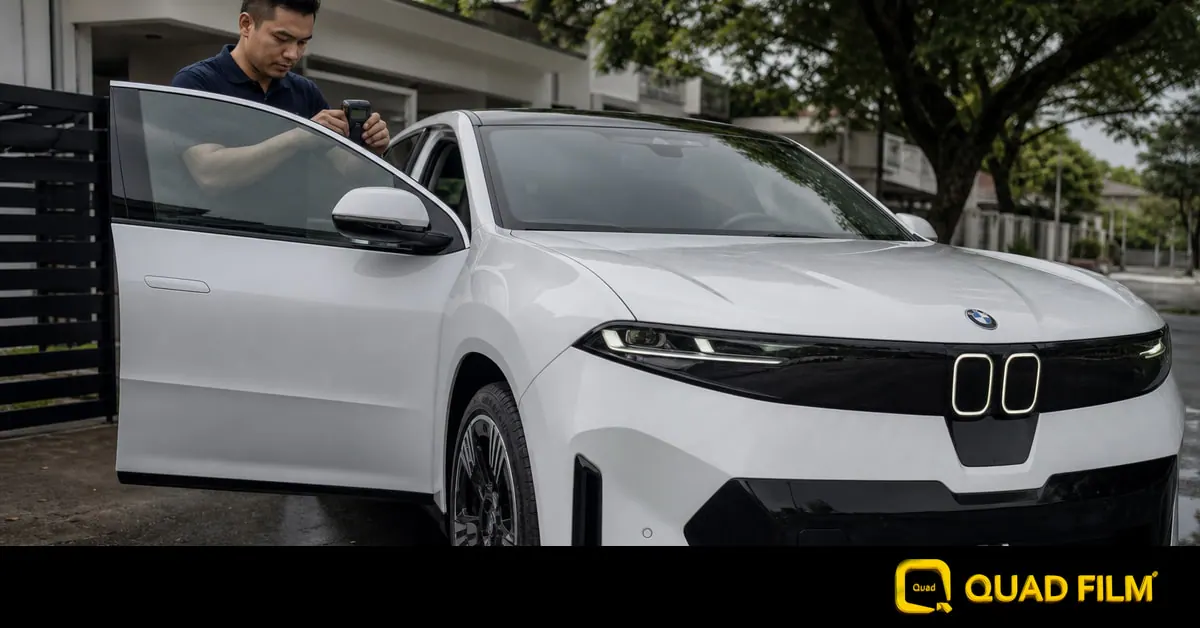
- The Malaysian iX3 arrives with a fixed panoramic sunroof and climate comfort glazing and no roller blind, so the largest heat-collecting surface on the car is the one occupants cannot cover from inside.
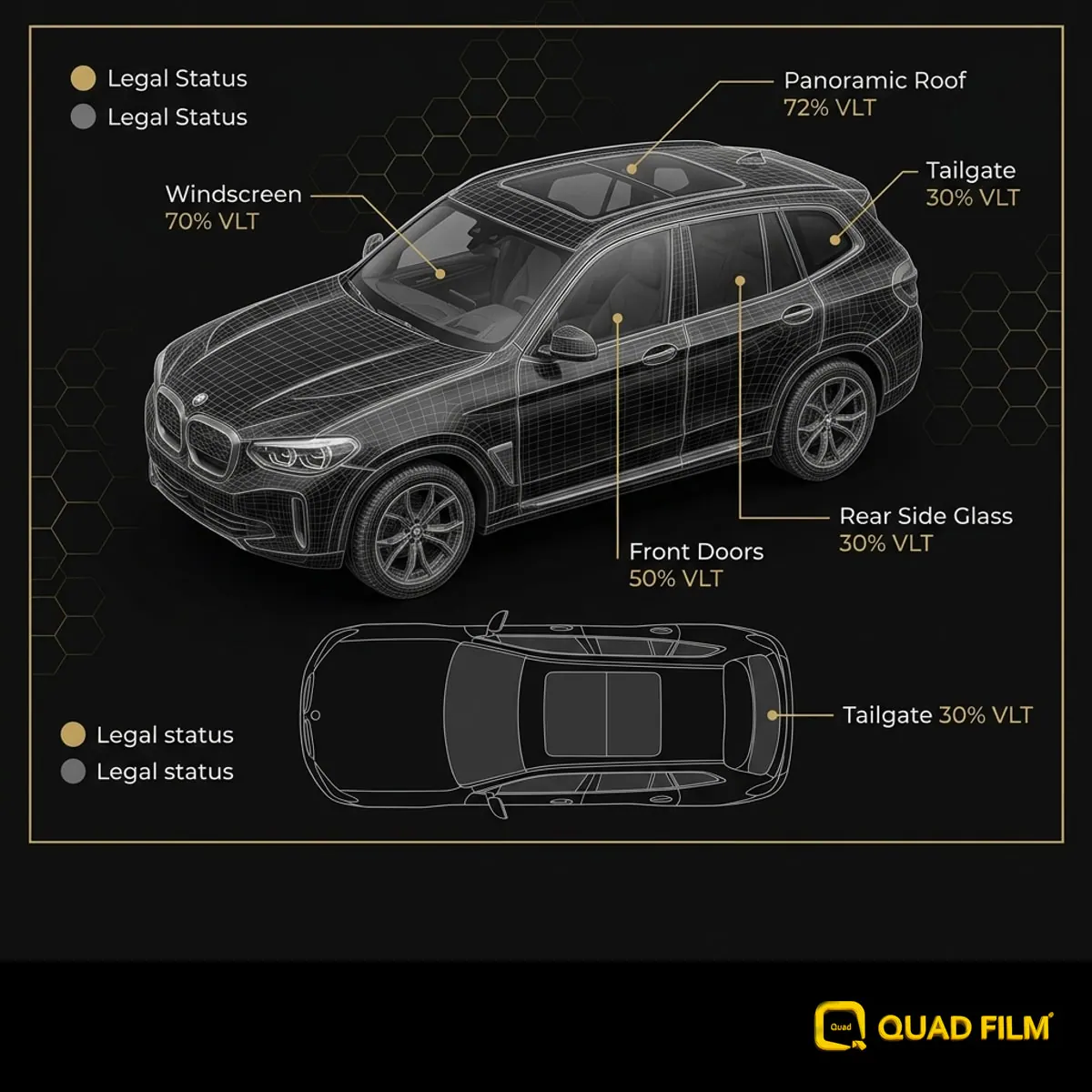
- JPJ sets a minimum of 70 percent visible light transmission on the windscreen and 50 percent on the front door glass, with no minimum on the rear side and tailgate glass for private vehicles.
- Factory glazing already reduces heat, but that reduction is measured as part of the glass, so any film added on top must be chosen around what the pane blocks rather than in isolation.
- Infrared rejection, total solar energy rejection and ultraviolet rejection describe three different things, and a film can be excellent at one and only average at another.
- On a 108.7 kWh pack, cutting cabin cooling load has a range effect you can actually calculate, and this article works that arithmetic out step by step rather than quoting an overseas percentage.
Window tint on a BMW iX3 in Malaysia is not a darkness decision, it is a heat decision, and on this particular car the two get confused more than usual. The Malaysian M Sport Pro specification arrives with a panoramic sunroof with climate comfort glazing that is fixed in place. It does not open, and there is no roller blind to pull across it. Whatever solar energy that glass lets through, you live with for the life of the car.
So does the iX3 need film if it already has climate comfort glazing? Yes, and the reason is coverage rather than doubt about the factory glass. Climate comfort glazing reduces solar transmission through the pane it is fitted to. It does nothing for your windscreen, nothing for your front doors, and it is not an engineered infrared barrier with a published rejection figure. Film is specified pane by pane, and it comes with numbers you can hold an installer to.
This guide covers what glass the Malaysian car actually has, how film cuts solar load, a worked figure for how much battery better heat rejection protects, which Quad Film series suits the car, the legal shade for every pane under JPJ rules, and what to confirm before you pay. If you want the electric vehicle context first, the guide to the best window tint for EVs in Malaysia explains why metallised films win on battery cars.
What Glass Does the Malaysian iX3 Come With?
Why Does Upright Neue Klasse Glass Heat a Cabin?
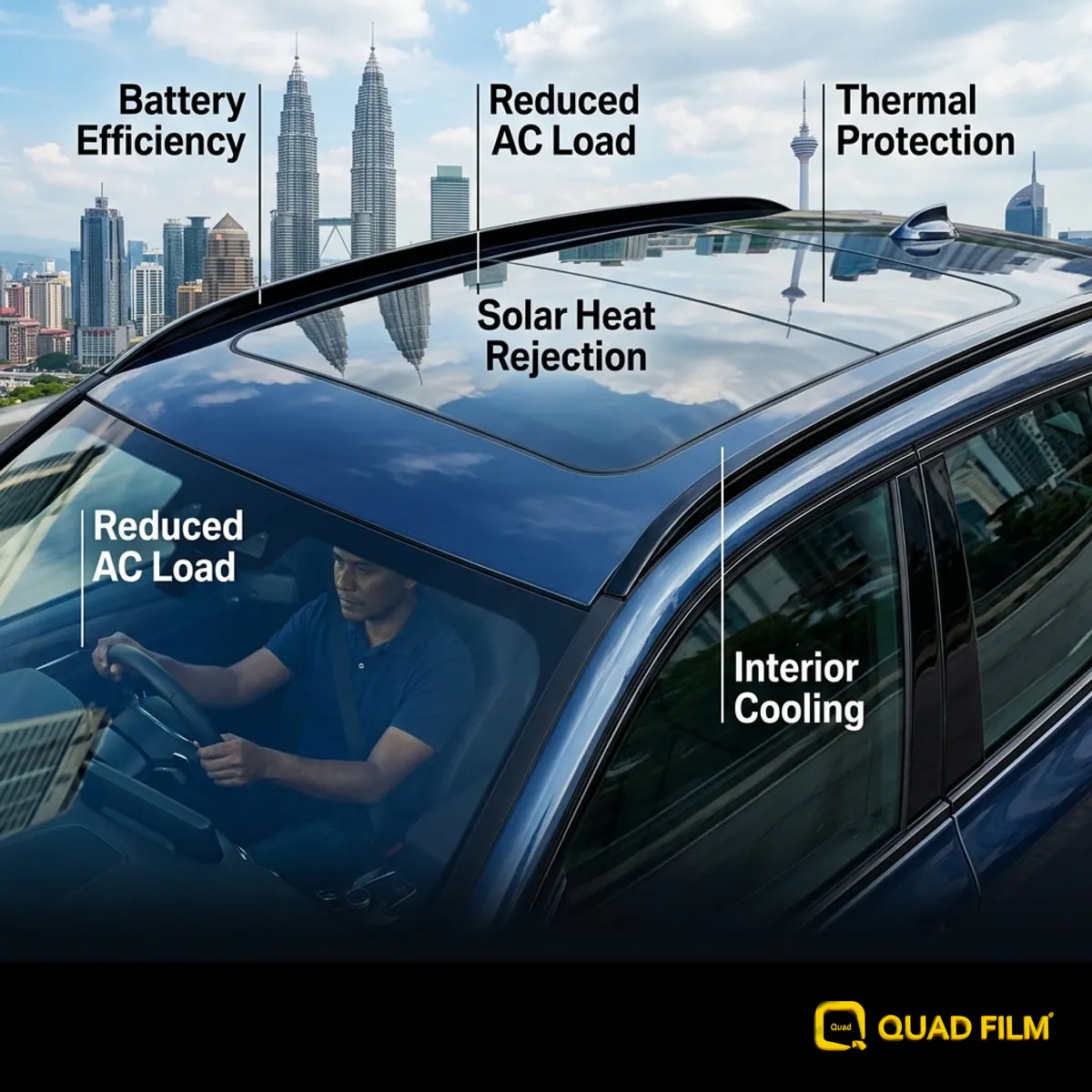
Park an iX3 on the open top deck of a Mid Valley carpark at 1pm on a clear day, leave it for two hours, and come back. The steering wheel is uncomfortable to hold, the seat bolsters are hot through your clothes, and the air inside feels thick rather than merely warm. That is not the air temperature doing the work on its own. It is solar energy that has already passed through glass, been absorbed by the dashboard, the seats and the trim, and then re-radiated inside a sealed box. Glass lets short-wave energy in easily and lets long-wave heat back out very poorly, which is why a parked car ends up hotter than the shade outside it.
The iX3 makes this worse in two specific ways. The windscreen and door glass sit more upright than on the previous generation, which is a Neue Klasse design signature and good for visibility, but an upright pane takes a much more direct hit from a sun that sits close to vertical at Malaysian noon. Then there is the fixed panoramic roof overhead, contributing solar gain across the entire cabin footprint with no blind to close. Set the climate control to 22 degrees, pull out of that carpark, and the system spends the first ten minutes fighting heat that is already stored in the materials rather than heat arriving through the glass.
That first ten minutes is the part owners feel and the part the battery pays for. A three-zone climate system on a large-cabin SUV pulls real current when it is asked to drop cabin temperature quickly, and it keeps pulling current for as long as fresh solar energy keeps arriving through five large panes and a roof. Reducing how much energy gets in is the only lever available to an owner after the car is built. You cannot change the glass angle, you cannot fit a blind that BMW did not provide, and you cannot ask the climate system to work for free.
How Does Window Film Cut Solar Load Inside?
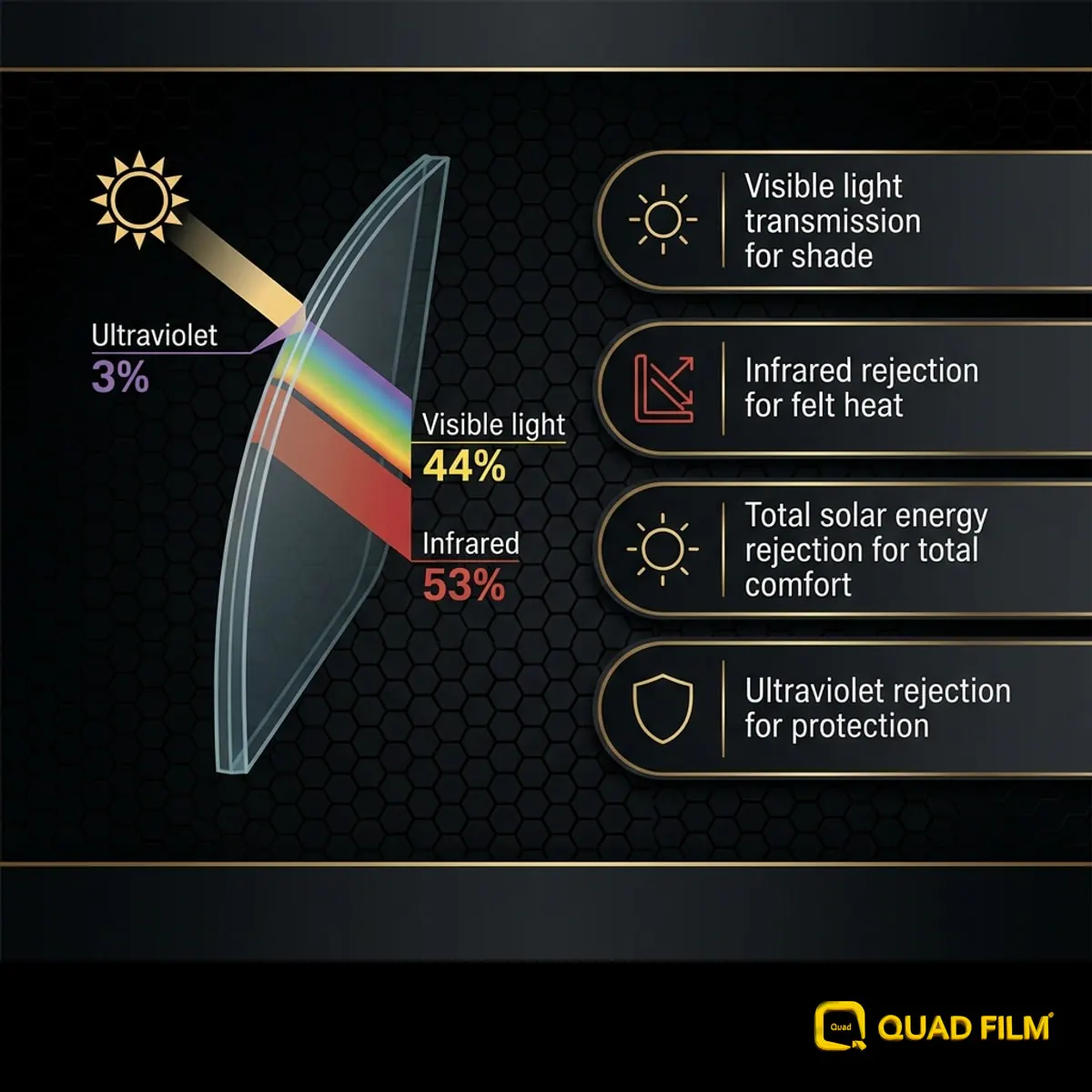
Window film works on the energy budget of sunlight rather than on brightness, and that is the part most counter conversations get wrong. Sunlight arriving at your glass is roughly 3 percent ultraviolet, 44 percent visible light and 53 percent infrared. Only the middle slice is what your eye reads as darkness. That is why a very dark dyed film can perform poorly on heat while a much lighter engineered film performs far better, and why choosing tint by how the car looks from outside is a guess dressed up as a decision.
Quad Film builds its automotive tint on a magnetron sputtering platform that deposits 36 distinct rare earth metals as aerospace alloy nanotechnology onto a PET substrate. The process runs through 11 levels of vacuum treatment, with coating thickness variation held within 0.00002244 mm. That sounds like factory trivia until you consider what uneven coating produces on a car window, which is patchy heat performance across a single pane, visible colour variation between the two front doors, and a film that ages unevenly under Malaysian sun. Consistency at the coating stage is what makes a published rejection figure meaningful on your actual car.
Once you stop thinking about darkness, four numbers describe everything a film does, and every honest quotation should state all four for every pane. They are visible light transmission, infrared rejection, total solar energy rejection and ultraviolet rejection. They are not interchangeable, and a film can be strong on one and unremarkable on another. Understanding what each one measures is the difference between buying a shade and buying a specification.
Visible light transmission
Visible light transmission, written as VLT, is the percentage of visible light that passes through glass and film together. It is the only one of the four numbers that carries legal weight in Malaysia, and it is also the one that has nothing to say about heat. A film at 70 percent VLT looks almost clear and can still be a serious heat barrier. A cheap dyed film at 20 percent VLT looks dramatic and can leave your cabin nearly as hot as bare glass. When an installer talks about shade, they are talking about VLT and only VLT.
Infrared rejection
Infrared rejection, or IRR, is the percentage of infrared energy the film blocks, and it is the number closest to what you actually feel on your forearm at a traffic light. Quad Film publishes exact figures for each series rather than ranges, which is the only way to compare films honestly. Treat any quotation that says high, solid or up to as incomplete, and ask for the figure. On this car the front door glass and the windscreen are where infrared rejection earns its keep, because those are the panes your body sits closest to for the length of every drive.
Total solar energy rejection
Total solar energy rejection, or TSER, accounts for the whole solar spectrum including the portion the film absorbs and re-radiates outward. It is the single most useful number for judging real cabin comfort, and it moves with shade. MEGALUX measures 72 percent TSER at 70 percent VLT, 76 percent at 50 percent VLT and 80 percent at 30 percent VLT. That progression is exactly why the sensible plan on an iX3 is a lighter film where the law requires it and a darker one where it does not, rather than the same shade on every pane.
Ultraviolet rejection
Ultraviolet rejection protects the people and the interior rather than the temperature. Ultraviolet energy is what fades trim, hardens plastics, cracks leather over time and reaches the skin of whoever sits in the sun-facing seat every day. Quad Film's tint range rejects 99 percent of ultraviolet across the series, and MIRACLE, which is built specifically around sun protection factor, filters 100 percent of UVA and UVB in the 280 to 400 nm band. If the health side of this matters to you, the article on car tint and UV skin protection sets out what that exposure actually does over years of driving.
How Much Battery Can Better Heat Rejection Protect?
This is the question the whole article exists to answer, and it deserves arithmetic rather than a borrowed percentage. Overseas tint marketing likes to claim 8 to 12 percent better range from window film. Those figures come from other climates, other vehicles and other test conditions, and repeating them on a Malaysian iX3 would be guesswork. What follows instead is a transparent illustration built from the car's own published specification, one published energy figure for automotive air conditioning, and one controlled test that Quad Film ran on its own roof film. You can check every input, and you can disagree with the assumption at the end because it is stated openly rather than buried.
Start with the car. The Malaysian iX3 50 xDrive carries a 108.7 kWh battery on an 800 volt architecture and is rated at up to 805 km on the WLTP cycle. Dividing energy by distance gives an average consumption of about 135 Wh per kilometre, which is the figure every later step converts back into. Next, the cooling load. The International Energy Agency has reported that air conditioning can account for roughly 20 percent of a vehicle's energy use in hot climates, and Malaysia is a hot climate all year rather than for one season. Applying that share to a full charge gives about 21.7 kWh spent on cooling the cabin rather than moving the car.
Then the film side. Quad Film ran a controlled comparison using its EV Sunroof PPF on a panoramic roof, with ambient temperature at 33 to 35 degrees, the air conditioning set to 20 degrees, fan at level 10, both cars starting at 93 percent state of charge and both covering 140 km. The car with Quad's roof film finished at 63 percent, and the car running a competitor film finished at 53 percent. That is 30 points of pack consumed against 40 points, a difference of 10 percentage points of the whole battery, and roughly a quarter less drain over the same drive. That test covers one pane on one route, so it is evidence rather than a promise.
Now the arithmetic, with the assumption stated plainly. Assume a full set of quality film across the glazing cuts cooling load by a conservative 20 percent, which is well below what the roof test alone produced.
- Energy spent on cooling per full charge: 20 percent of 108.7 kWh equals 21.7 kWh
- Cooling energy saved at a 20 percent reduction: 20 percent of 21.7 kWh equals 4.3 kWh
- Distance that energy would otherwise cover: 4.3 kWh divided by 135 Wh per km
- Result: about 32 km of range per charge
About 32 km per charge is the honest answer, and it is worth understanding what it represents. It is not extra range invented by film. It is range you were already losing to solar heat and no longer have to spend. Over a year of daily driving that recovered energy adds up to real charging sessions you did not need, and on the days it matters most, which are the 35 degree afternoons when the car has been sitting in an open carpark, the effect is larger than the average suggests. Change the assumption and the number changes with it, which is exactly why the working is printed here instead of a slogan.
Which Quad Film Tint Series Suits a New iX3?
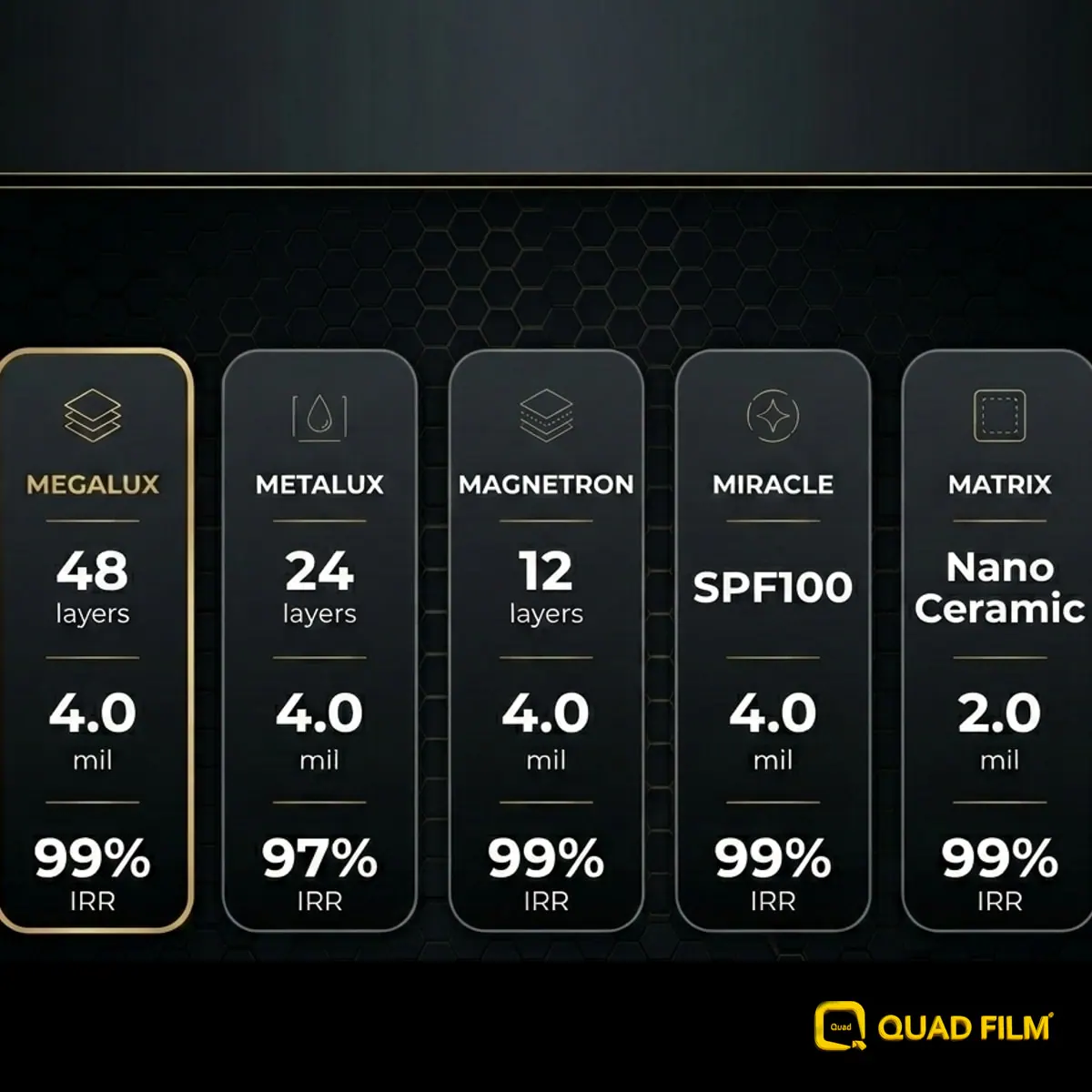
Five series cover the range, and they are separated by how the metal layers are built rather than by marketing tiers. All five reject 99 percent of ultraviolet or better, all five come with published infrared rejection figures, and all five are available in multiple shades. What changes between them is layer count, construction method and the balance between heat rejection, optical clarity and night vision. On an iX3 the deciding factors are usually the size of the glass area, how much night driving you do, and whether the car spends its days parked outdoors.
MEGALUX
MEGALUX is the flagship, built with Multi-layer Sputtering 48 technology on a German Leybold dual-vacuum chamber line, running four coating cycles to lay down 48 layers in a 4 mil film. It rejects 99 percent of infrared and 99 percent of ultraviolet, and its total solar energy rejection runs 72 percent at 70 percent VLT, 76 percent at 50 percent VLT and 80 percent at 30 percent VLT. The multi-layer stack functions as a radiant barrier rather than an absorber, and it is oxidation and fade resistant. On a car with this much glass area, MEGALUX is the series to specify if heat is the reason you are tinting at all. The comparison of sputtered against multi-layer sputtered film explains why the layer count matters more than the shade.
METALUX
METALUX uses Multi-layer Sputtering 24 in a dual-cycle process, giving 24 layers in a 4 mil film, with 97 percent infrared rejection and 99 percent ultraviolet rejection. Its total solar energy rejection runs 70 percent at 70 percent VLT and 74 percent at 50 percent VLT. What sets METALUX apart is not heat but optics. It leads the range on clarity, night driving comfort including for drivers with astigmatism, glare reduction and quick heat dissipation, and it carries the longer warranty of the range. For an owner who drives a lot after dark on unlit stretches of the Guthrie or the Karak, that trade is often the right one.
MAGNETRON
MAGNETRON is a multi-layer magnetron sputtered film with 12 layers at 4 mil, rejecting 99 percent of infrared and 99 percent of ultraviolet, with total solar energy rejection of 66 percent at 70 percent VLT and 70 percent at 50 percent VLT. It is built for stability rather than headline numbers, with strong night vision performance, low heat irradiation back into the cabin and superior adhesives that resist bubbling in Malaysian humidity. If your last car developed bubbles along the top edge of the door glass after two years, that is the failure MAGNETRON's adhesive layer is designed to avoid.
MIRACLE
MIRACLE is built around sun protection factor rather than maximum infrared numbers. It is a 4 mil film rejecting 95 percent of infrared, and it filters 100 percent of UVA and UVB across the 280 to 400 nm band, which is the strongest ultraviolet performance in the range. Total solar energy rejection runs 62 percent at 70 percent VLT and 66 percent at 50 percent VLT. It also carries a high C-value, anti-shatter properties and fade-proof construction. For a family that runs the school route every afternoon with a child in a rear seat beside the glass, that ultraviolet figure is the one worth paying attention to.
MATRIX
MATRIX is the nano ceramic option, using titanium nitride and zirconium dioxide rather than a sputtered metal stack, and it is the thinnest film in the range at 2 mil. It rejects 99 percent of infrared and 99 percent of ultraviolet, with total solar energy rejection of 60 percent at 70 percent VLT and 64 percent at 50 percent VLT. Being ceramic, it is discolouration proof and finished with an ultra scratch-resistant coating, and being thin it handles heavily curved glass without fighting the installer. Whichever series you land on, fitting quality decides whether you get the published figures on your own car, and the guide to multi-layer sputtered film installation in Malaysia sets out what a proper session should look like.
Should You Keep Factory Glazing or Add Film?
This is not an either-or decision, and treating it as one is how owners end up disappointed. Climate comfort glazing is part of the glass. It cannot be removed, it does not need replacing, and it does useful work on the pane it is fitted to. Film goes on top of it and adds a second, separately specified barrier. The correct question is therefore not whether to keep the factory glazing but how much additional rejection each pane still needs once the glass has done its part.
The answer differs by pane, and that is where metering matters. On a pane that already blocks a meaningful share of solar energy, adding film produces a smaller improvement than the film's own specification suggests, because the two barriers overlap. On the windscreen and front door glass, where the factory contribution is smaller, the film does most of the work and the published figures are much closer to what you feel. This is also why a single quoted percentage for the whole car is close to meaningless. Ask the installer to state the expected result pane by pane, and to meter each one before and after so the claim can be checked.
One piece of advice circulating online deserves correcting. You will read that metallised film should be avoided on modern cars because the metal layers interfere with electronics. On a car like the iX3, with keyless entry, tyre pressure sensors, radar, cameras and a phone in every cupholder, that concern belongs to an earlier generation of thick metal-laden film. Modern sputtered construction lays extremely thin metal layers with tightly controlled thickness, and it is precisely those layers that reflect infrared instead of absorbing it. Reflecting energy back out is what keeps the glass itself cooler, which is why sputtered film performs so well on battery cars where every watt of cooling comes from the pack.

What Shade Fits Each iX3 Pane Under JPJ?
Malaysian tint law comes from the Motor Vehicles Prohibition of Certain Types of Glass Rules 1991, with the thresholds that everyone quotes today taking effect on 8 May 2019. For a private vehicle the front windscreen must transmit at least 70 percent of visible light, the front side windows must transmit at least 50 percent, and the rear side windows and rear windscreen have no minimum provided both side mirrors are intact and usable. A first offence carries a fine of up to RM2,000 or up to six months imprisonment, and a repeat offence doubles to up to RM4,000 or up to twelve months. JPJ has issued more than 100,000 tint-related notices since the rules changed, so this is enforced rather than theoretical.
The trap that catches careful owners is that the law measures the glass and the film together. Puspakom has warned publicly about tint claims that ignore this, because a pane of factory glass that already reduces transmission, plus a film rated at exactly the legal minimum, adds up to a combined figure below the limit. Picture the inspection lane at a Puspakom centre with the meter clipped to your front door glass. The film box said 50 percent, the factory glass took a few percent of its own, and the reading comes back in the mid forties. Nothing about the film was misdescribed, and the car still fails. The fix is to specify a film with headroom on the panes that carry a legal minimum, and to have every pane metered before quoting and again after fitting so both numbers exist on paper.
If you need a shade below the legal minimum there is a formal route rather than a workaround. JPJ grants exemptions on medical grounds at no cost, and on personal security grounds for a fee of RM5,000, with applications made through the MyJPJ app and processing taking about 14 working days. What no film and no installer can do is make an illegal shade legal, and no product warranty covers a summons. Treat any shop that offers to sort that out for you as a shop that will also be relaxed about the things you cannot see.
The table below sets out a compliant specification for every pane on the car, using MEGALUX figures because it is the series most iX3 owners will be choosing between shades of.
| Glass on the iX3 | JPJ minimum VLT | Recommended Quad film and shade | UV rejection | Infrared rejection | TSER | JPJ status |
|---|---|---|---|---|---|---|
| Front windscreen | 70 percent | MEGALUX at 70 percent VLT | 99 percent | 99 percent | 72 percent | Compliant |
| Front door glass | 50 percent | MEGALUX at 50 percent VLT | 99 percent | 99 percent | 76 percent | Compliant |
| Rear side glass | No minimum | MEGALUX at 30 percent VLT | 99 percent | 99 percent | 80 percent | Compliant |
| Rear tailgate glass | No minimum | MEGALUX at 30 percent VLT | 99 percent | 99 percent | 80 percent | Compliant |
| Panoramic roof glass | No minimum | Quad EV Sunroof PPF at 72 percent VLT | 99 percent | 95 percent heat reflection | Not published | Compliant |
One line in that table needs explaining rather than skimming. The roof product is not a window tint, it is a dedicated 7 mil EV sunroof film, and Quad Film publishes its performance as heat reflection of over 95 percent rather than as an infrared rejection figure. Those are two different measurements and they should not be compared side by side as though they were the same number. The same product sheet records an interior temperature falling from 52 degrees to 22 degrees under test, and a construction of 24 layers of rare earth metals including gold and silver, at 72 percent visible light transmission so the cabin does not lose its sense of openness.
Which Tint Mistakes Do New EV Owners Repeat?
The most common mistake is buying darkness and calling it heat rejection. It is an easy trap, because darkness is the one property you can verify standing in a carpark and infrared rejection is not. An owner picks 20 percent on the rear glass because it looks right, accepts whatever the shop puts on the windscreen because the law limits it anyway, and then wonders why the cabin still bakes after an afternoon at IOI City Mall. The windscreen is the largest pane facing the sun on the move, and a 70 percent film there with real infrared performance changes the drive far more than another five points of darkness at the back.
The second mistake is treating the word ceramic as a guarantee. Ceramic is a construction method, not a performance grade, and there are excellent ceramic films and thoroughly ordinary ones sold under the same word. The reason it comes up so often at the counter has more to do with margin and simplicity than with your cabin temperature, which is exactly what the article on why tint shops push ceramic film unpacks. The way through it is boringly effective. Ask for the four numbers, pane by pane, in writing, and compare those instead of the vocabulary.
The third mistake is forgetting the roof entirely. Owners specify all five vertical panes carefully, then leave the largest piece of glazing on the car untouched because it was not on the quotation and nobody raised it. On an iX3 that omission is worse than on most SUVs, because the roof is fixed and blindless, so it contributes solar gain to every seat on every sunny day with nothing an occupant can do about it. Roof film is a separate product and a separate line, and it needs to be asked for by name.
The same pattern shows up on other new electric cars sold here, and the tint walkthroughs for the MG S5 EV and the iCaur 03 work through the same pane-by-pane logic on very different cars, which is a useful reminder that this is about glass area and climate rather than about badge value.
What Should You Confirm Before Paying for Tint?
Everything above becomes real at the counter, so treat the quotation as the deliverable rather than the conversation. The document should name the series, state the shade as a VLT percentage for each pane, and list the four performance figures for the film being fitted. If a single percentage is quoted for the whole car, ask for it to be broken down, because a windscreen at 70 percent and rear glass at 30 percent cannot share one number. The general car tint checklist for Malaysia is a useful second pass over any quotation before you commit.
Insist on metering, and insist on it twice. Have every pane measured before any film is ordered so the factory contribution is on record, then have the same panes measured again after fitting so the combined figure is on record too. Ask for both sets of readings to be written on the invoice rather than shown to you on a screen. Those two columns are what protect you at a roadblock or in a Puspakom lane, because they demonstrate the car was specified to the limit rather than close to it. An installer who is confident in the film will not hesitate, and one who resists is telling you something useful.
Then confirm the practical side of the fitting itself. Ask whether patterns are computer cut or hand cut, whether the bay is enclosed and dust controlled, and how the door glass edges are finished, since edges are where poor jobs announce themselves within a year. Ask how long the windows must stay up after fitting, expect a short curing period, and expect some haze or small water pockets in the first week that clear as the adhesive dries. Confirm that workmanship is covered and that the cover is stated on the invoice rather than described verbally. Finally, check that film for the panoramic roof appears as its own line, because it is a different product from window tint and should never be folded silently into a whole-car figure.
Getting BMW iX3 Window Tint Right in Malaysia
The iX3 does need film, and not because the factory glass is poor. It needs film because a fixed blindless panoramic roof, tall upright panes and a three-zone climate system all draw from the same battery, and cutting solar load is the only lever an owner still controls after delivery. Specify by pane rather than by shade, keep the windscreen at 70 percent and the front doors at 50 percent with real infrared performance behind them, give the roof its own dedicated film, and have every pane metered before and after so the numbers exist on paper. If you want to compare the Quad Film range or find an authorised installer, both are worth doing before the car spends its first full afternoon in an open carpark.
Frequently Asked Questions
How dark can the BMW iX3's front side windows be under JPJ rules?
The front side windows must transmit at least 50 percent of visible light, and the windscreen at least 70 percent. The figure that counts is the glass and the film measured together, not the number printed on the film box, so a pane that already reduces transmission leaves less room than owners expect. Specify a film with a little headroom on both, and have each pane metered before and after fitting so the combined reading exists on paper.
Does window tint really reduce air conditioning load on a BMW iX3?
Yes, and the size of the effect depends on how much solar energy the film keeps out rather than on how dark it looks. Working from the car's 108.7 kWh pack and its 805 km WLTP rating gives roughly 135 Wh per kilometre. Applying the widely reported figure that air conditioning can take about 20 percent of vehicle energy in hot climates gives about 21.7 kWh per full charge spent on cooling. A conservative 20 percent cut in that load frees about 4.3 kWh, which is roughly 32 km of range per charge.
Will window tint interfere with the BMW iX3's cameras, radar or GPS?
Properly specified film does not. Modern sputtered construction uses extremely thin metal layers with tightly controlled thickness, which is very different from the thick metallised films that caused problems on cars decades ago. Radar and camera apertures on the windscreen are worked around rather than covered, and the panoramic roof takes a dedicated film rather than window tint. Confirm with the installer how the sensor zone behind the windscreen is treated before fitting.
Can I tint the iX3's rear windows darker than the front?
Yes. For a private vehicle there is no minimum transmission on the rear side windows or the rear windscreen, provided both side mirrors are intact and usable. This is why the sensible plan on an iX3 is a lighter high-performance film where the law sets a limit and a darker shade behind, which also raises total solar energy rejection at the back where passengers sit.
Which Quad Film tint series gives a BMW iX3 the best heat rejection?
MEGALUX. It is built with Multi-layer Sputtering 48 technology, 48 layers laid down over four coating cycles in a 4 mil film, rejecting 99 percent of infrared and 99 percent of ultraviolet, with total solar energy rejection of 72 percent at 70 percent VLT rising to 80 percent at 30 percent VLT. MAGNETRON and MATRIX also reject 99 percent of infrared, and METALUX at 97 percent is the series to choose if optical clarity and night driving comfort matter more than the last two points of heat.
Does the iX3's panoramic roof glass need its own film?
Yes, and it needs a different product rather than a darker window tint. Quad Film's EV Sunroof PPF is a 7 mil film built with 24 layers of rare earth metals including gold and silver, at 72 percent visible light transmission, and it is published as reflecting over 95 percent of solar heat and blocking over 99 percent of ultraviolet. Because the iX3's roof is fixed and has no roller blind, this is the pane where film changes the cabin most.
Does the iX3's factory climate comfort glazing already block enough heat?
It helps, and it is not a substitute. Climate comfort glazing reduces solar transmission through the pane it is fitted to, but it is not an engineered infrared barrier with a published rejection figure, and it does nothing for the windscreen or the front door glass. Film is specified pane by pane with numbers you can hold an installer to, which is why the two work together rather than one replacing the other.
Protect your Investment today
Don't wait for stone chips to ruin your paint. Speak to our experts about custom PPF and Tinting solutions.