
- Clear car glass alone does not fully protect your skin, side and rear windows let a large share of UVA through.
- UVA drives photoaging and cumulative skin-cancer risk, and Malaysian drivers get it on the same arm and face daily.
- A quality UV film blocks close to 100% of UV on every window it covers, like sunscreen for your car.
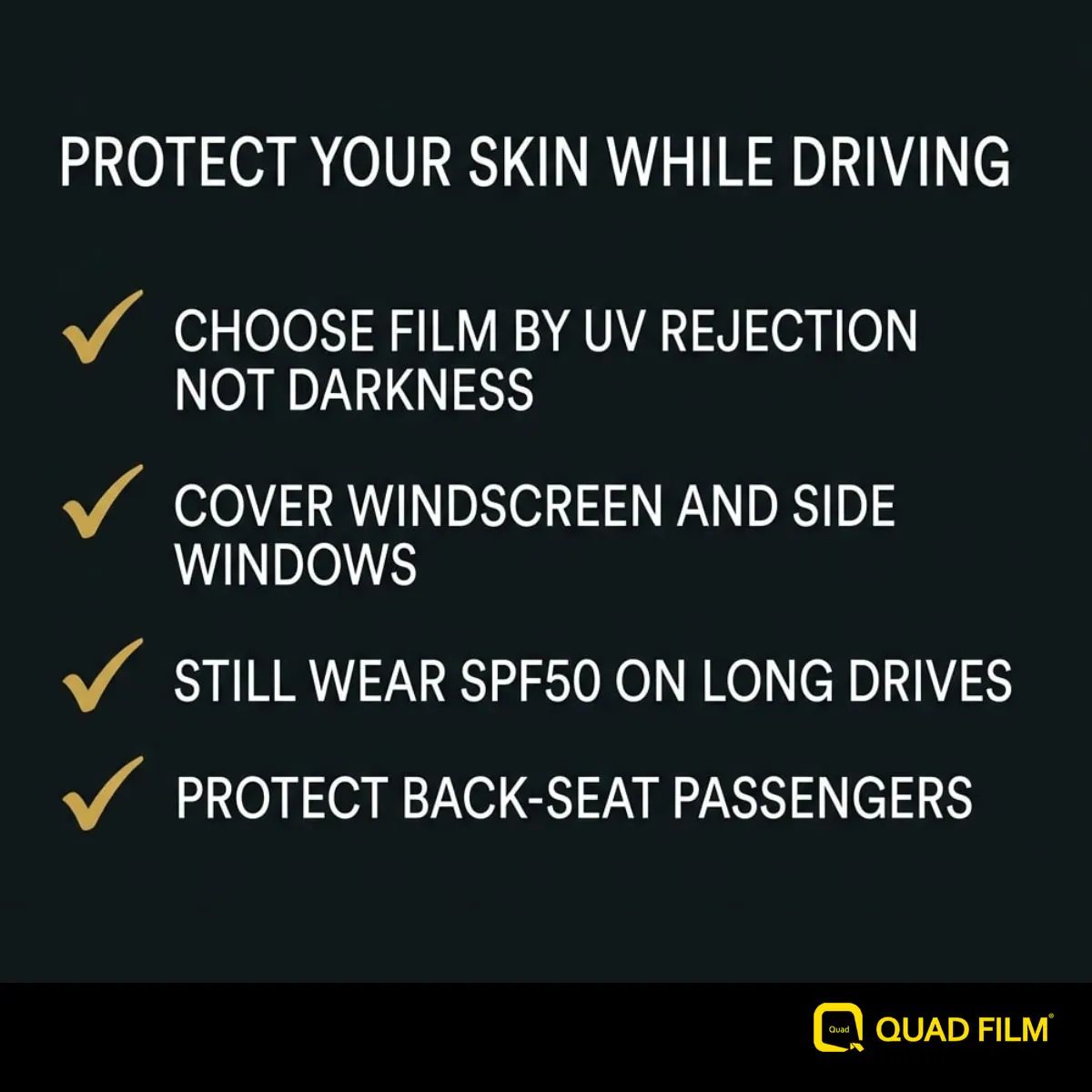
- UV protection is independent of darkness, even a bright film can reject nearly all UV.
- Tint reduces exposure but does not replace sunscreen on long drives, combine both.
When it comes to car tint and UV skin protection, the honest answer is that your factory glass is doing far less than most drivers assume. Windscreens block most UVA, but the side and rear windows that face you every day let a meaningful amount through, and that is the wavelength linked to skin ageing and long-term damage. The right window film changes that completely. Here is how UV reaches your skin while you drive in Malaysia, and what actually stops it.
Does Car Tint Really Protect Your Skin from UV?
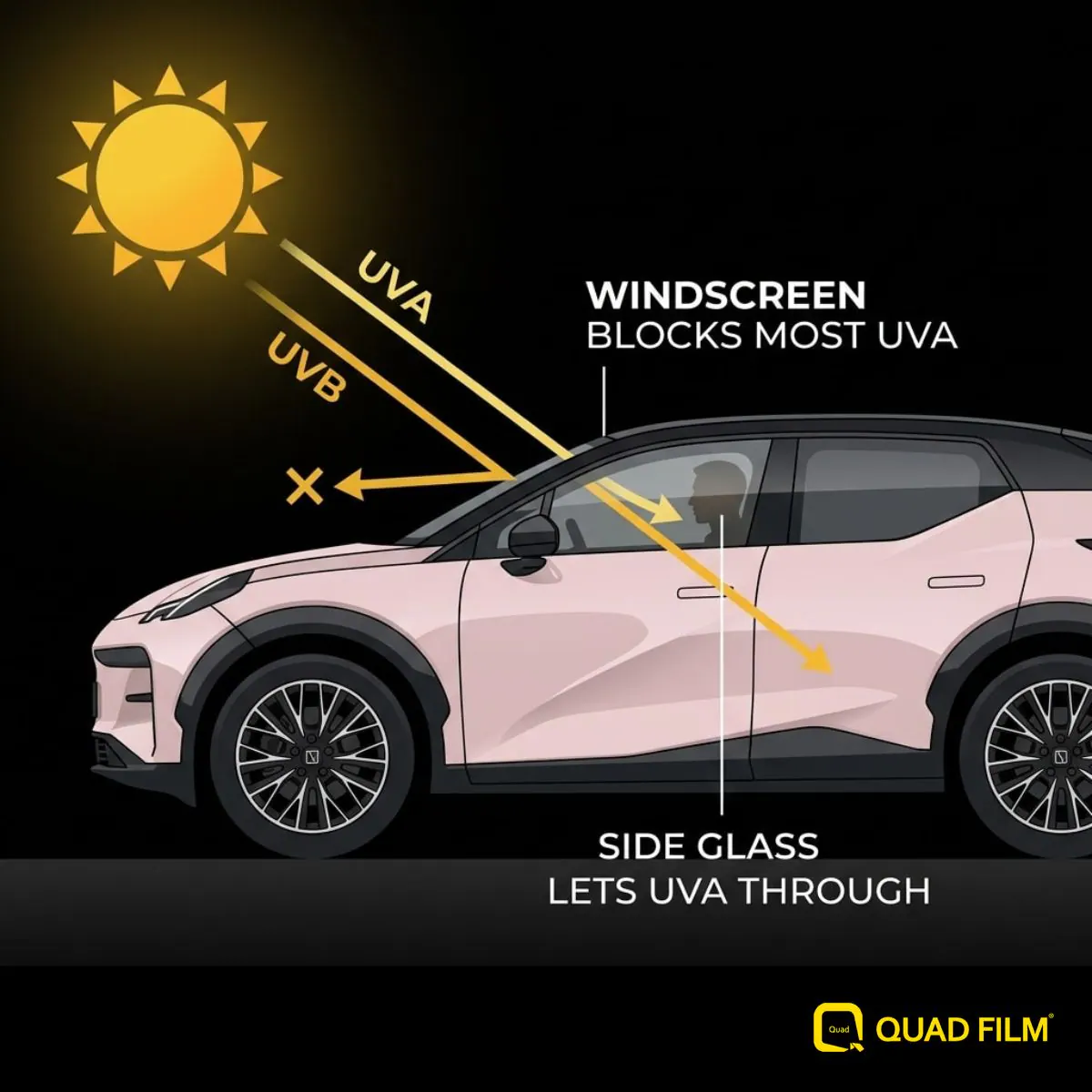
Clear glass on its own does not give you reliable skin protection, but a quality UV-rejecting film does. Laminated windscreens block roughly 96 to 98% of UVA, yet the tempered side and rear glass on most cars blocks UVB well while letting a large share of UVA pass through. Studies have measured side-glass UVA blocking averaging around 71%, with transmission ranging widely from about 4% to 56% across different vehicles.
That gap matters because UVA is the deep-penetrating ray tied to photoaging and cumulative skin damage. A proper UV film raises UV rejection on every window it covers to close to 100%, which is why we describe good tint as sunscreen for your car. It does not make you invincible, but it removes most of the daily exposure you would otherwise absorb.
UVA vs UVB: Which One Harms Your Skin While Driving
UVA is the bigger concern behind the wheel. UVB, the ray most responsible for sunburn, is largely blocked by ordinary glass. UVA penetrates deeper into the skin, drives photoaging and pigmentation, and contributes to long-term skin-cancer risk, and it passes through side glass far more easily than UVB. So the sun may not burn you through the window, but it can still be ageing and damaging your skin on every commute.
What Your Windscreen and Side Windows Actually Block
The two types of glass behave very differently. The windscreen is laminated, a glass-plastic-glass sandwich that blocks the vast majority of UVA. The side and rear windows are tempered glass, which stops UVB well but lets a much larger and inconsistent share of UVA through. That is why the sun-facing arm and cheek take most of the damage on a long drive.
This inconsistency is the real problem. You cannot tell by looking how much UVA your side glass blocks, and it varies from car to car. A UV-rejecting film removes that guesswork by bringing every covered window up to near-total UV rejection, regardless of the original glass.
Why Malaysian Drivers Are Especially at Risk
Malaysia sits under a high UV index almost every day of the year, so exposure is constant rather than seasonal. Long commutes on roads like the PLUS, KESAS and SPRINT mean hours in the sun, and the side nearest the window, usually the right arm and face, absorbs a one-sided dose day after day. Rideshare and delivery drivers rack up even more.
That cumulative, one-sided exposure is exactly the pattern dermatologists link to uneven photoaging and longer-term risk. It is also easy to ignore because there is no sunburn to warn you. The damage builds quietly, which is why drivers here benefit more from UV film than people in milder climates.
Why VLT Tells You Nothing About UV Protection
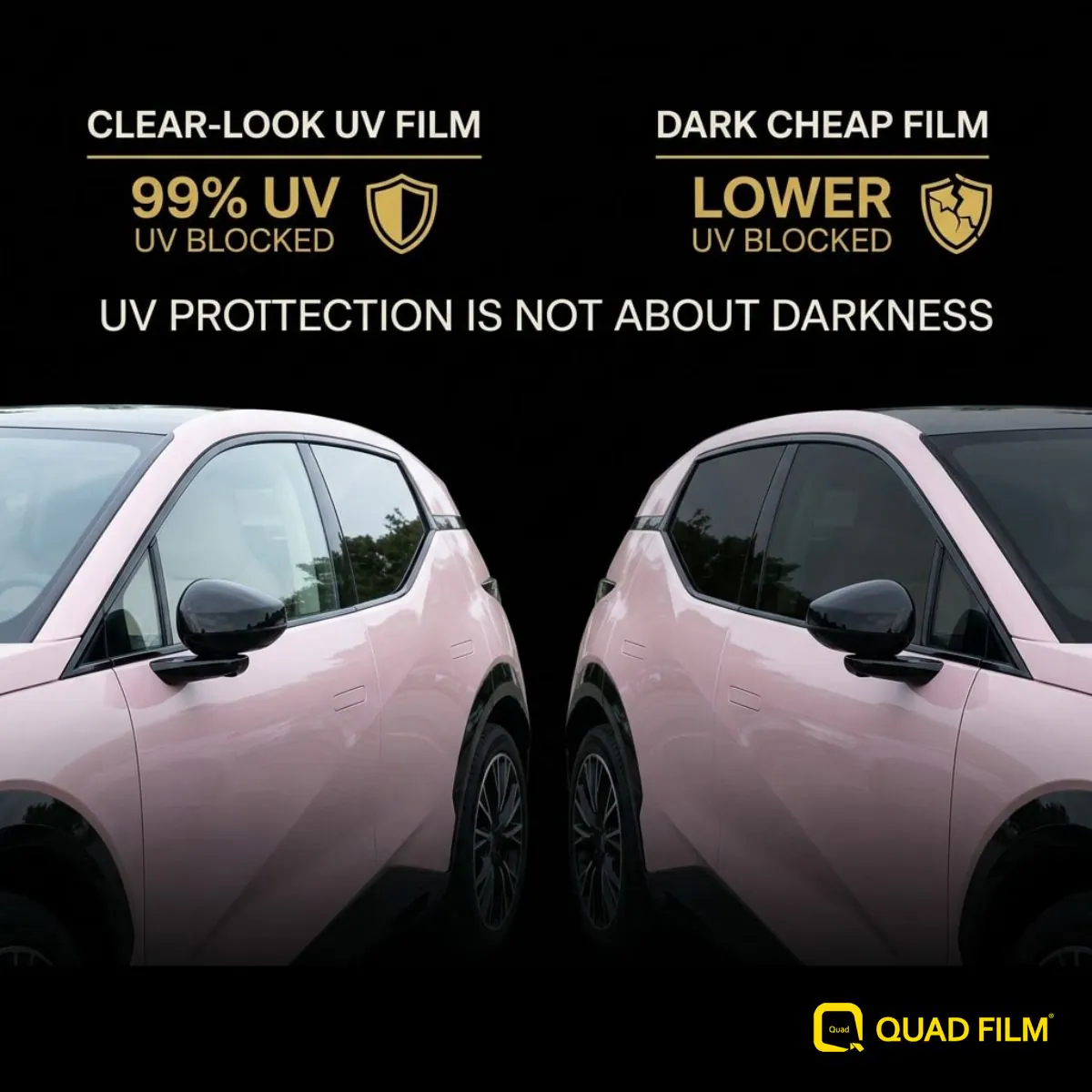
UV rejection is a separate spec from how dark a film looks. VLT only measures visible light, while UV rejection measures how much ultraviolet the film blocks. A near-clear film can still reject close to 100% of UV, and a dark film with poor construction can underperform on UV. So you should never judge skin protection by shade.
This matters in Malaysia because you are capped at 70% VLT on the windscreen and 50% on the front sides by JPJ rules. The good news is you can hit those bright, legal levels and still get near-total UV rejection by choosing the right film. Our guide on factory tint versus aftermarket tint explains why the spec, not the shade, is what protects you.
How the Right Film Blocks Up to 100% UV
A quality UV-rejecting film uses absorbers and multilayer construction to stop ultraviolet before it enters the cabin, reaching close to 100% UV rejection across every window it covers. Because this works independently of darkness, you protect your skin on the windscreen and front sides without going illegally dark, and you can go as protective as you like on the unrestricted rear glass.
Many modern films also reduce HEV blue light and reject infrared heat, so the same upgrade that protects your skin also makes the cabin cooler. If you are comparing technologies, our look at nano-ceramic versus sputtered tint shows how different builds achieve high UV and heat rejection.
Quad Film Options for Maximum UV Protection
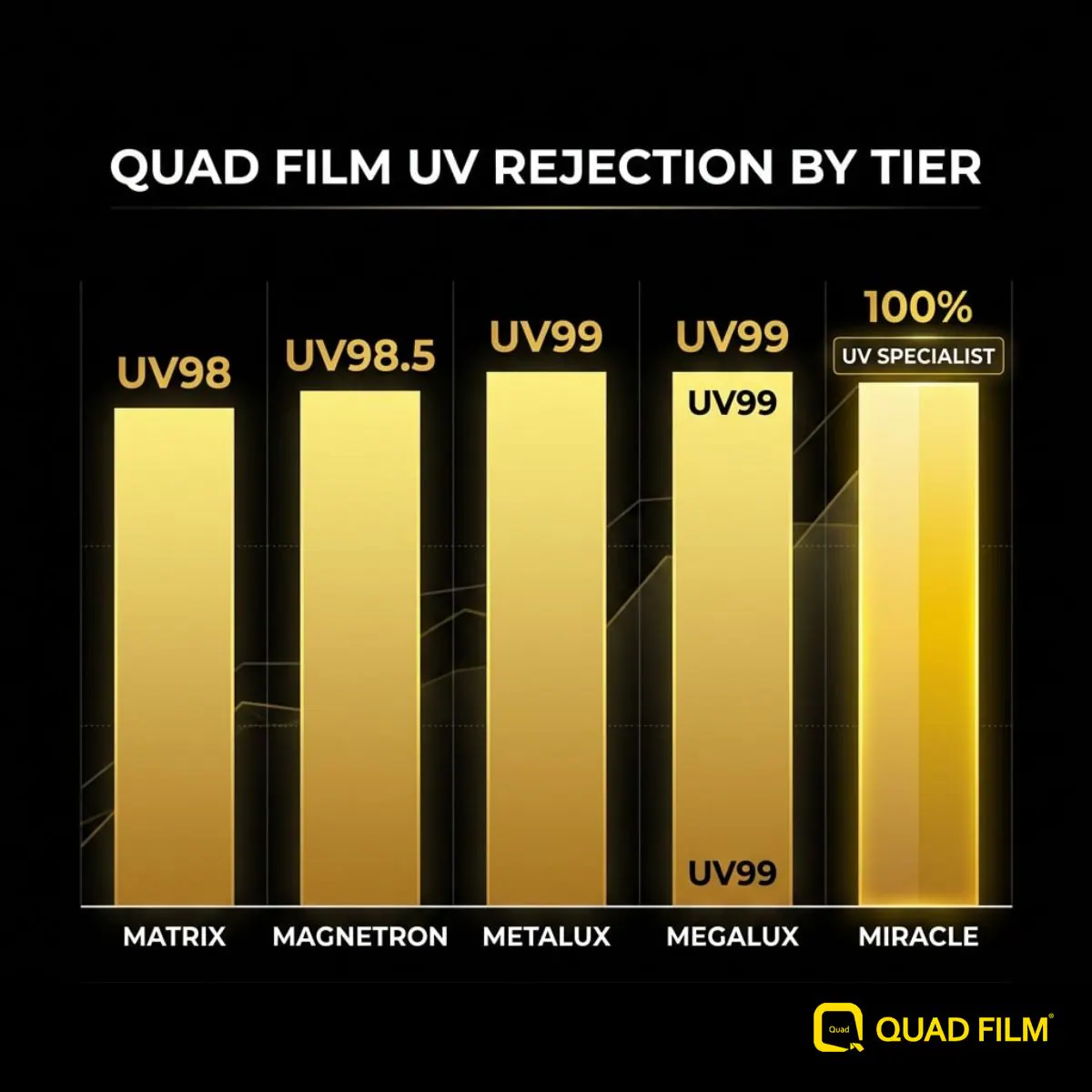
Every Quad Film tier delivers strong UV rejection, with one tuned specifically as a UV specialist. All prices below are for a full-car SUV-size job, from Standard to XLarge.
| Film | Construction | Warranty | UV highlight | Full-car SUV price |
|---|---|---|---|---|
| MEGALUX | 48-layer sputtered | 15 years | UV99, IRR99 | RM4,600 to RM5,000 |
| METALUX | 24-layer | 10 years | High UV, IRR99 | RM3,200 to RM3,600 |
| MAGNETRON | 12-layer | 8 years | High UV, IRR97 | RM2,200 to RM2,600 |
| MIRACLE | UV specialist | 7 years | UV100 | RM1,800 to RM2,200 |
| MATRIX | Nano-ceramic entry | 5 years | Solid UV, RFID friendly | RM1,000 to RM1,200 |
If maximum UV protection is your priority, MIRACLE is the dedicated UV specialist at UV100, while MEGALUX pairs UV99 with top-tier heat rejection for owners who want both. You can compare the full lineup on the Quad Film window tint page.
Tint Is Not a Total Substitute for Sunscreen
Tint dramatically cuts your in-car UV exposure, but it is not a reason to skip sunscreen on long trips. Film only protects you while you are behind covered glass, and gaps, open windows and time spent outside the car still expose your skin. The strongest protection layers measures, so combine a UV film with a broad-spectrum SPF50+ on the arms and face for long drives, and add a sunshade where useful.
Think of it as reducing cumulative exposure rather than eliminating risk. The film handles the constant daily dose through the glass, and sunscreen covers the rest. Together they protect drivers, and importantly children in the back seat, far better than either alone.
Common Mistakes People Make About Tint and UV
The biggest mistake is assuming car glass already blocks all UV, when side and rear windows clearly do not. The second is believing darker tint means more UV protection, when the two are unrelated. The third is trusting factory glass and ignoring the windscreen, which, while good for UVA, still leaves the side windows as the main exposure path if they are untinted.
Avoiding these traps comes down to checking the UV rejection spec and covering the right glass. If a shop leans on darkness as the selling point, our explainer on why tint shops push ceramic film helps you ask better questions, and the best car tint checklist for Malaysia keeps you focused on the specs that matter.
Making a Real UV-Protection Choice for Your Car
Car tint genuinely protects your skin, but only if you choose it for UV rejection rather than how dark it looks, and only if you cover the windows that actually expose you. In Malaysia's year-round sun, a film that blocks close to 100% UV on the windscreen, sides and rear removes most of the cumulative dose you absorb on every drive. Pair it with sunscreen on long trips, and you have proper, layered protection for yourself and your passengers.
FAQ
Do car windows already block UV rays?
Partly. The laminated windscreen blocks most UVA, but tempered side and rear windows let a large and inconsistent share of UVA through, so untinted side glass leaves your skin exposed.
Does window tint protect against skin cancer?
A quality UV film blocks close to 100% of UV, which reduces the cumulative UVA exposure linked to skin-cancer risk. It lowers risk rather than guaranteeing prevention, so combine it with sunscreen.
Is UVA or UVB the bigger risk when driving?
UVA. Ordinary glass blocks most UVB, but UVA penetrates deeper, drives photoaging, and passes through side glass much more easily, making it the main concern behind the wheel.
Does darker tint mean better UV protection?
No. UV rejection is independent of VLT. A near-clear film can block almost all UV, while a dark film can underperform, so choose by the UV rejection spec.
Can I skip sunscreen if my car is tinted?
No. Tint cuts in-car exposure significantly, but it does not cover open windows, gaps, or time outside the car. Wear SPF50+ on long drives as well.
Which Quad Film tint blocks the most UV?
MIRACLE is the dedicated UV specialist at UV100, while MEGALUX offers UV99 alongside top heat rejection if you want maximum all-round protection.
Does tint protect kids in the back seat?
Yes. Covering the rear side windows, which are unrestricted under JPJ rules, with a high UV-rejection film greatly reduces the UVA reaching back-seat passengers.
Protect your Investment today
Don't wait for stone chips to ruin your paint. Speak to our experts about custom PPF and Tinting solutions.