
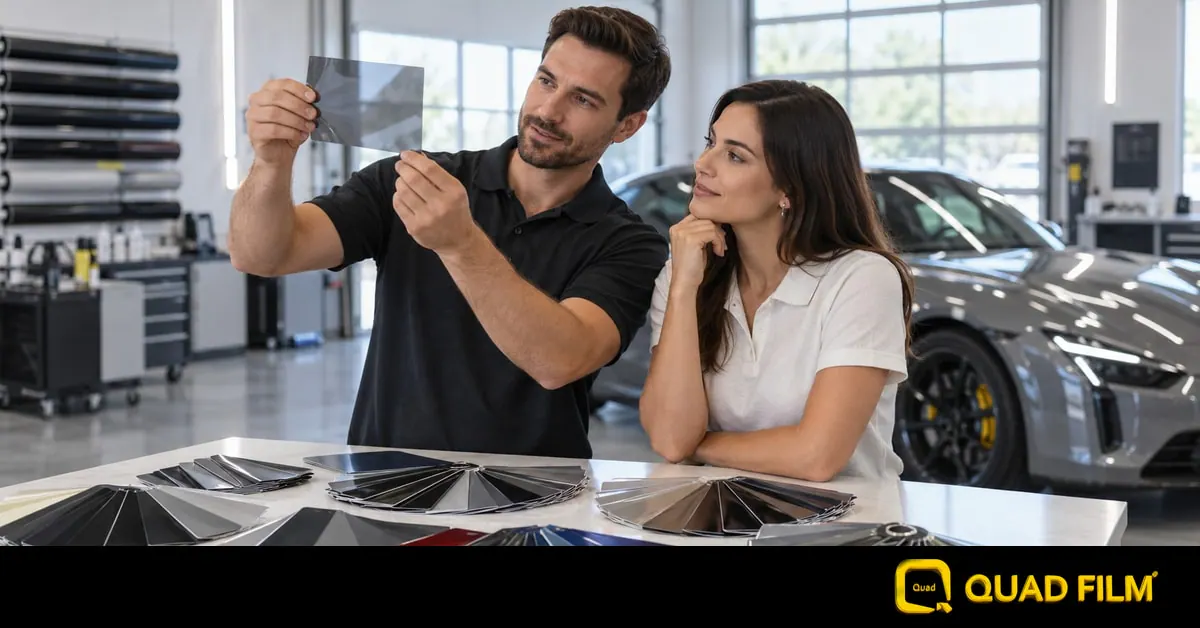
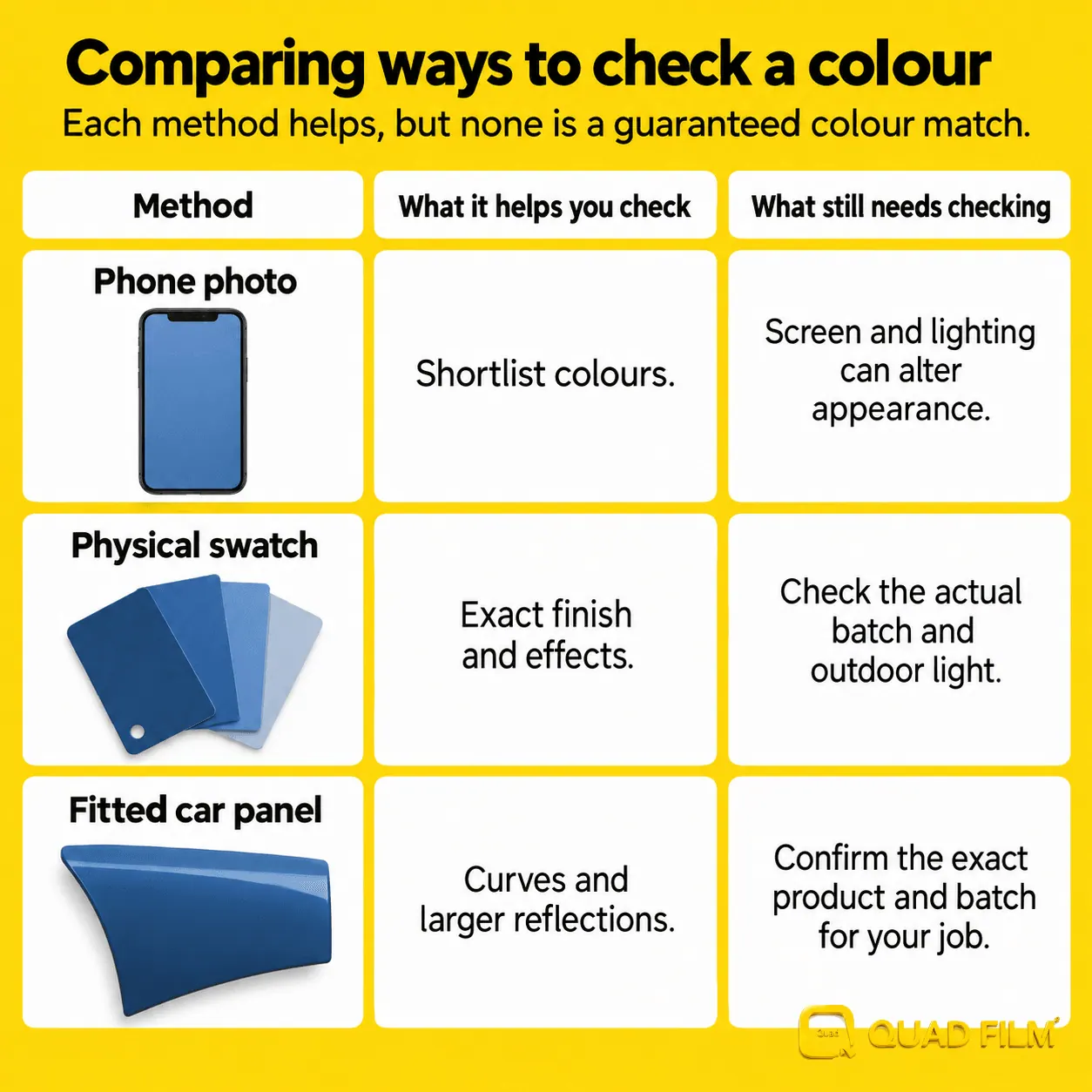
- A phone photo is fine for a shortlist. For the final call, it helps to see a physical swatch indoors, in shade and in direct sun, and next to your own trim and wheels.
- A physical swatch lets you check the finish, metallic or pearl effects, and any colour shift as you move it.
- JPJ records vehicle colour. For a full colour change, you can confirm how your new colour should be recorded before booking.
- Since gloss, satin and matte change how the same colour looks, the sample you approve should be in the exact finish you plan to order.
- Before booking, the quote should name the exact film and explain how you will approve a sample from the roll going on your car.
A colour PPF swatch can look different in a phone photo from the actual colour beside your car. Photos help you build a shortlist, but a physical sample lets you compare the shade and finish under showroom lights, in shade and in direct sun before you choose.
A swatch is simply a physical sample of one colour PPF shade and finish. You can ask to see one before booking and compare it against your own car rather than relying only on the seller's photographs. Colour film is still paint protection film, so the shade is only half of what you are approving. The specification and warranty are the other half.
Why phone photos can change the colour
Two phones can show the same colour PPF photo differently. Screen brightness, display settings and warm screen filters can change how the colour appears. Even before it reaches your screen, the lighting and camera settings affect the picture, so it is not a reliable final colour reference.
A camera uses white balance to adjust for the light source. Adobe's explanation of white balance shows how a white object can appear blue under some lighting and how camera settings can correct that. A photo can therefore be carefully made, but you still do not know whether your screen shows what the photographer saw.
You do not need to decide whether a seller has edited a picture to recognise this limit. A photo taken under white workshop lights and another taken near sunset are different viewing conditions, not a controlled comparison. If you like a shade in a post, its product name or colour code gives you something specific to request in person.
A glossy colour in a photo also tells you nothing by itself about the film's resistance to heat and humidity or paint condition when PPF is removed. Those are separate product and paint questions. A flattering reflection should not be the evidence for either.
What a physical swatch lets you check
A physical colour PPF swatch lets you change the viewing angle instead of judging one frozen view. Metallic sparkle and pearl effects can look different as the sample moves under the light. One still photo cannot show that whole change, and a close view may look different from a few steps away.
You can feel the surface texture too, but that does not establish its thickness or how long it will last. A specification can state the construction and thickness. Durability needs supporting test evidence, care information and the terms of warranty cover, rather than a judgement from touching the sample.
X-Rite's explanation of colour measurement describes why effect finishes are assessed at several angles. For your own comparison, that means looking straight at the sample and then moving it slowly, rather than choosing from the brightest sparkle you happen to catch. Metallic sparkle that is obvious close up may be much less noticeable when you step back from the car.
A small sample also cannot show the whole car. You might like a colour beside one door but feel differently when it covers the bonnet, roof and bumpers. Seeing the same film on a finished car can help you judge those larger areas and reflections, while still leaving the exact film for your own job to be checked.
How to check colour against your car
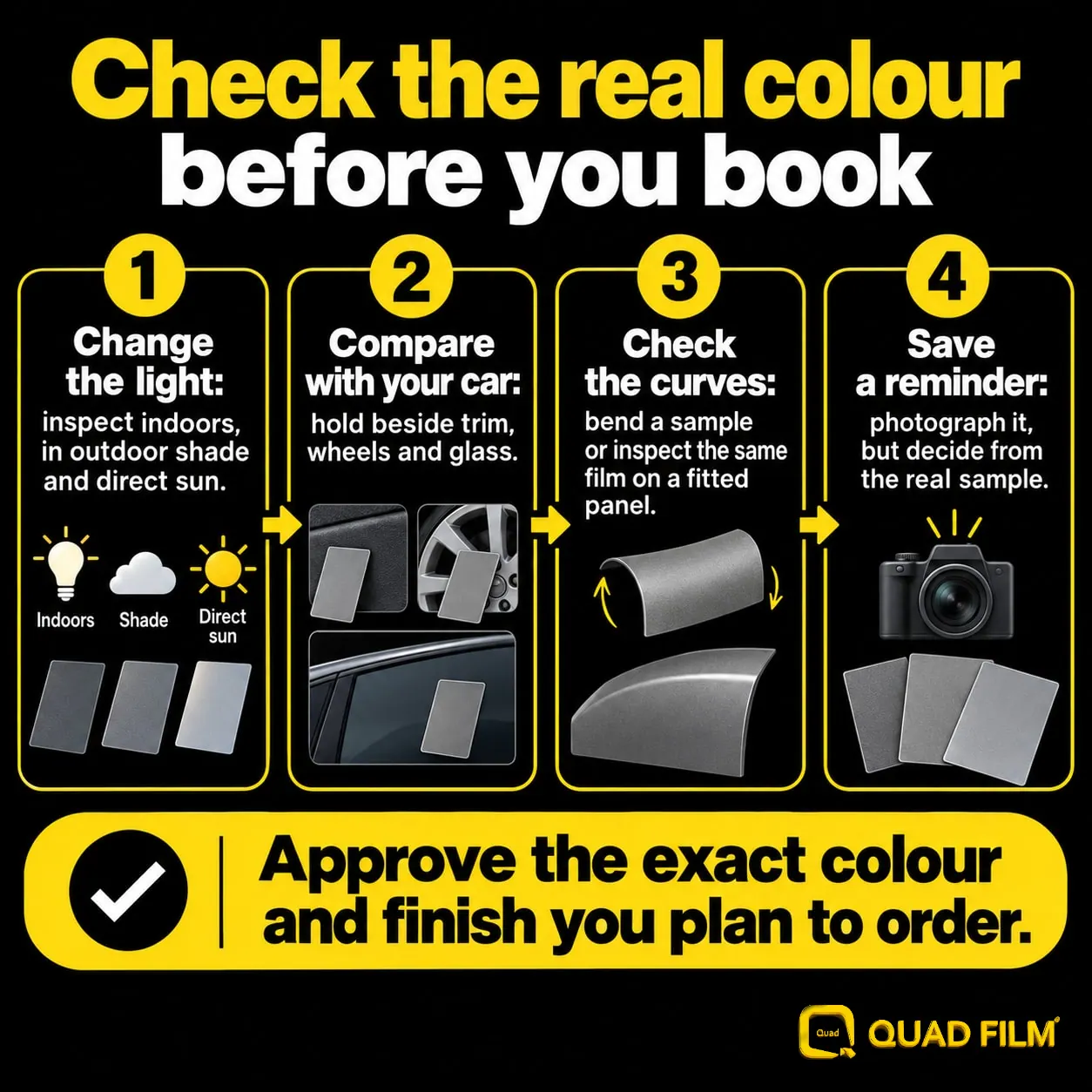
You can compare a colour PPF swatch beside your car under indoor light, outdoor shade and direct sun. Keeping the sample next to the same trim makes it easier to notice what changes with the light. There is no need to rush a decision while one bright reflection catches your eye.
- The first look is indoors, the second is outside in daylight. Colour and reflections rarely hold steady across showroom lights, shade and direct sun, so one look indoors is not enough.
- Next, the swatch goes beside your own trim, wheels and glass. That pairing is what you will see every day, and it tells you more than the swatch on its own.
- If a suitable sample or fitted example is available, you can compare a curved surface too. The installer can explain which sample can be handled without damaging it. Curves change reflections in ways a flat sample does not show.
- A photo at the end is a useful reminder, though what you saw in person is what you decide on.
If you have two shortlisted colours, you can compare them together in the same place. Looking at one indoors and the other outside makes it harder to know whether you prefer the film or simply the lighting. Keeping the viewing conditions similar gives you a fairer comparison without needing a colour measuring instrument.
Your car's trim stays part of the decision even if the paint colour changes. Black window surrounds, chrome details, wheel colour and visible glass remain beside the new film. A sample held next to them can answer a different question from whether the colour looks attractive on its own: do you like the combination you will actually drive?
Outdoor shade and direct sun are both useful, rather than one being the single correct view. A colour you enjoy only in strong sunlight may not be the one you prefer in a shaded parking space. If rain or a late appointment prevents the daylight check, another visit is an option before you approve a film you have not seen that way.
Gloss, satin and matte look different
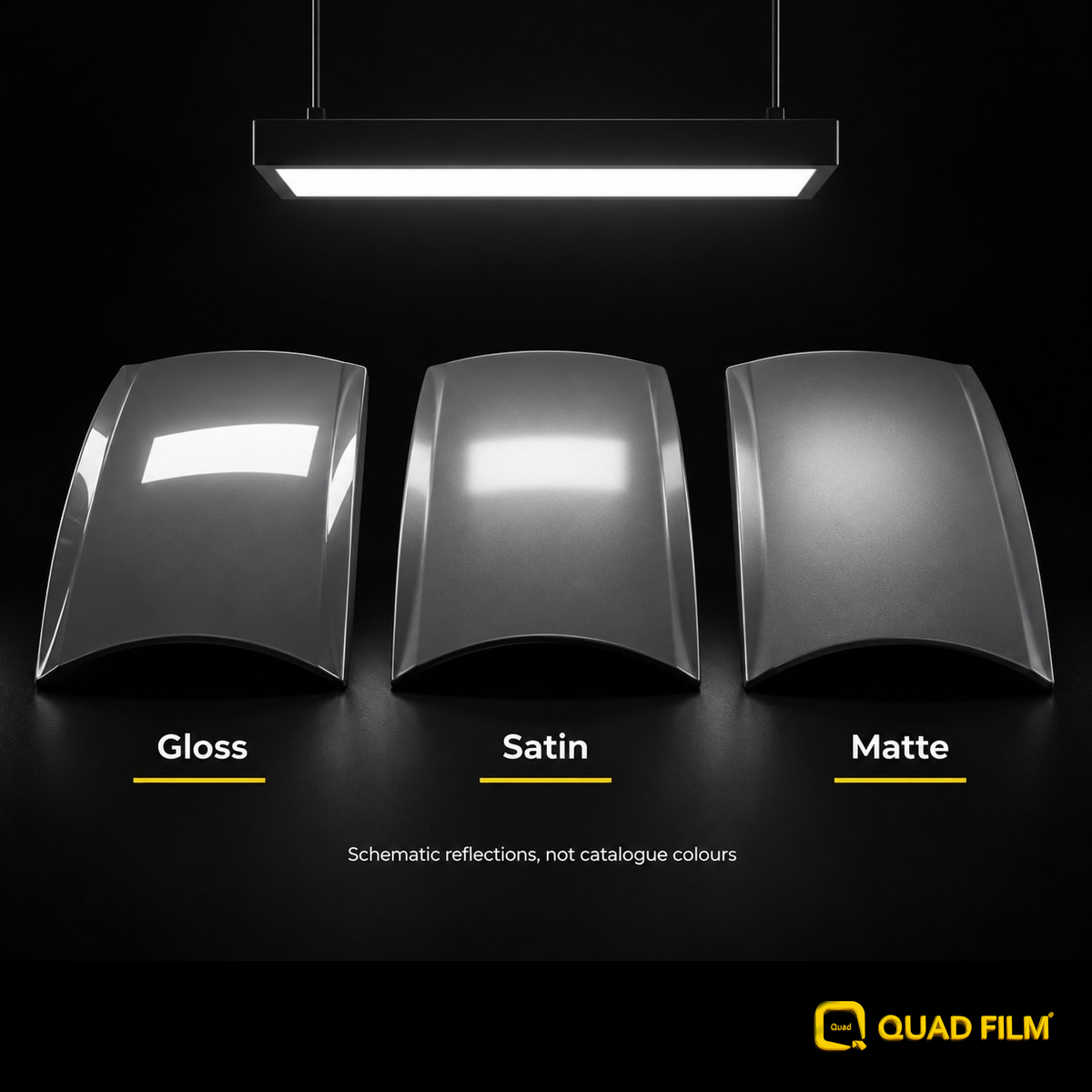
Gloss PPF shows sharper reflections. Satin softens those reflections, while matte makes reflected shapes much less distinct. These finishes change how you see the colour and the car’s curves. The exact effect depends on the product, so your sample should have the finish you plan to order.
Our matte film is QUBOND and our satin film is QUATRIX. Those names tell you the finish, not the colour. Our product guidance reserves these films for factory matte and factory satin paint finishes, rather than gloss factory paint. The altered finish remains for the life of the wrap. These finish-specific films are not a promise that any colour PPF shade is available in the same finish.
For colour PPF, including custom colours, the exact series, colour code and available finishes are what the quote should name in writing, since not every colour comes in gloss, satin and matte. Finishes are easier to judge side by side than from any description.
Whichever you choose, the sample you approve should be the finish you will actually receive. A gloss photo is no basis for a matte order.
A completed matte installation gives you a view of the finish across a full car rather than a small square. Our reel featuring Chen Tang Jie's full-car matte PPF installation is an example of that broader view. It is not a colour reference for your own order and does not establish which series or batch you will receive.
The quote needs the exact film and finish
Before booking, a written quote can identify your car, the film series, the colour code, the finish and the panels included. Car size, film series, preparation and installation work affect what PPF costs in Malaysia. A discussion with the installer helps turn the colour you like into a clearly described job.

Product names and colour codes help the installer identify what you saw in the sample book. A written record can distinguish the film series from the colour and finish, so a familiar colour name is not mistaken for a complete specification. If the product has no colour code, an agreed physical sample and a clear product description give both sides a reference.
Specification and warranty deserve the same attention as colour. TPU means thermoplastic polyurethane, the flexible material used in our colour PPF. Our colour PPF product page describes protection against stone chips and minor scratches, with heat-assisted self-healing for minor surface marks. It does not mean torn film, deep cuts or dents repair themselves.
A sample cannot prove those protection claims by its appearance. You can compare the exact product's construction, stated test conditions and warranty cover separately from its colour. A gloss finish, a thick feel or a convincing demonstration should not replace that product information.
If you may want the original colour back later, your paint's condition matters before installation. Correctly fitted film on sound factory paint can usually be removed professionally, but previous resprays, weak paint and film age affect the risk. You can disclose any known paint repairs during the quotation, rather than treating removability as a guarantee that every painted panel will come back unchanged.
JPJ records vehicle colour, and its official K8 amendment form includes a field labelled "Warna" for changing that record. For a full colour-change wrap, you can confirm with JPJ how the new colour should be recorded before booking. The form alone does not establish a blanket exemption for removable film.
Which parts will show the new colour?
A colour PPF swatch shows the film, not where coverage will stop on your car. Door openings, panel gaps and any areas excluded from the job may leave the original paint visible. You can discuss those boundaries alongside the sample so the finished appearance is not decided by colour alone.
If your original paint contrasts strongly with the chosen film, an opening or uncovered edge may matter more to you than it would with a similar shade. Before booking, you can ask which painted surfaces are included, which are excluded and what you will see when the doors are open. A full-car description needs a clear panel list rather than an assumption that every painted surface is covered.
PPF needs to be fitted and trimmed around panel edges as well as laid over the broad painted surface. A sample cannot show you that work. Our clear PPF installation photo shows trimming beside an edge. For your colour job, you can discuss where the film will stop and how those edges will be finished.
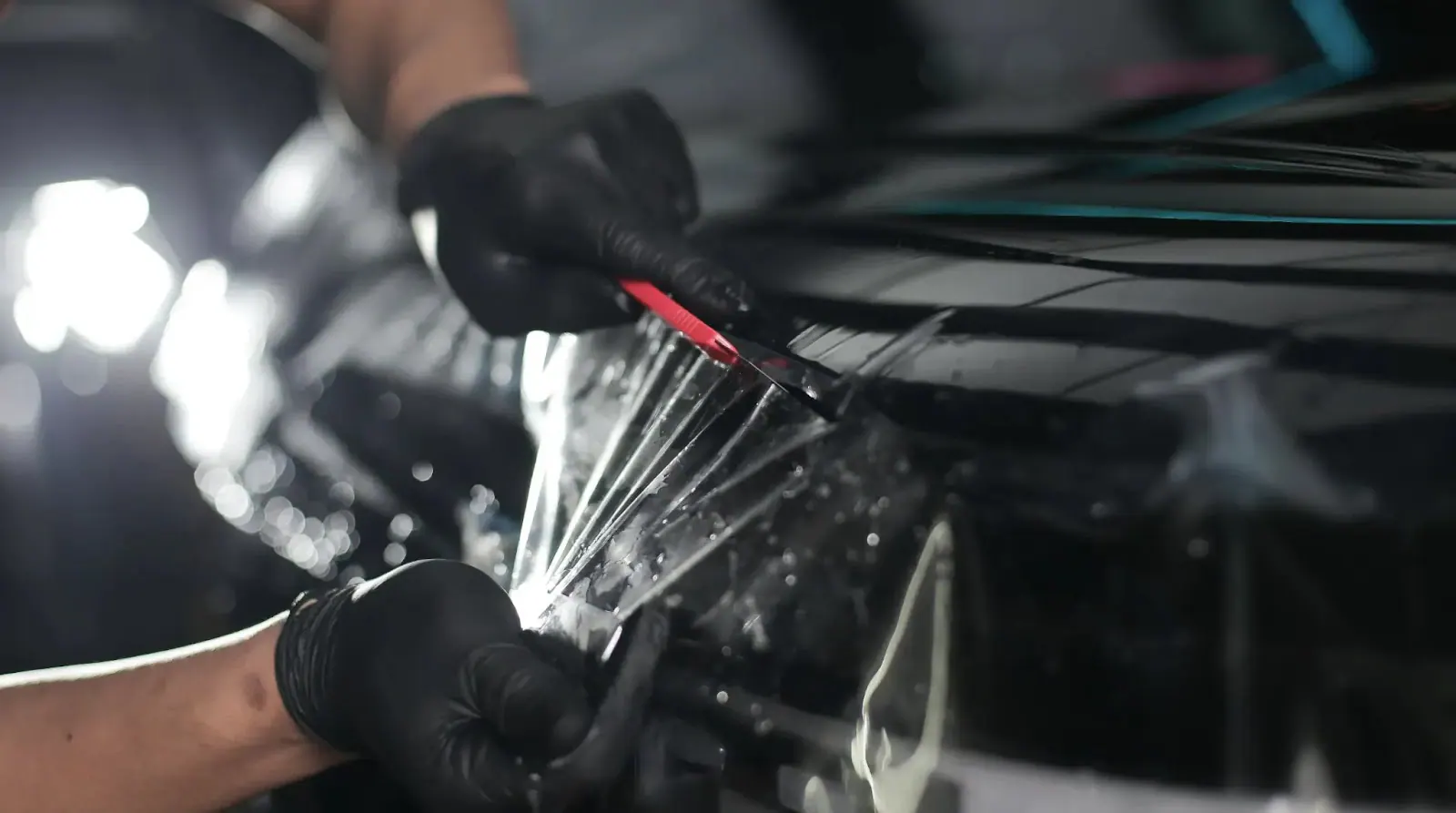
You can discuss the same point around badges, handles and trim without assuming every part has to be removed. The installer needs to explain the proposed work for your car. A sample book cannot establish the method, and a close-up of another installation cannot promise the same access or edge treatment on yours.
If a future repair replaces only one wrapped panel, a saved colour code helps identify the original product but is not an unconditional matching guarantee. You can ask how replacement film would be selected and compared with the remaining panels. That is a separate decision from liking a fresh sample today, especially if you plan to keep the wrap for some time.
What if the sample does not match?
If the film presented for your job looks different from the sample you approved, you can pause approval and compare them together under the same light. The first question is whether they are the same product, colour and finish. A phone photo alone is a poor way to settle that disagreement.
The first check is the label on the film being prepared against the written quote. A different series or finish is a different order, not simply a colour looking different under new lighting. If the details match, comparing the physical samples side by side is more useful than sending new phone photographs that may introduce another colour shift.
A sample from the proposed roll or batch is useful only if everyone understands when it will be checked. You can agree whether that happens before cutting, what happens if you do not approve it, and whether any payment is refundable. Those are terms to settle with the installer, not promises that every shop follows the same policy.
If you and the installer still see a difference after comparing the samples together, the next step is to resolve the product identification or approval terms before work continues. A new photo does not settle what you are willing to accept on the car. Written confirmation of the agreed film and the accepted sample gives both sides a clearer record than a chat containing several similar pictures.
Colour PPF swatches before booking
A colour PPF swatch helps you judge the actual film beside your car, not just an appealing photo. Our colour PPF options can help you shortlist a shade. Before booking, you can contact an authorised outlet near you to arrange a sample check in the finish and lighting you want to see.
Frequently Asked Questions
Is colour PPF the same as a vinyl wrap?
No. Vinyl wraps are mainly about appearance, while colour PPF generally uses thicker thermoplastic polyurethane (TPU) film to change the colour and add some protection against stone chips and light scratches. Vinyl can offer a little surface protection, but it is not usually equivalent to PPF for impact. Thickness, self-healing features and price vary, so any comparison has to be product by product.
Why does colour PPF look different from the Instagram photo?
Lighting, camera settings and editing all shift the colour, and Instagram re-compresses what gets uploaded, so even an untouched photo of the right film can land on your screen a shade off. A post is useful for finding a colour you like, but not for confirming the final shade beside your car.
Can I see the actual colour PPF film before booking?
You can request a physical sample before booking, but availability and approval terms vary by installer. The useful sample is the exact colour and finish you plan to order. You can also agree how film from the proposed roll or batch will be checked, and what happens if you do not approve it.
Does colour PPF protect paint like clear PPF?
Colour PPF can reduce damage from some stone chips and light scratches, though how much depends on the product. Its construction, thickness and warranty are what to compare against the clear film you were considering. Self-healing, where it is offered, works on fine surface marks, not deep cuts or dents.
What is the difference between matte and satin PPF?
Satin has a soft sheen, while matte makes reflected shapes much less distinct. You can compare that difference on a curved panel as well as a flat sample. The same colour can look different across the two finishes, and not every colour is available in both.
Do I need to tell JPJ about a full colour change?
JPJ records vehicle colour, and its K8 amendment form includes a field for changing that record. For a full colour-change wrap, you can confirm with JPJ how the new colour should be recorded. Removable film should not be assumed to be exempt.

Aaron Cheah
Car Detailing Expert, Blog Contributor
"He is a car detailing specialist focused on helping Malaysian drivers protect and maintain their vehicle’s paintwork and interior for the long run. He prioritizes clear comparisons, maintenance best practices, and decision checklists so readers can choose the right protection for their budget and avoid costly mistakes. The goal is to make detailing topics easy to understand while setting clear expectations on durability, care routines, and results."
View All ArticlesProtect your Investment today
Don't wait for stone chips to ruin your paint. Speak to our experts about custom PPF and Tinting solutions.