
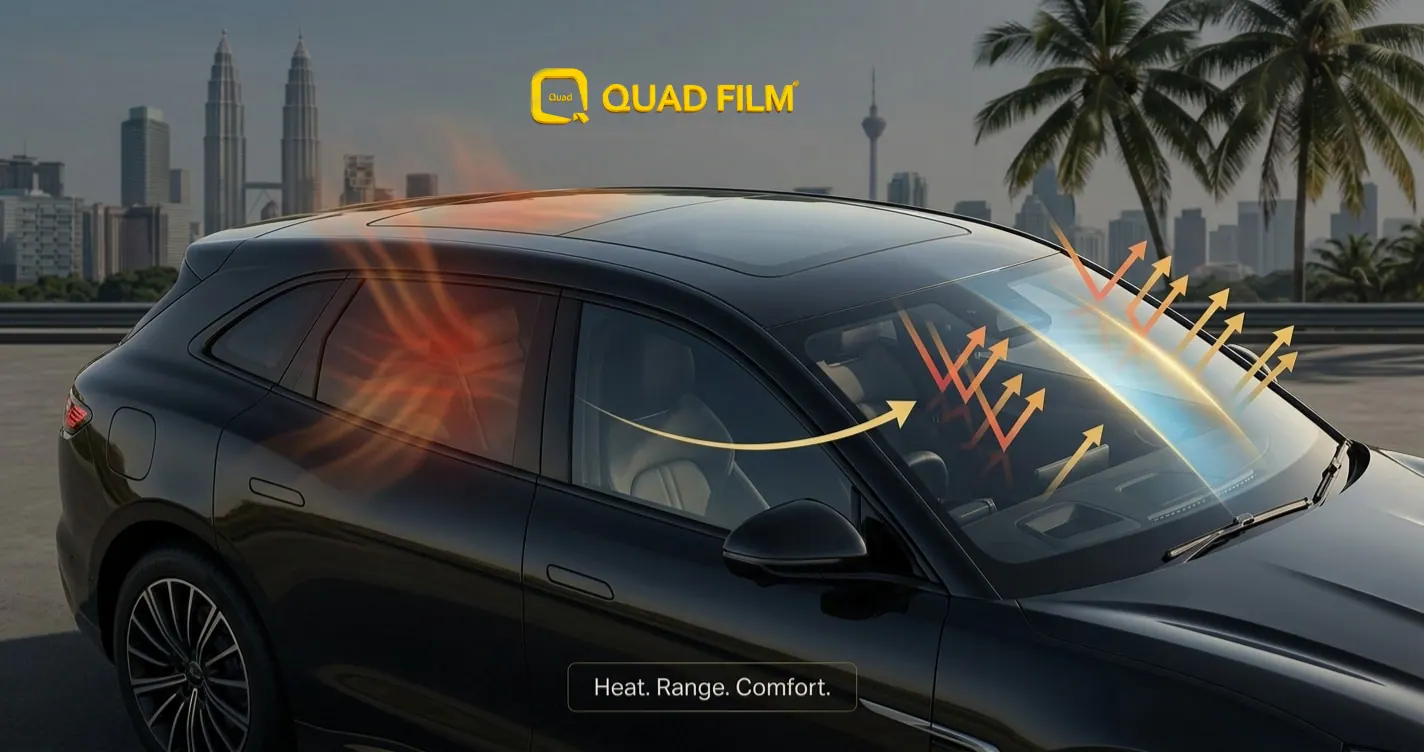
- On the Z9GT's 122.49 kWh battery, cutting cabin heat is worth 12.25 kWh per 140 km in Quad Film's own battery test, which scales to 117 km more range per full charge in 33 to 35°C conditions.
- Darkness is not heat rejection. MEGALUX at a road-legal VLT 50 rejects 76% of solar energy, more than MATRIX at limo-dark VLT 5 on 73%.
- MEGALUX at the X Large price of RM5,000 works out to RM333 per year of warranty, which is cheaper per year than METALUX at RM360.
- The panoramic glass roof takes Quad Film EV Sunroof PPF at 72% VLT and 95% heat reflection, with a measured 52°C to 22°C interior drop. At RM1,800 for X Large, charging savings cover it in 3.4 years.
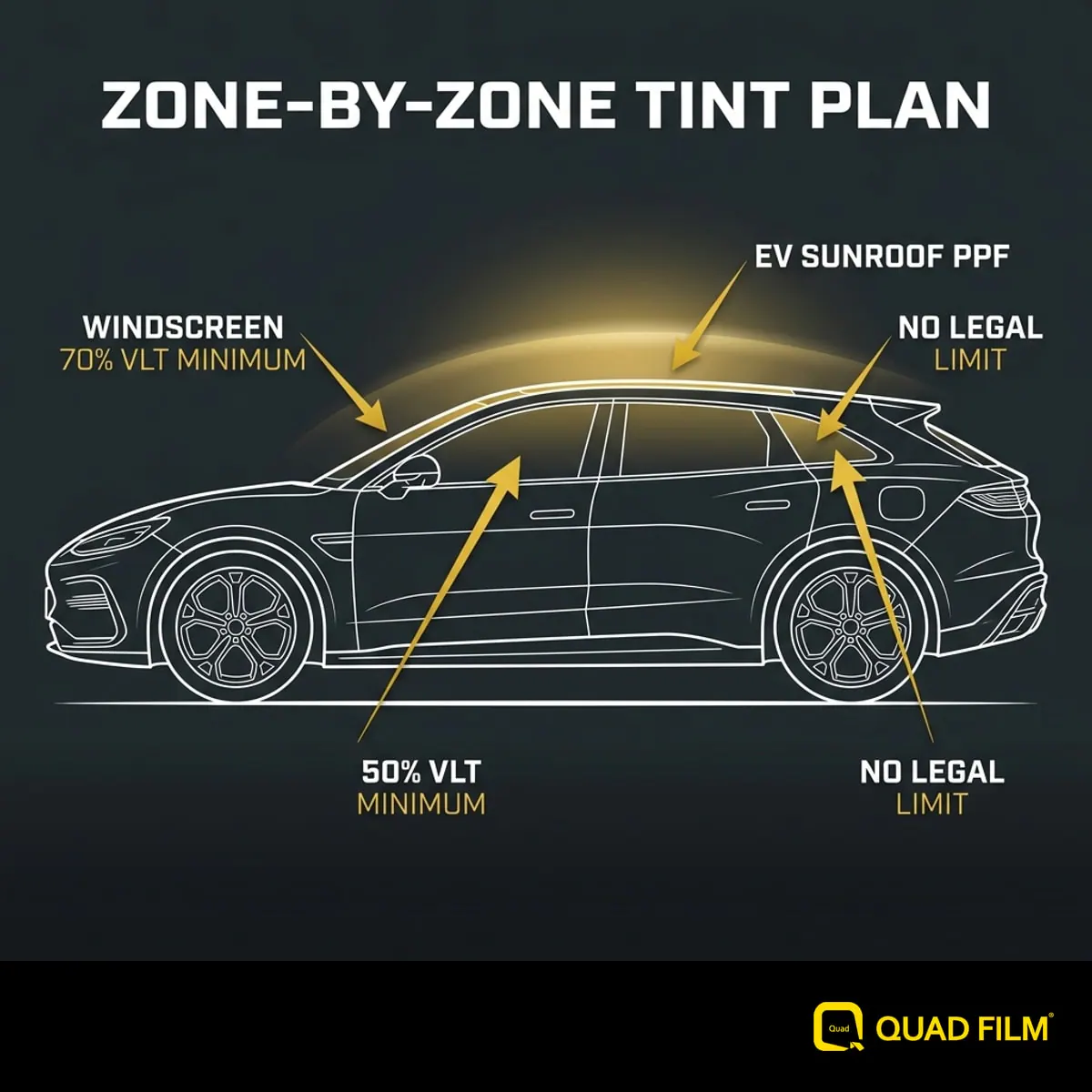
- JPJ sets 70% VLT on the windscreen and 50% on the front side windows. Rear glass has no minimum, so MEGALUX VLT 5 at 85% TSER belongs there.
Choosing the right Denza Z9GT window tint in Malaysia comes down to three numbers rather than a shade you pick off a sample board: TSER, infrared rejection, and the energy your air conditioning pulls out of a 122.49 kWh battery. The Z9GT launched here on 15 July 2026 at RM358,800, with 1,156 PS, 600 km of WLTP range, and a full panoramic glass roof over a 5,180 mm shooting-brake body.
This guide gives you the film and shade for every piece of glass on the car, the JPJ limits you have to respect in front, and a worked calculation of what cooler glass is actually worth in kilometres and ringgit. The same heat logic runs through our guide to window tint for the iCaur 03 and our breakdown of MG S5 EV panoramic sunroof heat, while the wider category view sits in best window tint for EVs in Malaysia. This article stays on the Z9GT and answers the spec question with figures.
Why the Denza Z9GT Bakes Fast in Malaysian Sun
The Z9GT heats up fast because a 5,180 mm shooting-brake body carries long side glazing under a full panoramic glass roof, and there is no opaque roof panel to hide behind. Park it in the open at midday and solar energy loads the cabin faster than the four-zone air conditioning can clear it.
Here is the moment that matters. You park on the open rooftop level at Sunway Pyramid at 12:40 pm, spend 90 minutes inside, and come back to a steering wheel you cannot hold. You set the air conditioning to 20°C with the fan at level 10, and for the first four minutes the system is only stirring hot air. By the time you have queued out of the ramp and joined the Federal Highway, you have run roughly 15 minutes of full-blast cooling before the cabin feels normal again. Repeat that twice a day, five days a week, and it becomes a fixed tax on the car.
On an EV that tax is paid in range, not just sweat. The climate system draws from the same 122.49 kWh pack that delivers 1,156 PS and 1,210 Nm, so every degree of heat soak is battery you do not get to use on the road. The panoramic roof is the worst offender because it faces the sun squarely for the whole time you are parked and sits directly above your passengers' heads instead of beside them. Owners of glass-roof EVs describe the same pattern in our write-up of MG S5 EV panoramic sunroof heat, and the Z9GT has more glass than most of them.
TSER and IR Rejection Beat Darkness Every Time
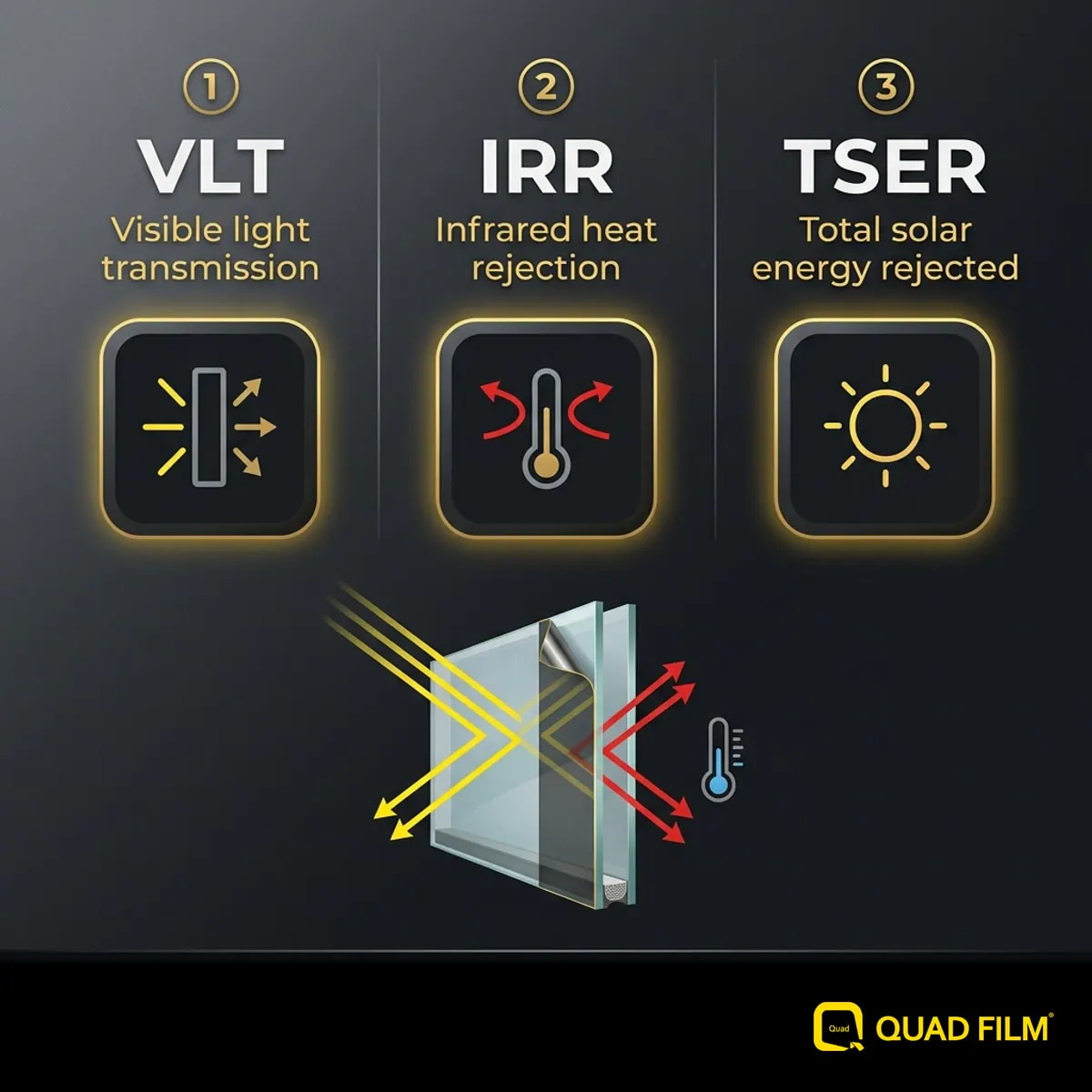
TSER decides how cool your Z9GT stays, not how dark the glass looks. Total Solar Energy Rejection is the share of solar energy the glass and film reject together, and infrared rejection covers the wavelength band your skin reads as heat. A light, road-legal film with strong TSER out-cools a dark cheap film every single time.
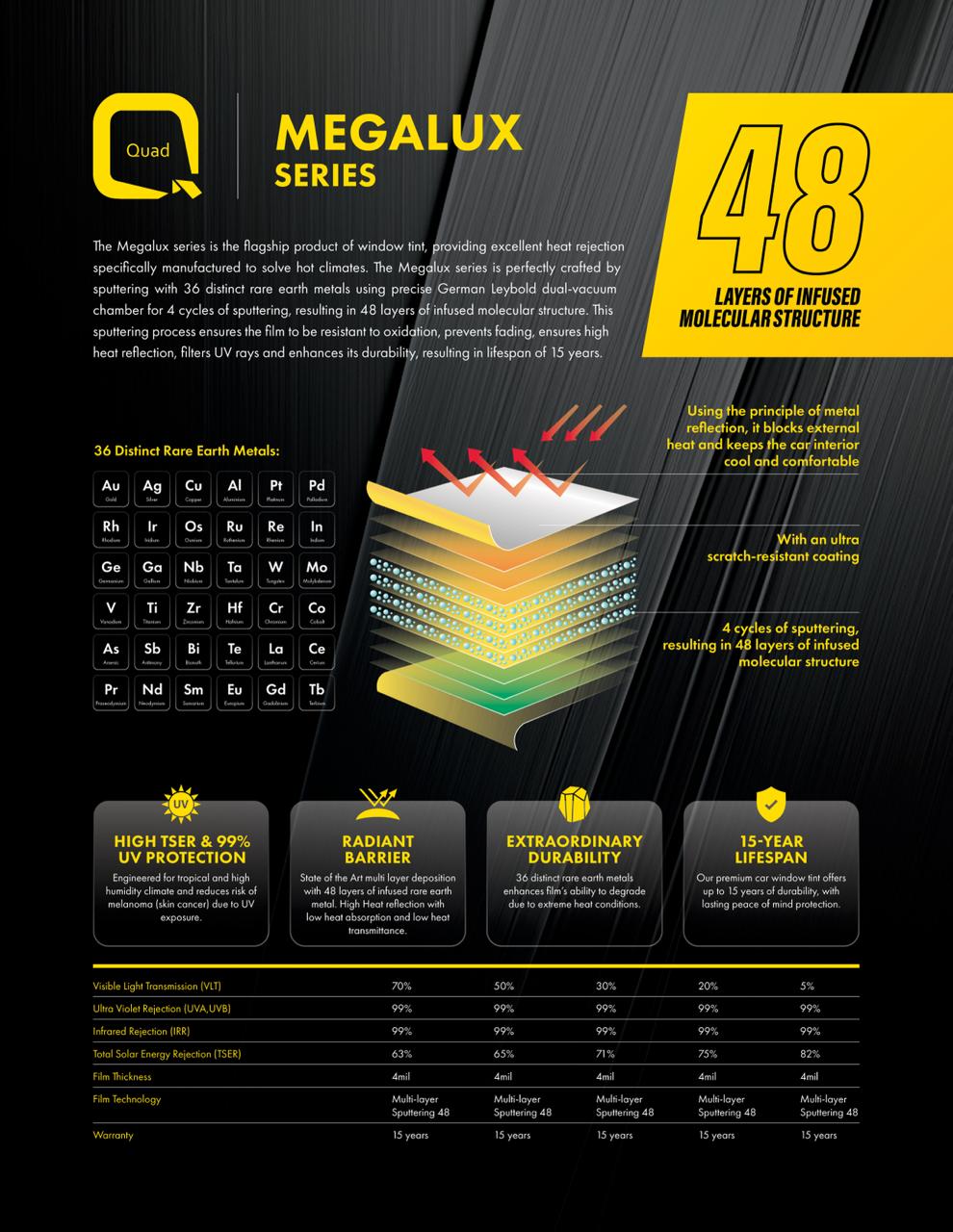
The Quad Film spec sheet proves it in one line. MEGALUX at VLT 70, light enough to sit legally on a windscreen, rejects 72% of total solar energy. MATRIX at VLT 5, dark enough that you cannot see the rear passengers, rejects 73%. Those two are effectively level on heat while looking nothing alike. So the driver who paid for near-black glass on the front sides at a RM300 shop on Jalan Klang Lama gets a summons risk and no real heat advantage over an owner running MEGALUX at a legal VLT 50, which rejects 76%. That is the whole argument in three figures.
Ask any installer for TSER and IRR at the exact VLT you intend to fit, measured after installation. A film brochure that only advertises darkness and a vague heat claim is hiding the number that matters, which is why so many shops steer buyers toward whatever they stock most cheaply, a pattern we unpack in why tint shops push ceramic film.
Total Solar Energy Rejection (TSER)
TSER is the share of the sun's total energy, meaning visible light, infrared and UV together, that the glass and film reject as a system. It is the single most useful comparison number. Across the Quad Film range it runs from 60% (MATRIX at VLT 70) to 85% (MEGALUX at VLT 5), so the spread between the entry film and the flagship at the same darkness is worth 12 percentage points of solar energy.
Infrared Rejection (IRR)
Infrared is the part of sunlight you physically feel on your forearm at a traffic light. MEGALUX, METALUX and MATRIX all reject 99% of it, MAGNETRON rejects 97%, and MIRACLE rejects 95%. This is the figure that decides whether the Federal Highway sun at 6:45 pm feels like light on your arm or a heat lamp on your arm.
Visible Light Transmittance (VLT)
VLT only describes darkness. A 70% VLT film is nearly clear and a 5% VLT film is very dark, and two films at identical VLT can feel completely different inside the same car because their metal or ceramic structure differs. That structural difference also decides how long the film holds its colour and performance, which we compare in multi-layer sputtered film durability.
The Range Maths: 12.25 kWh Saved Every 140 km
Cooler glass on a Z9GT is worth 12.25 kWh of battery every 140 km of hot-weather driving. That is not a feeling, it is arithmetic from Quad Film's controlled EV battery test applied to this car's 122.49 kWh pack. Scaled across a full charge in the same heat, the difference is 117 km of range between a heat-protected car and an unprotected one.
Here are the inputs and the working, so you can check it yourself:
- Test conditions: ambient 33 to 35°C, air conditioning set to 20°C, fan level 10, both cars starting at 93% battery and covering the same 140 km.
- Test result: the car protected with Quad Film EV Sunroof PPF finished at 63%, using 30 percentage points. The comparison film finished at 53%, using 40 points.
- Applied to the Z9GT: 30 points of a 122.49 kWh pack is 36.75 kWh, which is 262 Wh per km. 40 points is 49.00 kWh, which is 350 Wh per km.
- Saving: 12.25 kWh per 140 km, or 87.5 Wh per km.
- Full-charge equivalent in those conditions: 467 km against 350 km, a gap of 117 km.
- Charging cost at RM0.30 per kWh over 20,000 km a year: 1,750 kWh, or RM525 a year.
- Stated assumptions: the test's heat load stands in for Klang Valley midday driving, and the car covers 20,000 km a year on home charging.
The payback follows from the same numbers. EV Sunroof PPF for the roof costs RM1,800 at the X Large tier, so RM525 a year of saved charging covers it in 3.4 years, comfortably inside its 5-year warranty. Everything after that is free range. Put differently, on a 205 km Sunday run up the PLUS to Ipoh at 34°C, the protected car arrives with roughly 12 percentage points more battery in the pack, which is the difference between charging at Tapah and driving straight home.
Comfort improves on the same curve. A cabin that starts 10°C cooler needs less time at fan level 10, so the compressor stops fighting a losing battle in the first kilometre out of a carpark. That is why the film spec and the roof film are one decision on this car, not two separate upgrades you can postpone.
Quad Film Tint Tiers Costed Per Year of Warranty
At 5,180 mm long the Z9GT sits in Quad Film's X Large pricing tier, so the honest way to compare tiers is cost per year of warranty rather than sticker price. On that measure MEGALUX costs RM333 a year and METALUX costs RM360 a year, which means the flagship film is the cheaper long-term choice of the two.
That works out to RM0.91 a day for the best heat rejection Quad Film makes, on a car that cost RM358,800. For an owner who parks on the open level 6 at Mid Valley three times a week, RM0.91 buys back the 15 minutes of hard cooling described earlier and the 12.25 kWh per 140 km calculated above. Judged against the RM45 you would spend on one carpark coffee run, the film stops looking like a luxury add-on.
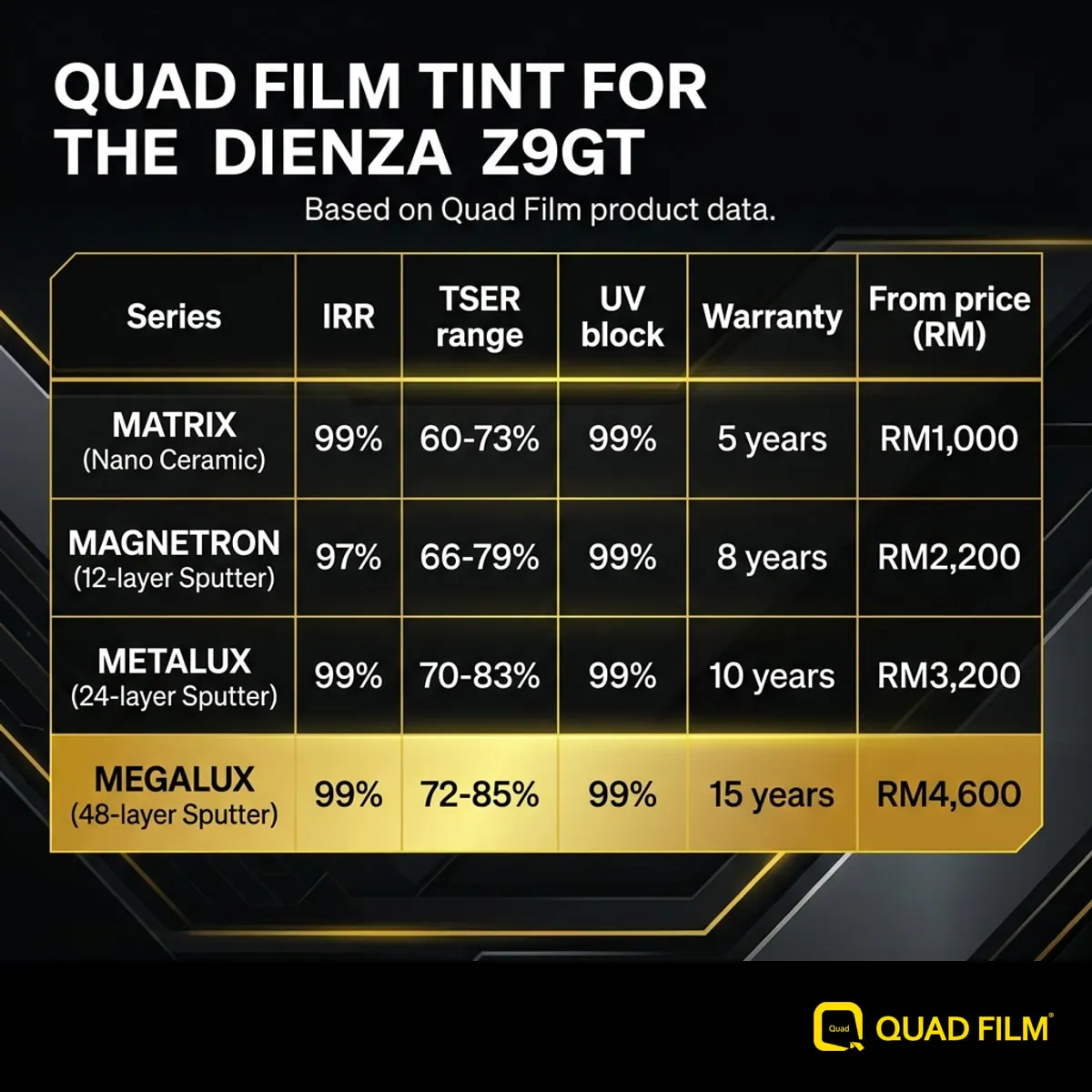
The table below shows the full range at the X Large tier, followed by the cost-per-year calculation. Every figure comes from the Quad Film product specifications, and TSER is shown at both ends of the shade range so you can see how much darkness actually buys.
MEGALUX: 15-Year Flagship Heat Shield
MEGALUX is the tier that matches this car. It uses 48 layers of multi-layer sputtering, rejects 99% of infrared and 99% of UV, and delivers 72% TSER at VLT 70 rising to 85% TSER at VLT 5, all on a 15-year warranty. At the X Large tier a full car costs RM5,000, and the 15-year term is what drops the annual cost below every other sputtered series.
METALUX: 10-Year Night-Driving Clarity
METALUX uses 24 layers of sputtering, rejects 99% of infrared, and delivers 70% TSER at VLT 70 rising to 83% at VLT 5, on a 10-year warranty at RM3,600 for an X Large car. Quad Film tunes it for optical clarity and glare reduction, which is the series to ask about if you drive the unlit stretch of the LATAR or the Guthrie Corridor at night regularly.
MAGNETRON: 8-Year Mid-Premium Choice
MAGNETRON uses 12 sputtered layers, rejects 97% of infrared, and delivers 66% TSER at VLT 70 rising to 79% at VLT 5, on an 8-year warranty at RM2,600. It is the sensible middle tier for a Z9GT that sleeps in a basement carpark and does short Klang Valley runs rather than long exposed highway hours.
MATRIX: 5-Year Entry Nano-Ceramic
MATRIX is a 2 mil nano-ceramic film rejecting 99% of infrared, with 60% TSER at VLT 70 rising to 73% at VLT 5, on a 5-year warranty at RM1,200. It is the budget entry point, and note that its 2 mil thickness and shorter term are what separate it from the sputtered series over a decade of Malaysian sun. Installation quality matters just as much as the film grade, which is why so few shops handle sputtered film correctly, as we set out in multi-layer sputtered film installation in Malaysia.
Here is the full Quad Film window tint range at the X Large tier that applies to the Z9GT.
| Quad Film series | Technology | IRR | TSER at VLT 70 | TSER at VLT 5 | UV | Warranty | X Large full car |
|---|---|---|---|---|---|---|---|
| MATRIX | Nano ceramic, 2 mil | 99% | 60% | 73% | 99% | 5 years | RM1,200 |
| MIRACLE | Sun protection factor, 4 mil | 95% | 62% | 75% | 100% | 7 years | RM2,200 |
| MAGNETRON | 12-layer magnetron, 4 mil | 97% | 66% | 79% | 99% | 8 years | RM2,600 |
| METALUX | 24-layer sputtering, 4 mil | 99% | 70% | 83% | 99% | 10 years | RM3,600 |
| MEGALUX | 48-layer sputtering, 4 mil | 99% | 72% | 85% | 99% | 15 years | RM5,000 |
Figures and X Large pricing from Quad Film product specifications.
Now divide each price by its warranty term. This is the calculation almost no tint shop will run for you, and it reorders the range.
| Quad Film series | X Large full car | Warranty | Cost per year of warranty |
|---|---|---|---|
| MATRIX | RM1,200 | 5 years | RM240 |
| MIRACLE | RM2,200 | 7 years | RM314 |
| MAGNETRON | RM2,600 | 8 years | RM325 |
| MEGALUX | RM5,000 | 15 years | RM333 |
| METALUX | RM3,600 | 10 years | RM360 |
Cost per year is an original Quad Film calculation dividing the X Large price by the warranty term.
Per-Window Tint Plan for Every Piece of Z9GT Glass
A complete Z9GT job is five separate specifications, not one film for the whole car. The windscreen and front sides are capped by JPJ, the rear glass can run as dark as you like for privacy and peak TSER, and the panoramic roof takes a different product altogether because side-window film is not built for sustained overhead load.
The sequence shows up on a real drive. Coming out of the SPRINT tunnel at 3 pm with two passengers in the back, the heat they complain about is coming down through the roof, not sideways through the doors. Quad Film's own measurement on EV Sunroof PPF is a 52°C surface dropping to 22°C, so this is the one zone where the right film changes the passenger experience immediately rather than gradually.
Take this table to the installer and ask them to quote it line by line, with a VLT meter reading on each pane after installation. Any shop that quotes one film and one price for the whole car has not looked at your roof.
| Glass on the Z9GT | Quad Film series and shade | VLT | TSER | IRR | UV | JPJ status |
|---|---|---|---|---|---|---|
| Front windscreen | MEGALUX VLT 70 | 70% | 72% | 99% | 99% | Legal, meets the 70% minimum |
| Front side windows | MEGALUX VLT 50 | 50% | 76% | 99% | 99% | Legal, meets the 50% minimum |
| Rear side windows | MEGALUX VLT 20 | 20% | 82% | 99% | 99% | No minimum VLT |
| Rear windscreen | MEGALUX VLT 5 | 5% | 85% | 99% | 99% | No minimum VLT |
| Panoramic glass roof | Quad Film EV Sunroof PPF, 7 mil | 72% | 95% heat reflection | Not published for this film | Over 99% | Outside the VLT rule |
Series, shade, VLT, TSER, IRR and UV figures from Quad Film product specifications. JPJ minimums per Berjaya Sompo and 3M Malaysia guidance.
Front Windscreen: MEGALUX VLT 70 at 72% TSER
The windscreen has to sit at 70% VLT or lighter, and MEGALUX at that shade still rejects 72% of solar energy and 99% of infrared. That is the point most owners miss. The legal front glass on a Z9GT can carry the strongest film in the range, because the shade limit does not limit the technology behind it.
Front Side Windows: MEGALUX VLT 50 at 76% TSER
Front sides are capped at 50% VLT, where MEGALUX rejects 76% of solar energy. This is the glass sitting against your right arm through 40 minutes of KESAS crawl, so the 99% infrared figure here is the one you feel most directly, along with the 99% UV rejection on the skin of your forearm.
Rear Side Windows: MEGALUX VLT 20 at 82% TSER
Rear side glass has no legal minimum, so VLT 20 gives rear passengers 82% TSER and real privacy in a mall carpark. On a shooting brake with this much rear glazing, going from 76% to 82% across four large panes is a measurable change for anyone sitting behind you.
Rear Windscreen: MEGALUX VLT 5 at 85% TSER
The rear windscreen is the one pane where you can take the full 85% TSER without any legal question. Keep your night reversing in mind, since the Z9GT's cameras carry the load there, and pair it with the VLT 20 rear sides for a consistent look.
Panoramic Glass Roof: EV Sunroof PPF at 72% VLT
The roof is the largest single heat source on the car and takes Quad Film EV Sunroof PPF, not window film. It uses magnetron sputtering with 24 layers of rare earth metals, reflects 95% of heat, holds 72% VLT so the glass stays see-through, blocks over 99% UV at 7 mil, and drops a 52°C interior to 22°C on a 5-year warranty. Pricing is RM800, RM1,200 or RM1,800 by roof size, and the Z9GT's full-length roof falls in the X Large band. Full specs sit on the Quad Film products page.
JPJ Tint Limits Every Z9GT Owner Must Follow
JPJ sets two hard numbers on this car. The front windscreen must transmit at least 70% VLT and the front side windows at least 50% VLT, while the rear side windows and rear windscreen carry no minimum at all. Going darker in front without an approved exemption puts you on the wrong side of a tint meter.
Enforcement is not theoretical. A spot check on Jalan Tun Razak takes about two minutes: the officer clamps a meter on your driver's window, reads the VLT, and writes the summons if it falls under 50%. The commonly quoted penalty for non-compliant front glass starts at RM2,000, which is more than a full MAGNETRON job at RM2,600 and roughly 40% of a full MEGALUX job at RM5,000. Puspakom inspections check the same thing when the car is presented, so illegal front glass also becomes a paperwork problem later.
The workaround is the plan already in the table above. Put the strongest film at the lightest legal shade in front, then spend your darkness budget at the rear where the law says nothing. A Z9GT running MEGALUX VLT 70 on the windscreen and VLT 50 on the front sides is fully compliant while still rejecting 72% and 76% of solar energy, so you are not trading legality for heat. If you want the full pre-purchase question list, our what to check before buying car tint guide covers the specs, the scams and the warranty wording.
Three Tint Mistakes Z9GT Owners Make
Three decisions account for almost all tint regret on a car at this price. Each one has a number attached, and each one is avoidable before you hand over the keys at the workshop bay.
Buying on Darkness Instead of TSER
A dark film with no published TSER figure still lets heat through, and the spec sheet proves the trap: MATRIX at VLT 5 rejects 73% while MEGALUX at VLT 70 rejects 72%. Pay for near-black front glass and you take a RM2,000 summons risk for one percentage point. Ask for TSER and IRR at the exact VLT you intend to fit.
Skipping the Panoramic Glass Roof
Tinting four side windows and leaving the roof bare skips the largest heat source on the car, and it forfeits the 12.25 kWh per 140 km calculated earlier. RM1,800 of EV Sunroof PPF at the X Large size pays for itself in 3.4 years of charging cost, so postponing it is the most expensive line item on the quote.
Choosing an Unaccredited Installer
A 48-layer sputtered film is only as good as the hands fitting it, and a 5,180 mm car with a full glass roof leaves no margin for bad heat shrinking or lifted edges. Insist on a shop that measures VLT with a meter after installation, shows the series spec sheet, and puts the 15-year MEGALUX warranty in writing under your name.
Choosing the Right Denza Z9GT Window Tint for Your Drive
The recommendation for this car is specific. MEGALUX VLT 70 on the windscreen, VLT 50 on the front sides, VLT 20 on the rear sides and VLT 5 on the rear windscreen, with EV Sunroof PPF on the panoramic roof. That set is fully JPJ compliant in front, delivers 72% to 85% TSER across the glass, and costs RM5,000 plus RM1,800 at the X Large tier.
If that is beyond the budget, MAGNETRON at RM2,600 keeps 97% infrared rejection and 66% to 79% TSER on an 8-year term, and MATRIX at RM1,200 remains a real nano-ceramic film rather than dyed plastic. Do not economise on the roof film in either case, because that is the line item the range calculation is built on. The one thing to avoid entirely is spending on darkness in front, since the numbers show it buys nothing except exposure to a RM2,000 summons.
When you are ready, book the car in with a Quad Film authorised installer, ask for VLT and TSER readings on each pane after installation, and keep the warranty card with the service records. Spec the film around where the car actually parks, and the rest of the decision takes care of itself.
Denza Z9GT Window Tint FAQ
How much does Quad Film window tint cost for a Denza Z9GT in Malaysia?
The Z9GT falls in the X Large tier at 5,180 mm long. A full car costs RM1,200 for MATRIX, RM2,200 for MIRACLE, RM2,600 for MAGNETRON, RM3,600 for METALUX and RM5,000 for MEGALUX. EV Sunroof PPF for the panoramic roof is RM1,800 at the X Large roof size, so a complete MEGALUX plus roof job is RM6,800.
Which Quad Film tint suits the Denza Z9GT's panoramic glass roof?
The roof takes Quad Film EV Sunroof PPF rather than window film. It reflects 95% of heat, holds 72% VLT, blocks over 99% UV at 7 mil thickness, drops a 52°C interior to 22°C, and carries a 5-year warranty at RM1,800 for the X Large roof size.
How much range does the right tint save on a 122.49 kWh Denza Z9GT?
Applying Quad Film's EV battery test to this car's 122.49 kWh pack, heat-protected glass uses 262 Wh per km against 350 Wh per km, a saving of 12.25 kWh over 140 km. Scaled to a full charge in 33 to 35°C conditions that is 467 km against 350 km, a gap of 117 km, worth RM525 a year in charging at 20,000 km and RM0.30 per kWh.
What is the legal tint VLT for the Denza Z9GT's front windscreen?
JPJ requires at least 70% VLT on the windscreen and at least 50% VLT on the front side windows, with no minimum on the rear glass. MEGALUX at VLT 70 still rejects 72% of solar energy and 99% of infrared, so a fully legal front does not cost you heat performance.
Is MEGALUX or METALUX better for a Denza Z9GT kept for 10 years?
MEGALUX. It rejects 72% to 85% of solar energy against METALUX at 70% to 83%, and its 15-year warranty makes it RM333 per year at the X Large price of RM5,000 against RM360 per year for METALUX at RM3,600 over 10 years. Choose METALUX only if the 10-year term matches how long you plan to keep the car.
Will VLT 5 rear glass hurt night visibility in the Denza Z9GT?
VLT 5 on the rear windscreen cuts most of the light reaching your interior mirror, so on this car you lean on the reversing and surround cameras at night. The front glass stays at VLT 70 and VLT 50 by law, which is where your actual night vision comes from, and sputtered MEGALUX holds better optical clarity than dyed film at every shade.
Does the Denza Z9GT's factory glass already reject enough heat?
No. The factory panoramic roof and side glazing still let enough solar energy through that the cabin heat-soaks in an open carpark, which is why the 12.25 kWh per 140 km gap in Quad Film's test exists at all. Factory glass gives you a baseline, and the film plus EV Sunroof PPF is what takes solar rejection to 72% to 85% and 95% roof heat reflection.
Protect your Investment today
Don't wait for stone chips to ruin your paint. Speak to our experts about custom PPF and Tinting solutions.