
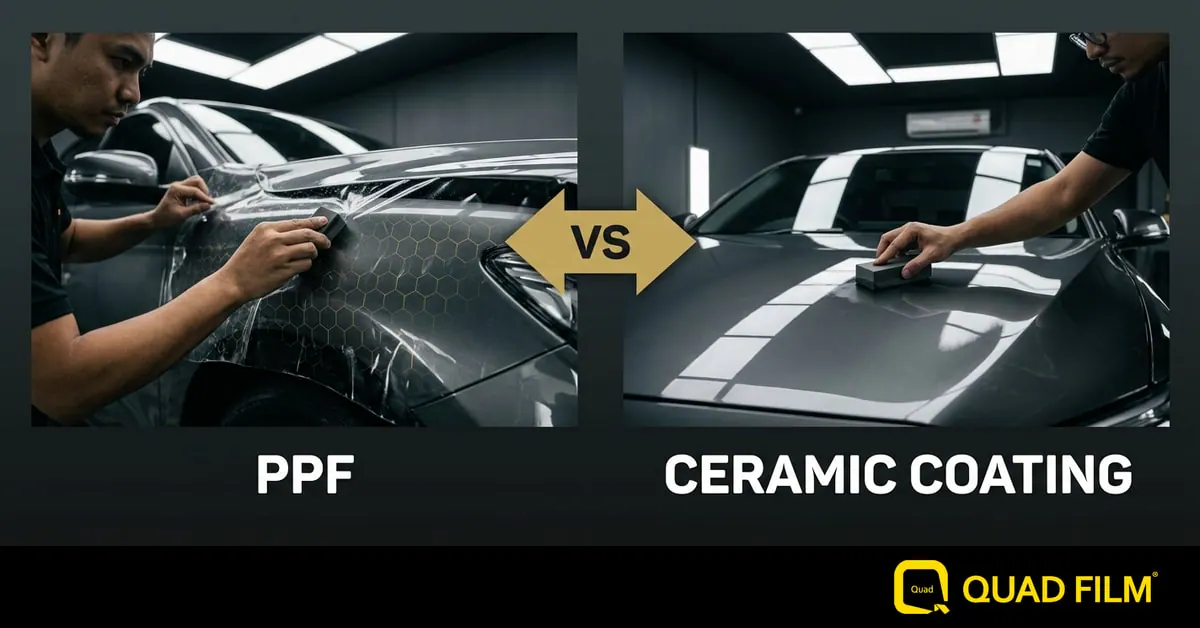
- PPF is a physical film that absorbs stone chips, scratches and road debris. Ceramic coating is a liquid chemical layer that adds gloss and makes cleaning easier but cannot stop physical impacts.
- For Malaysian drivers who face highway gravel, tight parking lots and intense UV daily, PPF provides stronger long-term paint protection than ceramic coating alone.
- Ceramic coating works well for car owners who mainly want easier washing and a glossier finish, especially if the car stays garaged most of the time.
- The best setup for many Malaysian car owners is PPF on high-impact zones (bonnet, bumper, mirrors, door edges) combined with ceramic coating on the remaining panels.
- Full car PPF in Malaysia ranges from RM9,000 to RM20,000+, while ceramic coating ranges from RM1,500 to RM5,000. Budget and driving habits should guide your choice.
PPF vs ceramic coating is one of the most common debates among Malaysian car owners right now. You walk into a detailing shop in KL, and the staff recommends two products that sound similar but cost very different amounts. One is a thick transparent film. The other is a liquid applied to your paint. Both promise to protect your car. But they work in completely different ways, and picking the wrong one could mean spending thousands of ringgit on protection that does not match what your car actually faces on the road.
This article breaks down the real differences between PPF and ceramic coating so you can make a clear decision based on how you drive, where you park, and what kind of protection your car needs in Malaysian conditions. If you want a deeper understanding of PPF before comparing, read our full guide on paint protection film malaysia.
What Is PPF? A Quick Overview
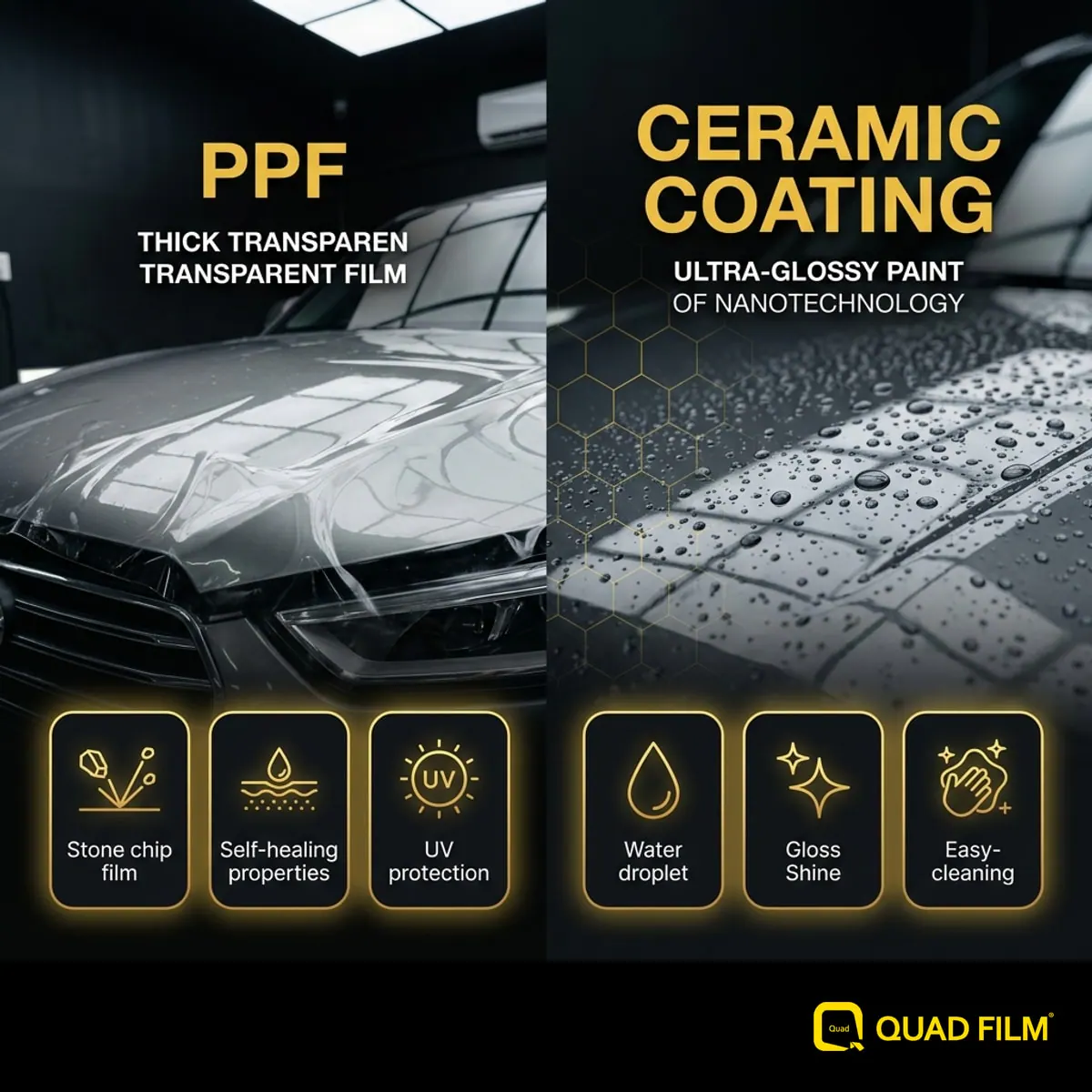
Paint protection film (PPF) is a thick, transparent polyurethane film applied directly over your car's paintwork. It acts as a physical barrier between your paint and everything the road throws at it.
Here is what PPF does:
- Absorbs impact from stone chips, gravel, sand and road debris
- Protects against scratches from bushes, car wash brushes and minor contact
- Uses self-healing technology that repairs light surface scratches when exposed to heat
- Blocks UV rays that cause paint fading and oxidation over time
- Typical thickness ranges from 150 to 250+ microns (7.5 to 10 MIL), depending on the product tier
Premium PPF products like the Quad Film QUANTUM series use a double-layer TPU structure at 10 MIL thickness with up to 99% self-healing capability and 7-year warranty coverage. That is a serious amount of material sitting between your paint and the outside world.
For a full breakdown of PPF types, specifications and how the technology works, refer to our complete paint protection film malaysia guide.
What Is Ceramic Coating?
Ceramic coating is a liquid polymer that is applied to your car's paint surface and chemically bonds to the clear coat. Once cured, it creates a thin, hard, hydrophobic (water-repelling) layer over the paint.
Here is what ceramic coating does:
- Makes the car surface extremely slippery so water, dirt and contaminants slide off easily
- Adds a deep gloss and shine to your paintwork
- Provides some UV protection to slow down paint oxidation
- Makes regular washing faster and easier because dirt does not stick as firmly
- Offers minor scratch resistance at the surface level
What ceramic coating does NOT do:
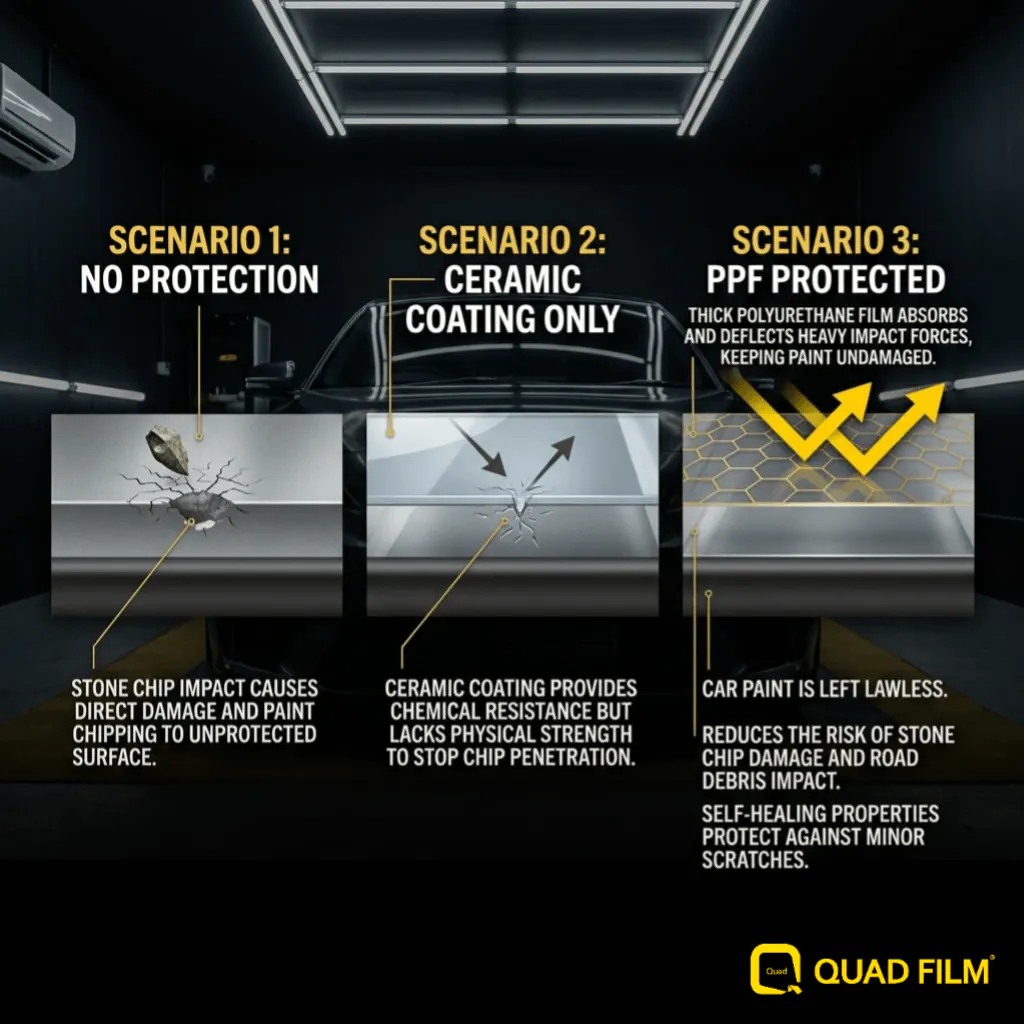
- It cannot stop stone chips. A rock from a highway truck will go straight through it.
- It cannot absorb physical impacts. The coating is only a few microns thick, compared to PPF at 150 to 250+ microns.
- It does not self-heal. Once scratched, the damage stays.
Think of ceramic coating as a permanent wax on steroids. It makes your car look great and stay cleaner for longer, but it is not armour.
The Core Difference: Physical Barrier vs Chemical Layer
This is the single most important thing to understand before spending any money.
PPF is a physical barrier. It is a thick film that sits on top of your paint and takes the hit when something makes contact. Stone chip? The PPF absorbs it. Shopping trolley scrape in a parking lot? The film takes the damage, not your paint. Light scratch from a branch? The self-healing layer repairs itself within minutes under sunlight or warm water.
Ceramic coating is a chemical layer. It bonds to your paint surface and changes how the surface behaves. Water beads and rolls off. Dirt does not cling as hard. Your car looks glossier. But if a stone chip or a hard scratch hits the surface, the ceramic layer cannot absorb that force. It is simply too thin.
A good way to picture it: PPF is like putting a screen protector on your phone. Ceramic coating is like applying a water-resistant spray to a jacket. Both are useful. But one physically blocks damage, and the other changes the surface properties.
PPF vs Ceramic Coating: Side-by-Side Comparison
| Factor | PPF | Ceramic Coating |
|---|---|---|
| Protection type | Physical barrier (thick film) | Chemical layer (liquid polymer) |
| Stone chip protection | Yes | No |
| Scratch resistance | Yes, with self-healing | Minor surface resistance only |
| UV protection | Yes | Yes |
| Hydrophobic effect | Yes (premium films) | Yes (strong) |
| Ease of cleaning | Good | Excellent |
| Gloss enhancement | Maintains factory gloss | Enhances gloss |
| Typical lifespan | 5 to 10 years | 2 to 5 years |
| Cost (full car) | RM9,000 to RM20,000+ | RM1,500 to RM5,000 |
| Removable | Yes, without paint damage | No (wears off gradually) |
| Best for | Physical protection on high-impact areas | Easy maintenance and gloss boost |
When PPF Makes More Sense for Your Car
PPF is the better choice if your car faces regular physical threats. Here are the situations where PPF gives you the most return:
- You drive highways regularly. PLUS, ELITE, LDP and NKVE highways in Malaysia are known for loose gravel, sand and debris from trucks. Your front bumper, bonnet and side mirrors take the worst of it.
- You park outdoors or in public lots. Open parking at malls, offices and airports exposes your paint to UV, bird droppings, tree sap and the occasional trolley or door ding.
- You plan to keep the car for 3 or more years. PPF preserves your paint in factory condition, which directly protects resale value when you eventually sell or trade in.
- Your car has expensive paint. Metallic, pearlescent and matte factory finishes cost thousands to repaint per panel. PPF is cheaper than repainting.
- You want protection you can see working. PPF physically takes the hits. You can inspect it, see the self-healing in action, and know the film is doing its job.
For a detailed look at what PPF costs across different coverage levels and car sizes in Malaysia, check out our ppf price malaysia guide.
When Ceramic Coating Makes More Sense
Ceramic coating is the better fit in these scenarios:
- You mainly want easier washing and a shinier car. If your priority is reducing wash time and keeping that showroom gloss, ceramic coating delivers exactly that.
- Your car lives in a covered garage most of the time. If your car does not face highway debris or outdoor parking daily, the physical protection of PPF matters less.
- You have a smaller budget for paint protection. At RM1,500 to RM5,000 for a full car, ceramic coating is significantly cheaper than full-body PPF.
- You already have PPF on high-risk areas. Many owners apply PPF on the front end and use ceramic coating on the remaining panels. This is a smart, budget-conscious approach.
Can You Use Both? PPF and Ceramic Coating Together
Yes. And for many Malaysian car owners, this combination is the smartest way to protect a car.
The logic is straightforward:
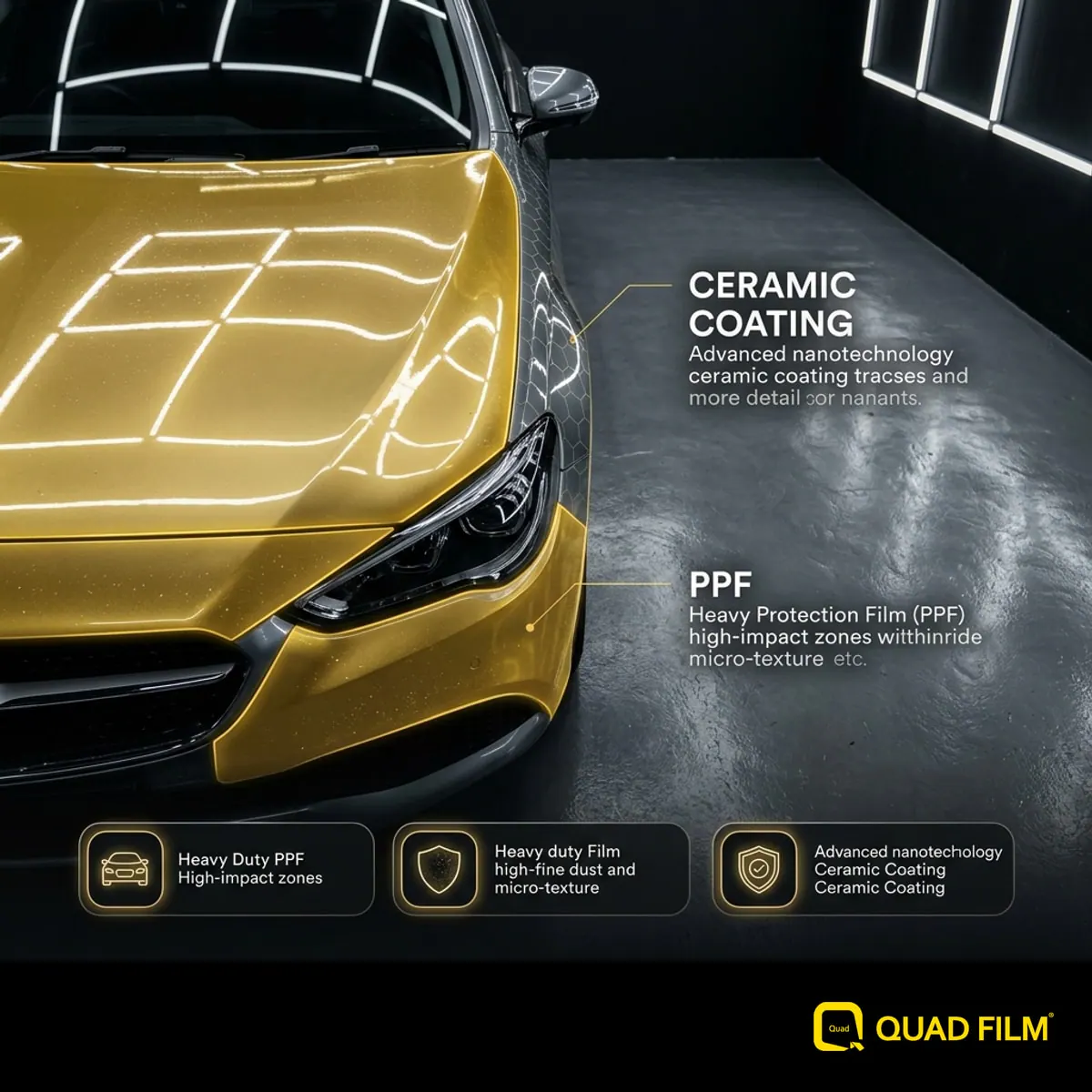
- Apply PPF on high-impact zones where your car takes the most physical punishment: front bumper, bonnet, headlights, side mirrors, door edges and rocker panels.
- Apply ceramic coating on the remaining body panels (roof, doors, rear quarter panels, boot lid, rear bumper) where physical impact risk is lower but you still want easy cleaning and UV protection.
- Some owners apply ceramic coating on top of PPF as well. This adds extra hydrophobic properties to the PPF surface, making the protected areas even easier to clean and giving a uniform gloss across the whole car.
This layered approach gives you physical protection where it matters most and surface-level maintenance benefits everywhere else. You do not overspend on full-body PPF for panels that rarely face stone chips, and you do not leave your front end exposed with only ceramic coating.
For realistic pricing on PPF coverage options in Malaysia, from partial front-end packages to full-body wraps, see our ppf price malaysia breakdown.
How Malaysian Weather Affects Both Options
Malaysia's tropical climate is one of the harshest environments for car paint. Here is how both protection options hold up:
UV exposure: Malaysia's UV index regularly hits 11 to 13+, which is classified as "extreme" by the World Health Organization. Both PPF and ceramic coating provide UV blocking. But PPF's thicker physical layer gives a more durable UV barrier that does not thin out or degrade as quickly.
Heat and humidity: Average temperatures of 30 to 35 degrees Celsius combined with high humidity accelerate the breakdown of chemical coatings. Ceramic coatings in Malaysia often need reapplication every 2 to 3 years to maintain full effectiveness. Quality PPF, by contrast, is designed to last 5 to 10 years in these conditions without yellowing or lifting when installed properly.
Heavy rain and flooding: Both PPF and ceramic coating handle rain well. Ceramic coating's hydrophobic surface excels here, causing water to bead and sheet off quickly. PPF with hydrophobic top coats (like the Quad Film QUARMOR series) offers similar water-repelling performance combined with physical protection.
Road conditions: Malaysian highways carry heavy trucks that drop gravel, sand and debris. City roads have potholes, construction zones and tight parking lots. These are physical threats that only PPF can address.
Common Myths About PPF and Ceramic Coating
"Ceramic coating is all the protection my car needs."
Not true if you are talking about physical protection. Ceramic coating cannot stop a stone chip, a door ding or a deep scratch. It protects the surface from chemical stains, UV and light marks, but it is not a barrier against impact.
"PPF turns yellow after a year."
This only happens with low-quality film or poor installation. Premium PPF uses anti-yellowing TPU materials. Quad Film's PPF range uses high-grade alicyclic HMDI-based TPU from Lubrizol, which is specifically engineered to resist yellowing, UV degradation and hydrolysis over the full warranty period.
"Ceramic coating lasts forever."
No ceramic coating is permanent. Most professional-grade coatings last 2 to 5 years before the hydrophobic effect noticeably weakens. In Malaysia's intense UV and heat, expect closer to the lower end of that range without regular maintenance.
"PPF is only worth it for luxury cars."
Any car you want to keep looking good benefits from PPF. A Honda City or Toyota Vios bumper repaint costs RM800 to RM1,500 per panel. After two or three stone chip repairs, you have already spent what a front-end PPF package costs. PPF makes financial sense for everyday cars too.
Making the Right Decision for Your Car
Here is a simple way to decide:
Start with what your car faces daily. If your commute involves highways, open parking lots, construction zones or heavy traffic where debris is common, PPF on the front end is the baseline you should consider. Add ceramic coating on the rest for easier maintenance.
If your car mostly sits in a covered garage and you drive short, low-risk routes, ceramic coating alone may be enough. You get the gloss, the easy cleaning and basic UV protection without the higher cost of PPF.
If your budget allows, the PPF + ceramic coating combination gives the best of both worlds. You get physical armour where your car needs it most and a clean, glossy surface everywhere else.
Compare what your car faces daily and let that guide your choice. If you want physical protection on the areas that take the most punishment, start with PPF on the front end and build from there.
Quad Film Protection Packages in Malaysia
Quad Film offers a full range of PPF products designed for Malaysian conditions, from the flagship QUANTUM (10 MIL, 7-year warranty, 99% self-healing) to the mid-range QUANTA (7.5 MIL, 5-year warranty).
For car owners who want the combined approach, Quad Film's Hybrid Packages bundle full front-end and bumper PPF with Gtechniq Crystal Serum Light ceramic coating, starting from RM3,600 for a standard-sized car. This gives you PPF protection on the highest-risk panels and professional ceramic coating coverage, all in one package.
To find an authorized Quad Film installer near you or get a recommendation on which protection setup fits your car and budget, visit quadfilm.com.my.
Frequently Asked Questions
Can ceramic coating be applied on top of PPF?
Yes. Applying ceramic coating over PPF adds extra hydrophobic properties to the film surface, making it easier to clean and giving a more uniform gloss across your entire car. Many detailers offer this as a standard add-on when installing PPF.
Which lasts longer in Malaysian weather, PPF or ceramic coating?
PPF lasts longer. Premium PPF carries warranties of 5 to 10 years and is built to handle tropical UV and humidity without degrading. Ceramic coating typically needs reapplication every 2 to 3 years in Malaysia's climate to maintain full performance.
Is PPF worth the extra cost compared to ceramic coating?
It depends on what protection you need. If your car faces stone chips, scratches and physical contact regularly, PPF saves you money on paint repairs over time. A single bumper repaint can cost RM800 to RM1,500. Two or three repairs and you have already matched the cost of a front-end PPF package.
Can I remove PPF later if I want to switch to ceramic coating only?
Yes. Quality PPF is designed to be removed without damaging your paint. The paint underneath should be in the same condition as the day the film was applied. After removal, you can apply ceramic coating directly to the clean paint surface.
Does ceramic coating prevent stone chips?
No. Ceramic coating is only a few microns thick and cannot absorb the force of a stone chip or gravel impact. Only PPF, which is 150 to 250+ microns thick, provides physical impact protection for your paint.
Protect your Investment today
Don't wait for stone chips to ruin your paint. Speak to our experts about custom PPF and Tinting solutions.