
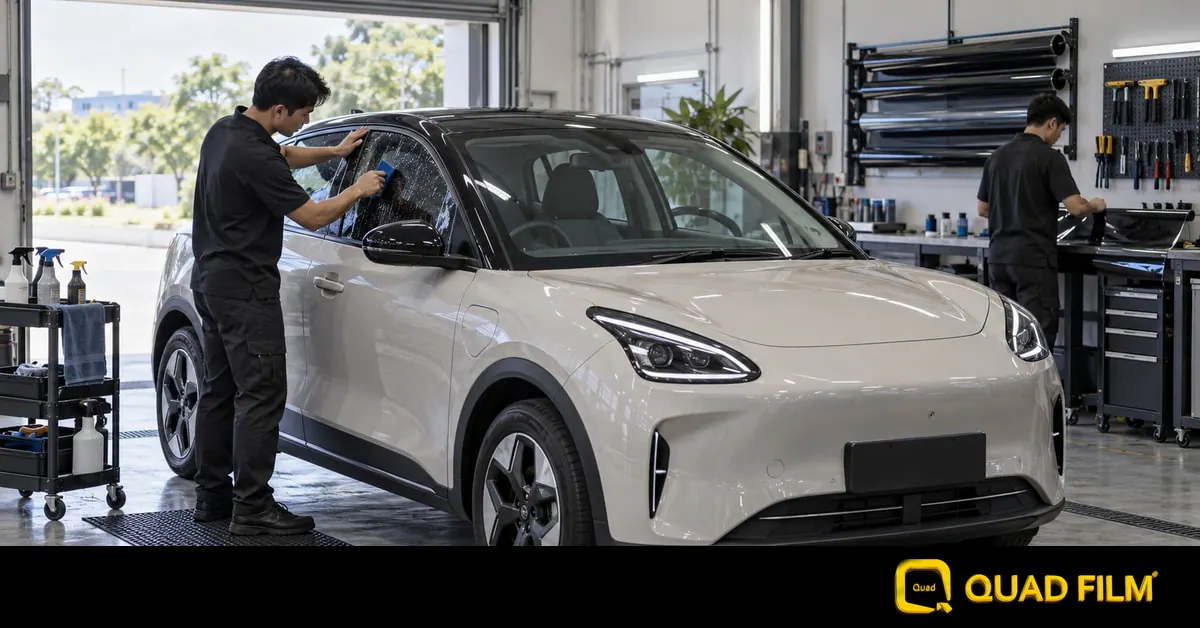
- Tint can reduce heat coming through the windows and may help the air con use less battery. It doesn't promise a set increase in driving range.
- VLT is the share of light that passes through the window. For private cars, JPJ requires at least 70% VLT on the front windscreen and 50% on the front side windows, measured through glass and film together. Rear windows have no minimum with two side mirrors fitted.
- TSER (total solar energy rejection) tells you how much of the sun's energy the glass and film reject together. IRR (infrared rejection) covers only the infrared part. Both figures need matching test conditions before you compare them.
- A darker film doesn't necessarily reject more heat, so it's worth asking the installer for the TSER and IRR of each film at the exact shade you plan to fit. A pricier film is worth it only when it rejects more heat, gives a clearer view or carries better warranty cover, in a way you'll notice.
- A finished-window reading checks the glass and film together. You can agree the measurement timing with the installer and keep the readings with your receipt and warranty card.
Proton eMAS 5 window tint should reduce heat coming through the glass without making your view too dark or taking the front windows below JPJ limits. A dark shade gives you privacy, but it won't tell you how much heat the film rejects. Our window tint range lists how much visible light each film lets through (VLT) and its infrared rejection, so you can compare series before asking installers for quotes.
If you are comparing packages before collecting your car, the useful question is which film and shade will go on each window. A useful car tint comparison names the film series, shade and ratings, rather than describing the package only as ceramic or premium.
Tint reduces heat, but range gains are unproven
Tint can reduce heat coming through the windows, which may reduce the work your air con has to do. However, we have no verified Proton eMAS 5 test showing how much extra range tint provides. Comfort is a reason to consider tint, but a promised gain in kilometres needs vehicle-specific evidence.
Proton eMAS 5 Prime has a 30.12 kWh battery and an advertised WLTP range of 225 km. Proton eMAS 5 Premium has a 40.16 kWh battery and a 325 km WLTP range. WLTP is a standard test used to quote driving range. It isn't a promise of how far you'll go on every drive, and neither figure tells you how many extra kilometres tint would add. Air con also draws power from the traction battery, so reducing its cooling load may help preserve energy for driving.
How much tint helps depends on the film, the weather, where you park and your air con settings. When comparing tint for Tesla and other EVs in Malaysia, published film specifications are more useful than an unsupported promise of extra range. Even with a high heat rejection film, a car parked in the sun still gets hot because heat keeps entering through the body and glass, which is why the cabin can take a while to cool down. Parking in the shade still leaves you with a cooler cabin to start with, so the air con has less work to do when you drive off.
NREL researchers have studied solar control glazing as a way to reduce vehicle air conditioning loads. Their study of solar and thermal control technologies supports that general principle, but it modelled US driving and weather conditions. It did not test Quad Film on a Proton eMAS 5, so its results cannot become a battery-saving percentage for your car.
A film’s heat rejection figure also cannot be applied directly to the battery. If a film has 70% total solar energy rejection, that does not mean the car uses 70% less air con power or gains 70% more range. Sunlight through the glass is only part of the heat entering the cabin. You are choosing tint to reduce that part, not to replace shade or air conditioning.
JPJ limits: 70% windscreen, 50% front sides
For a privately used Proton eMAS 5, the front windscreen needs at least 70% visible light transmission, or VLT, and front side windows need at least 50%. Rear windows have no minimum when the car has two side mirrors. These limits apply to the finished glass and film together.
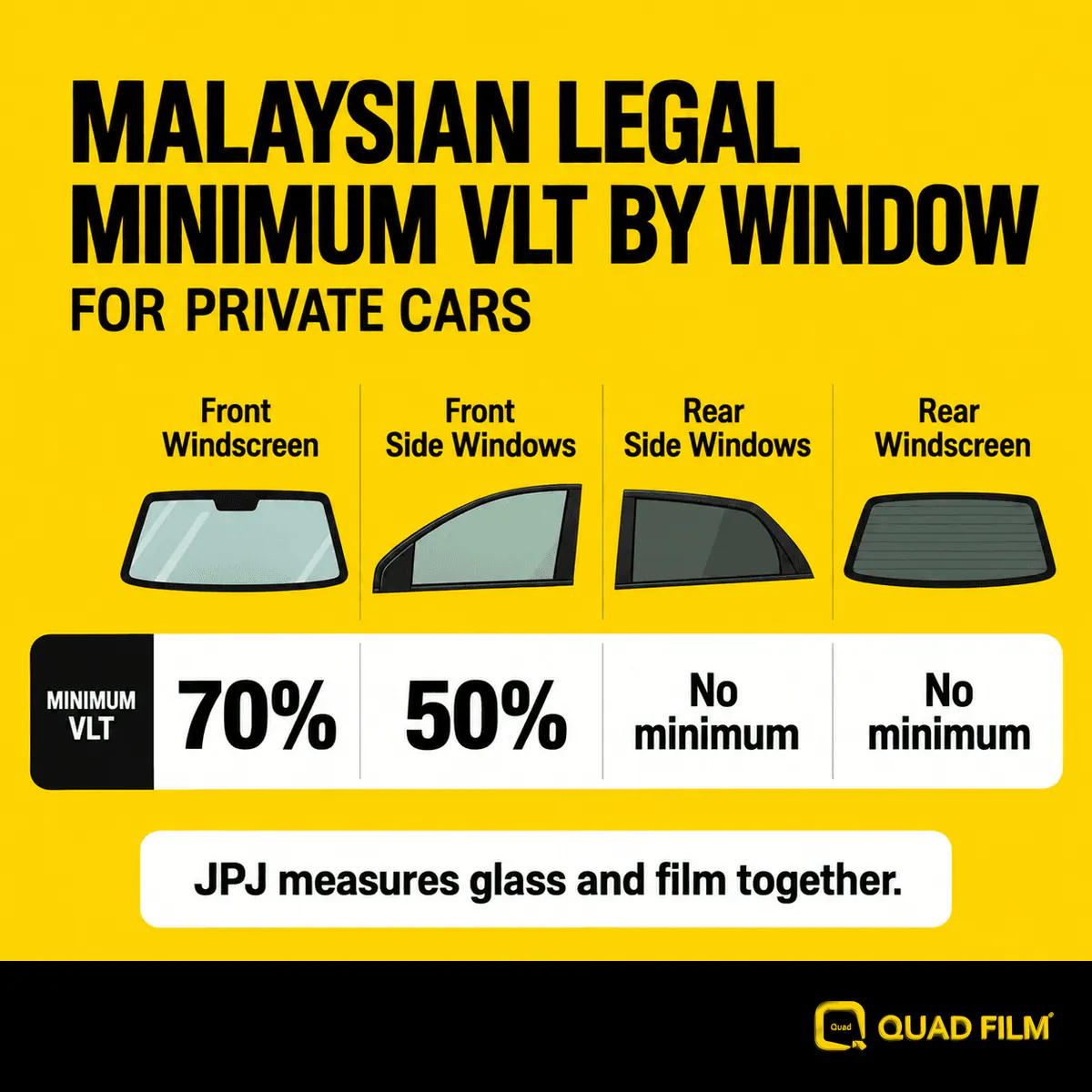
The Ministry of Transport’s parliamentary explanation sets out the private-car limits and mirror condition. PUSPAKOM’s clarification confirms that inspections assess glass and film together. Approved exemptions are separate from these ordinary limits.
| Window | Minimum installed VLT | What to look out for |
|---|---|---|
| Front windscreen | 70% | A light film, with the finished glass measured after fitting |
| Front side windows | 50% | Both front windows measured after fitting |
| Rear side windows | No minimum for private cars | A shade you can still see through comfortably at night |
| Rear windscreen | No minimum for private cars | Reversing visibility at night, and how the installer works around the thin heating lines in the rear glass |
Factory glass already blocks some light, so a film rated at 50% VLT will usually leave the finished window below 50%. A bare-glass reading helps the installer assess which film could leave the finished window within the limit. A reading after fitting checks the result. A film sold as “JPJ compliant” can still end up too dark once it's on your glass.
A film labelled 70% VLT may still leave your windscreen below the required 70% once fitted. We do not have bare-glass readings for your eMAS 5, so we cannot name a shade as automatically legal. The installer needs to allow for your glass when choosing it.
Rear shade is a separate choice. A legal dark rear window may still make a poorly lit carpark harder to see through, especially when reversing. You can compare fitted samples from inside the car rather than judging privacy only from outside. A clearer view matters more than matching the darkest car in the shop.
A darker film doesn't always reject more heat
Darkness only tells you how much visible light gets through, not how much heat the film keeps out. Heat rejection depends on the film and the glass it sits on, so a lighter film can keep out more heat than a darker one. Three figures help you compare:
- VLT tells you how much visible light passes through. Lower VLT means darker windows.
- IRR stands for infrared rejection. It measures how much infrared heat the film blocks. Infrared is only one part of the sun's heat, so IRR never covers all of it. Film makers also measure infrared over different ranges, so two IRR figures may not be measured the same way.
- TSER stands for total solar energy rejection. It tells you what percentage of the sun's energy the glass and film reject together in a test, covering more than just the infrared part.
A dark dyed film may give you privacy without the heat rejection you want, while a lighter ceramic or sputtered film can reject heat and still let more light through. That difference comes from what the window tint is made of, not its shade. For a buying comparison, similar VLT helps you compare heat rejection without changing the shade at the same time. Figures also need the same type of test glass and matching test conditions. A “99% IRR” claim on its own isn't enough to choose a film.
A lamp demonstration can show a difference under that lamp, but it cannot give you the same information as a full test specification. You can ask which infrared wavelengths were measured and whether the figure applies to the shade in your quote. Without those details, two identical percentages may describe different tests rather than equal performance.
Dyed, ceramic or sputtered: how they differ
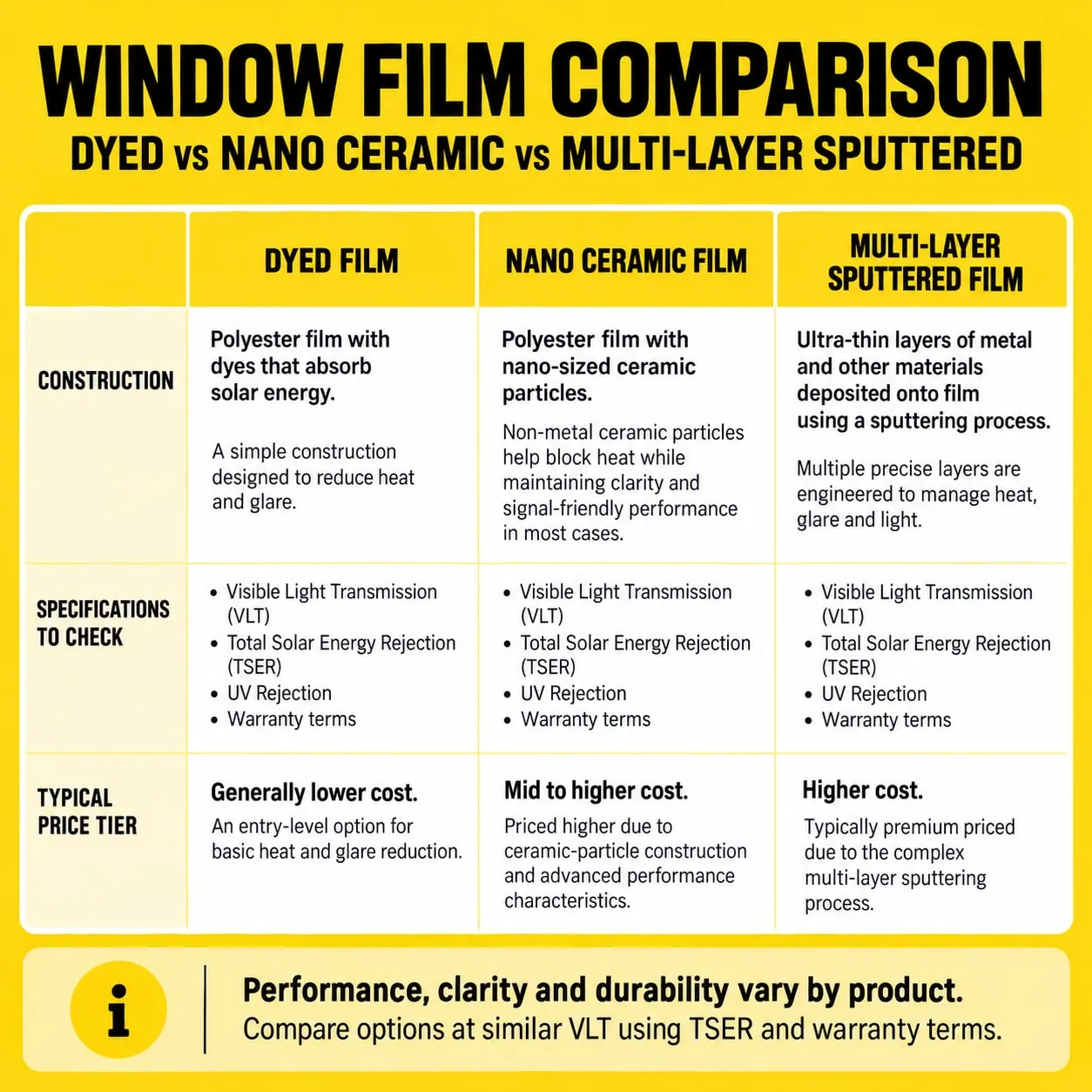
Dyed film mainly uses a dye layer for shade, while nano ceramic film uses ceramic particles without a metal layer. Sputtered film uses thin deposited layers that include metal. None of those names tells you the complete performance of a particular product. Its ratings, clarity and warranty still matter.
Many tint shops recommend ceramic by default, but the recommendation still needs to suit your driving and budget. Hybrid films combine ceramic and sputtered technology. Dyed film is generally a lower-cost option, but the exact product matters more than the material label.
How long a sputtered film lasts depends on how it is built and protected, including whether it uses a single-layer or multi-layer construction. Oxidation is a chemical change that can damage a film over time. Resistance to it depends on the product, so a material name cannot tell you when the film will need replacing. METALUX and MEGALUX are both multi-layer sputtered films and both come with warranty cover, so it helps to read the warranty terms alongside the quote. Two films made from the same material can still differ in heat rejection, in how long they last, and in clarity, meaning how clearly you can see through them, especially at night. The material name alone doesn't guarantee quality.
For the construction comparison below, the layers are schematic. A larger layer count is not a direct measure of how much cooler the car will feel. It describes how a film is built, while the test figures describe its measured performance under stated conditions.
Prices vary a lot between film types and shops. Your quote for a Proton eMAS 5 depends on the film series, the shade, how many windows are covered, the installer and whether old film has to come off first. An itemised quote that lists each window makes it easier to compare one shop against another.
Front tint must reject heat without becoming too dark
For your windscreen and front side windows, the finished glass must transmit enough visible light to meet JPJ limits. A film that rejects heat at a suitable light shade is useful here, but the legal result depends on your glass too. At the rear, you have more choice over privacy, provided you can still see comfortably.
The TSER range below runs from the lightest to the darkest listed shade in each series. A comparison at the same shade is more useful than comparing the ends of these ranges:
| Series | Film type | IRR | TSER |
|---|---|---|---|
| MATRIX | Nano ceramic | 99% | 60% to 73% |
| MAGNETRON | Hybrid sputtered and nano ceramic | 99% | 66% to 79% |
| METALUX | Multi-layer sputtered (24 layers) | 97% | 70% to 83% |
| MEGALUX | Multi-layer sputtered (48 layers) | 99% | 72% to 85% |
Our comparison lists 70%, 50%, 30%, 20% and 5% VLT options for these series. Those are product ratings, not installed readings or automatic recommendations for a particular window. We position METALUX for optical clarity and night driving, but that does not make a dark shade suitable for every driver.
Three of those four series share the same 99% IRR figure, so IRR alone won't separate them, and none of these ratings tell you how many degrees cooler your cabin will be. TSER gives you a second number to compare them on, and since it changes with the shade, it helps to compare it at the exact shade you plan to fit.
METALUX and MAGNETRON are our recommended series. MATRIX is the entry-level ceramic option to compare if budget is your main constraint. MATRIX uses nano ceramic technology and has a listed IRR of 99%. That still leaves the shade, total solar energy rejection and your view through the glass to consider. A darker sample does not automatically become the better choice because it carries the same series name.
If afternoon sun is your main complaint, a higher verified heat rejection figure may justify a higher quote. A pricier series is worth it when the film, at the exact shade you plan to fit, rejects more heat, gives you a clearer view or offers warranty cover that better suits your needs, not simply because it's the most expensive package.
You may prefer one series throughout, but that does not establish windscreen suitability or guarantee matching colour. Different shades can look different once fitted, even within one series, so a sample is more useful than a promise of a perfect match.
At the listed 70% shade, our comparison records TSER of 60% for MATRIX, 66% for MAGNETRON, 70% for METALUX and 72% for MEGALUX. These are product comparison figures, not measurements on an eMAS 5. Before treating the difference as a reason to upgrade, you can ask for the underlying test glass and conditions.
If you use a rear dashcam, recorded footage matters as well as your own view. A camera may struggle in a dark carpark even when a shade feels acceptable to your eyes. You can discuss the camera’s position before fitting and review night footage afterwards.
Tint fitting: preparation and glass protection
Your tint choice includes the fitting work, not only the film. Installers need clean glass, room to position the sheet and tools that will not damage the surface. You can ask how the shop protects the glass and nearby trim before the job, especially if old film needs removing.
Installers clean the glass before the film goes on, because dirt left beneath it can remain visible. They wet the loose film with application solution so it can be positioned before the solution is pushed out.
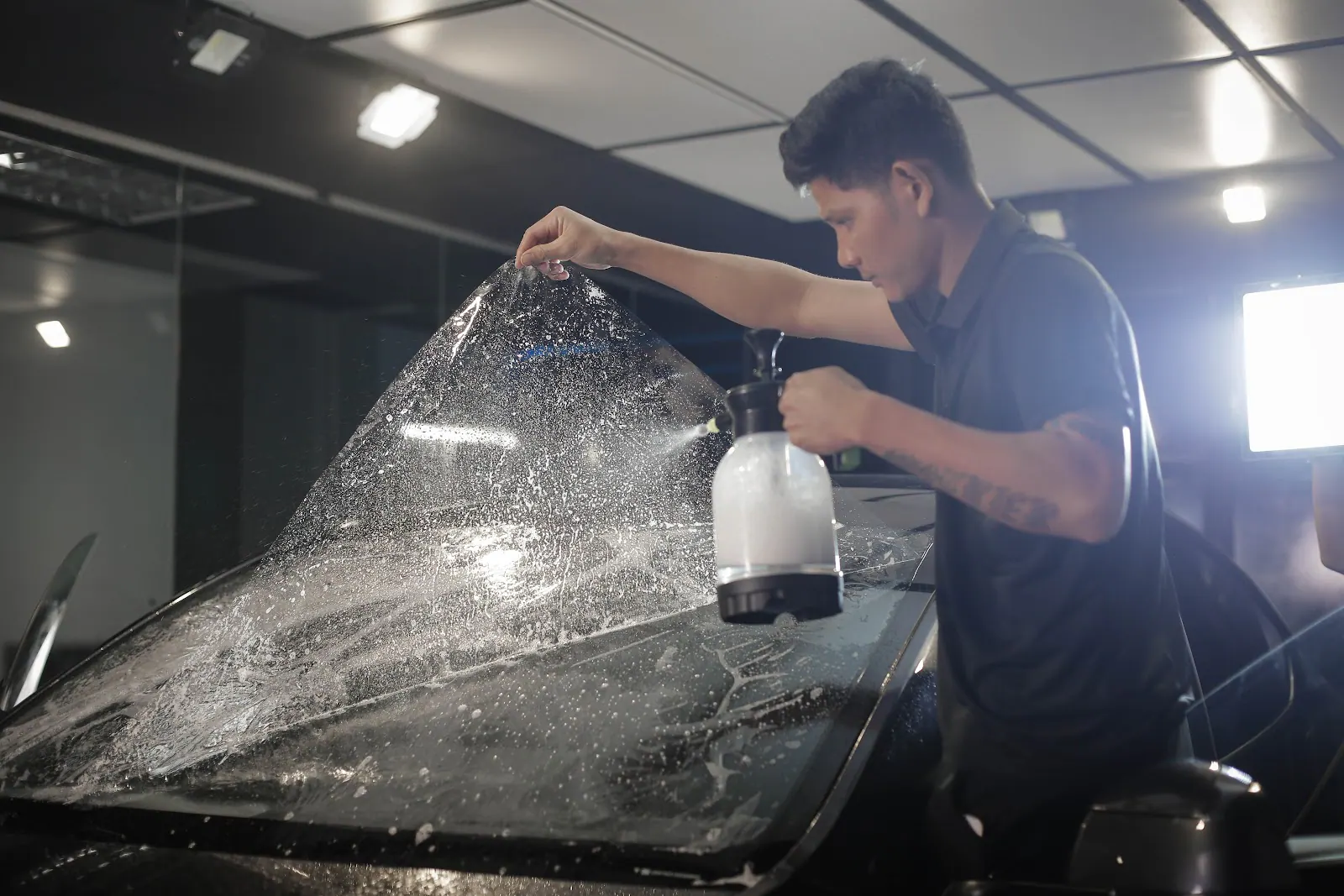
Inside the windscreen, the film needs to sit against curved glass. Our process includes shaping it for that curvature, then aligning and smoothing it on the inside surface. A squeegee pushes application solution out from beneath the sheet. This is why the quality of the fitting work matters as well as the film you selected.
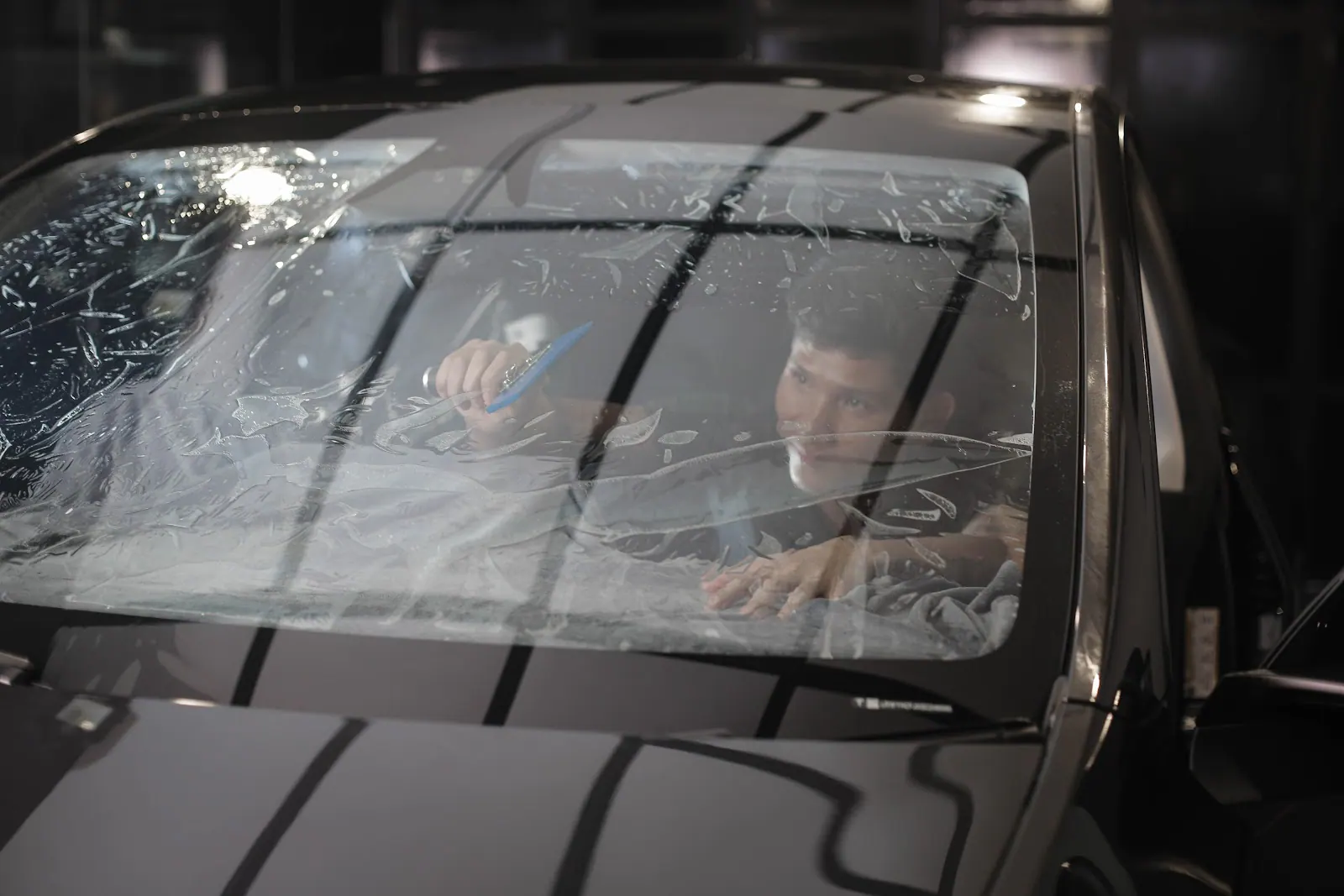
Glass protection matters during trimming as well as application. Our installation-details reel discusses protecting the surface when cutting and using suitable blades for different films. Before work starts, you can ask how the installer will avoid scratching the glass. The point is to understand the precautions, not to copy a cutting technique at home.
Water used during tinting also needs to be kept away from electrical components. You can discuss protection around the dashboard and door controls before work begins, rather than assuming an EV package covers every precaution. Water reaching switches or electrical connectors is an installation risk for car electronics, rather than proof that tint itself is unsuitable for an EV.
Before collection, you can look through the fitted glass from your normal driving position and check any concern with the installer. Drying instructions should name the film and the conditions of the job. You can agree when to return for a measurement rather than assuming every film dries on the same schedule.
Tint quotes: series, shade and warranty
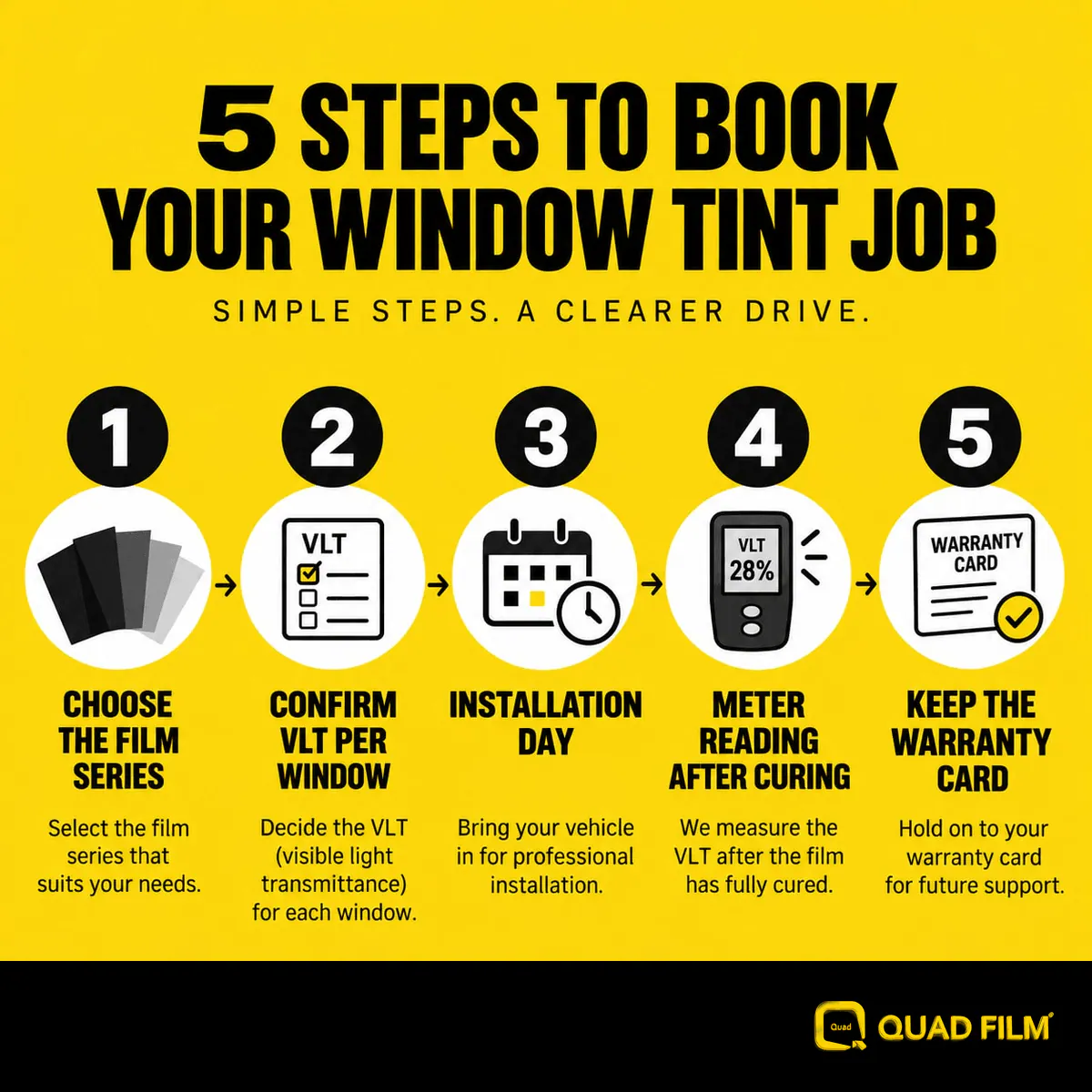
A written quote lets you compare the same job between installers and check what was fitted afterwards. It can identify the film for each window, the expected finished light transmission, the supporting test figures and the warranty terms. A package name on its own does not record those details.
- Which film series and shade will be fitted to each window.
- What the installed VLT is expected to be, allowing for your factory glass.
- IRR and TSER figures for those exact shades, including the glass and test conditions used.
- What the warranty covers and excludes, plus any removal charges.
- When the finished windows will be measured, following the film-specific drying and measurement guidance.
Keeping the final readings with your warranty card means you have them if the tint is ever questioned. If the shop can't measure your windows, getting them checked elsewhere is safer than relying on the film label.
A lower quote may exclude the rear windscreen or removal of existing film. A written window list makes those differences visible before you book, without relying on labels such as full car or premium package.
Your receipt and window plan record which film was fitted where. The final VLT readings record how much light passed through the completed windows when measured. Keeping those together with the warranty terms helps if you need to query the work or make a claim. It does not guarantee that a claim will be accepted.
eMAS 5 tint can reduce heat, not promise extra range
Tint can reduce heat coming through the windows, but the chosen shade must still leave a clear view and meet JPJ limits. A promise of extra driving range needs evidence specific to the eMAS 5. You can compare our window tint range and ask an authorised installer to measure your glass and quote a suitable film for each window.
Frequently Asked Questions
How much does it cost to tint a Proton eMAS 5 in Malaysia?
It depends on the film series, the shade, how many windows are covered and whether old film has to be removed first. We don't list a fixed price here because each of those choices changes the quote. An itemised quote from an authorised installer makes it easier to compare films by shade, heat rejection and warranty cover, not just the total.
What are the legal tint limits for a Proton eMAS 5?
VLT is the share of visible light that passes through the glass and film together. For a privately used Proton eMAS 5, the front windscreen must have at least 70% VLT and the front side windows at least 50%. Rear side windows and the rear windscreen have no minimum VLT for a private car with two side mirrors. Approved exemptions for darker front glass are a separate process.
Can window tint improve Proton eMAS 5 range?
It may help by reducing heat coming through the windows, so the air con may use less battery. How much difference it makes depends on the conditions, and there is no confirmed figure for extra range from tint on the Proton eMAS 5. Tint is better chosen for comfort and visibility than for a promised number of extra kilometres.
Is it worth tinting the Proton eMAS 5 windscreen?
Yes, if the film rejects a lot of heat while keeping the finished windscreen legal. At least 70% of visible light must pass through the glass and film together. It helps to compare TSER, which measures total solar energy rejection, as well as IRR, which measures infrared rejection. The installer can measure the finished windscreen to confirm it meets the limit.
Is ceramic tint enough for a Proton eMAS 5, or is sputtered film better?
A ceramic film may give you the heat rejection and visibility you need. TSER measures the total solar energy rejected by the glass and film together, while IRR measures infrared rejection. It's worth comparing ceramic and sputtered films at a similar shade, using figures tested on the same glass under the same conditions. Any improvement in heat rejection, clarity or warranty needs to justify the extra cost. A material name alone doesn't tell you which film is better.
How dark can I tint the rear windows on a Proton eMAS 5?
For a privately used Proton eMAS 5, JPJ sets no minimum percentage of visible light that must pass through the rear windows when the car has two side mirrors. Your choice still needs to leave you able to see when reversing at night. If you have a rear dashcam, its night recordings can help you judge whether the footage remains usable. A shade can be legal and still be too dark for you to see through comfortably.
Protect your Investment today
Don't wait for stone chips to ruin your paint. Speak to our experts about custom PPF and Tinting solutions.