
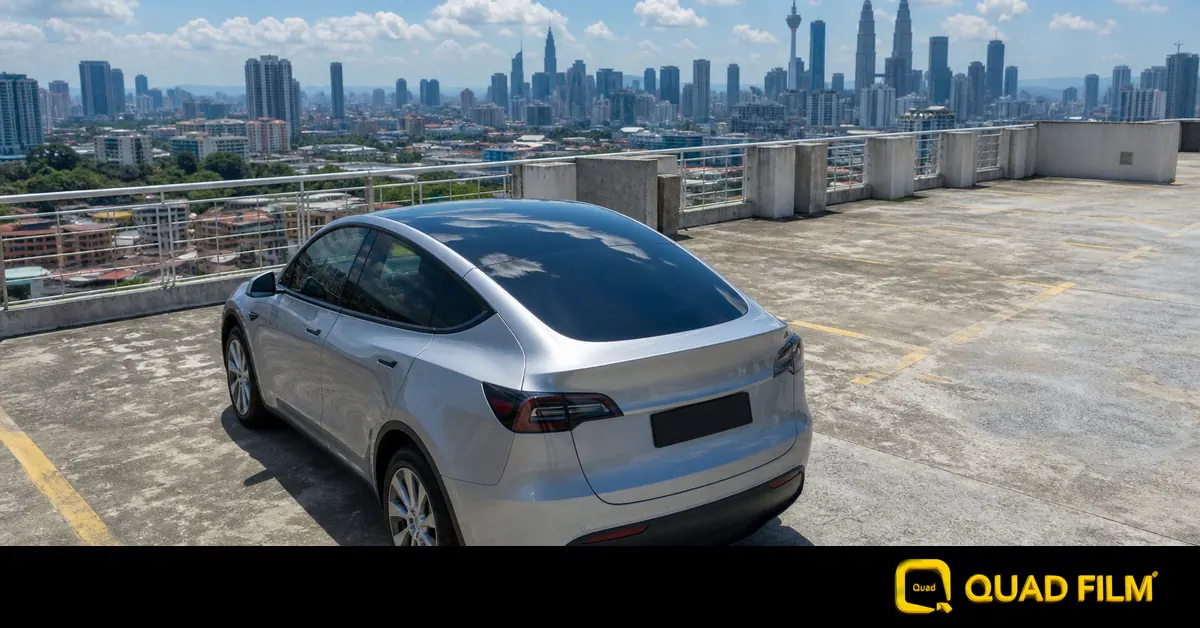
- The glass roof is the biggest single pane on your Model Y and the only one the sun hits square on at midday. It is the pane that decides how the cabin feels.
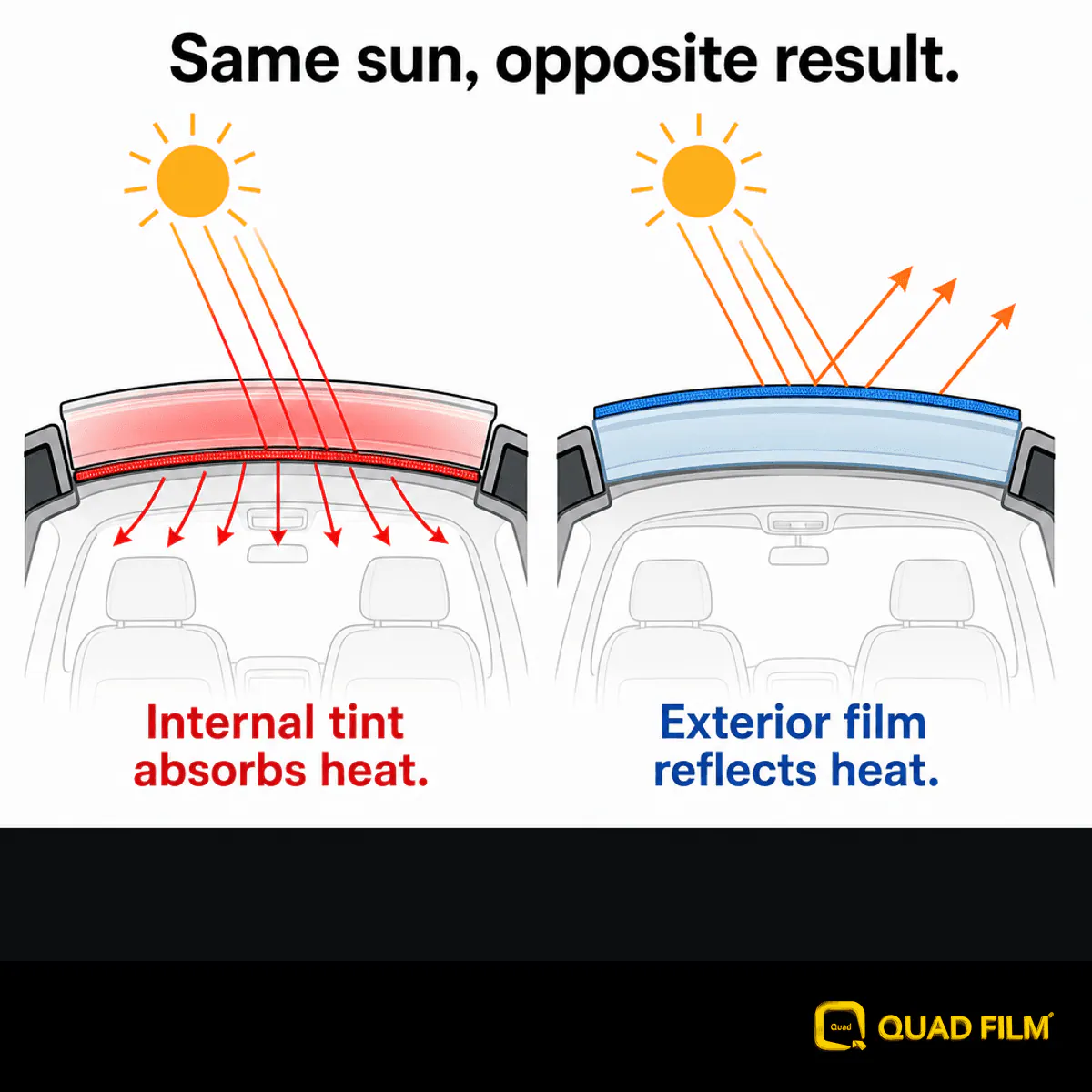
- Window tint is the wrong tool for it. Tint goes on the inside of the glass and works largely by soaking heat up. By the time it does anything, the roof glass above it is already hot and radiating down at you.
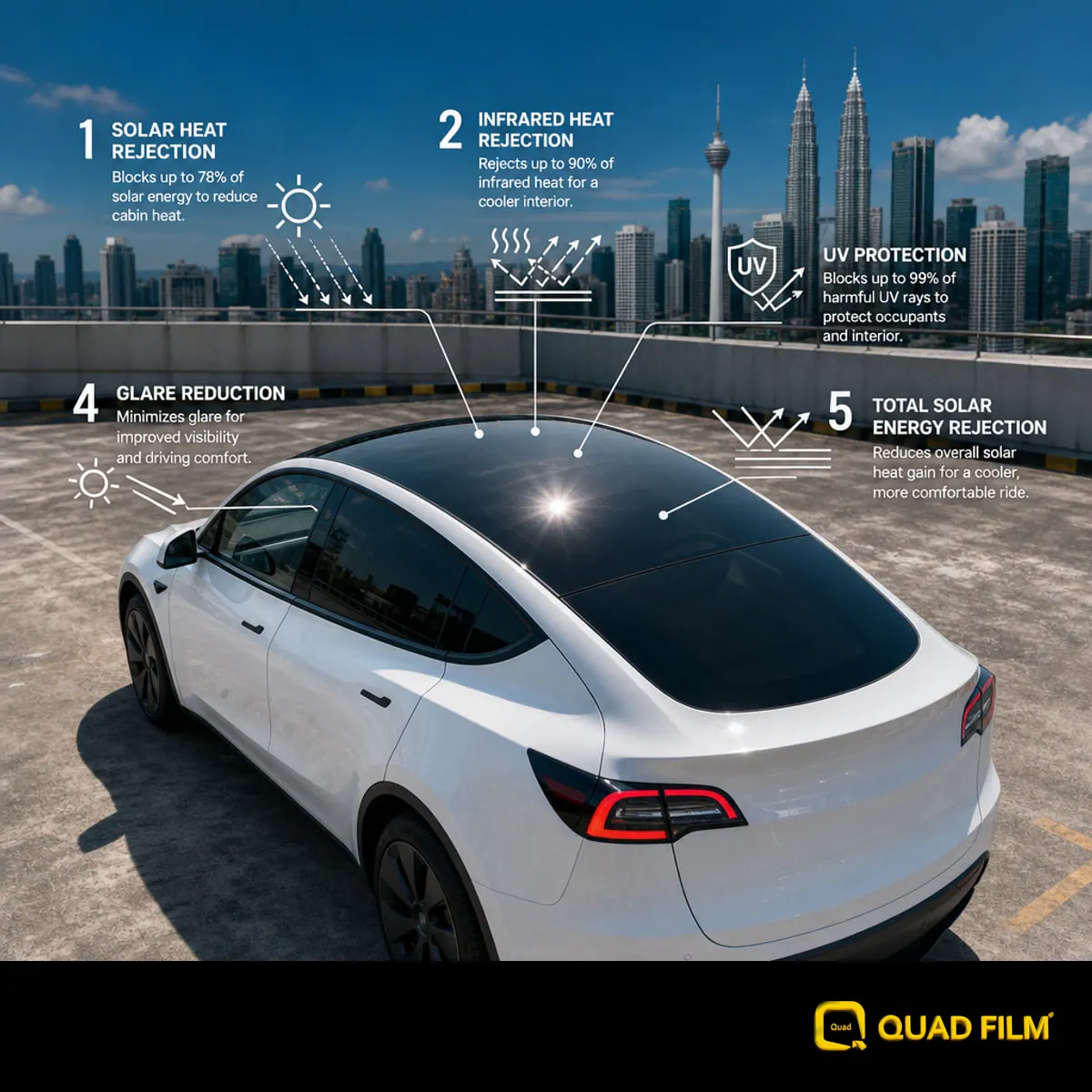
- Roof film goes on the outside and reflects. Quad EV Sunroof PPF reflects 95 percent of the heat and blocks 99 percent of UV before any of it reaches the glass.
- It keeps 72 percent light transmission, so you still get the view you paid for.
- On an EV the air conditioning draws from the same battery that moves the car. Quad's own testing showed a 10 percentage point battery difference over 140 km.
- For the side glass, shop on TSER, not on infrared rejection. They are not the same number and only one of them is what your cabin feels.
If you are looking at Tesla Model Y window tint in Malaysia, start at the roof and work down. That is the opposite of how most shops will quote you, and it is the reason so many owners come back three months later saying the cabin still feels hot.
The Model Y has more glass over your head than most cars have in total. Tesla fits it as one fixed panoramic pane, factory tinted with an infrared coating, and no sunshade unless you buy one. On a Malaysian afternoon that pane is doing more to your comfort than all four side windows combined. If you want the broader film comparison first, here is the best window tint for a Tesla in Malaysia.
This is the roof-first plan. What the roof actually needs, why it is not tint, and what to put on every other pane once the roof is sorted.
Why the Model Y Roof Cooks Your Cabin
Three things stack up on that roof and they all point the same way. It is large, it is flat to the sky, and it is directly above your head with nothing between it and you.
Every other window on the car is close to vertical. At midday in Kuala Lumpur the sun is almost straight up, so a vertical pane catches sunlight at a glancing angle and most of the energy skims past. The roof catches it square on. The same sunshine that barely troubles your door glass at 1pm is landing on the roof at full strength, across the biggest sheet of glass on the car.
Owners have been saying this since the car launched. On the largest Tesla owner forum there is a long-running thread where people describe the roof as too hot to touch and report the cabin sitting well above the outside temperature after an hour parked in the sun. Those are owners in countries where 30 degrees is a heatwave. Park on the top deck at Mid Valley at 1pm, come back after a two-hour lunch, and open the door. The air that hits you is coming off that roof. MG owners have the same complaint on the S5 EV, and we covered the same panoramic sunroof heat problem there.
Why Tint on the Roof Misses the Point
Here is the part nobody explains at the counter. Window tint and roof film sit on opposite sides of the glass and they do opposite jobs.
Tint goes on the inside. That is how window film works on every car, because the outside of a side window has to survive a rubber sweep scraping across it every time you drop the glass. Being on the inside is fine for a door, because a door window is small and vertical and the heat load is modest. On a roof it is a problem. Most of a tint's heat performance comes from absorbing energy and then shedding it, which means the glass above the film has to get hot first. You are effectively letting the roof heat up and then asking a film underneath it to deal with the consequences. Meanwhile the hot glass is radiating downward at the top of your head, which is exactly where you notice it.
Roof film goes on the outside, and it reflects. Quad EV Sunroof PPF is a metallised film that bounces the infrared away before it reaches the glass at all. The glass never gets the chance to warm up, so there is nothing to radiate down at you. This is the difference between stopping heat and coping with heat, and it is worth reading alongside heat rejection versus heat dissipation, because the two get sold as the same thing and they are not.
That is why a shop quoting you dark tint for the roof is answering a question you did not ask. Dark makes the cabin dimmer. It does not stop the pane above your head from becoming a radiator. If you have ever sat in a car with a heavily tinted sunroof and still felt the heat on your scalp, that is the mechanism, and no amount of extra darkness fixes it.
What Goes on the Model Y Roof Instead
Quad EV Sunroof PPF was built for this exact pane, on this exact kind of car. It is a magnetron sputtered film carrying 24 layers of rare earth metals, gold and silver among them, laid down in a vacuum chamber rather than dyed or coated on.
The numbers it delivers are the ones that matter for a roof. It reflects 95 percent of the heat. It blocks 99 percent of UV, which is what fades your dashboard and what reaches your skin through a pane you sit under for an hour a day. It holds 72 percent light transmission, so the roof still looks like a roof and you keep the open feeling you paid extra for rather than ending up under a dark lid. Quad's own testing puts the interior drop at 52 degrees down to 22 degrees.
It also does a second job that tint cannot. At 7 mil it is thick enough to hold the glass together. A panoramic roof is a large piece of glass over the heads of everyone in the car, and a film bonded across the whole of it absorbs and spreads impact rather than letting the pane let go all at once. That matters more on a fixed roof than on any other pane, because there is no frame breaking it into smaller sections.
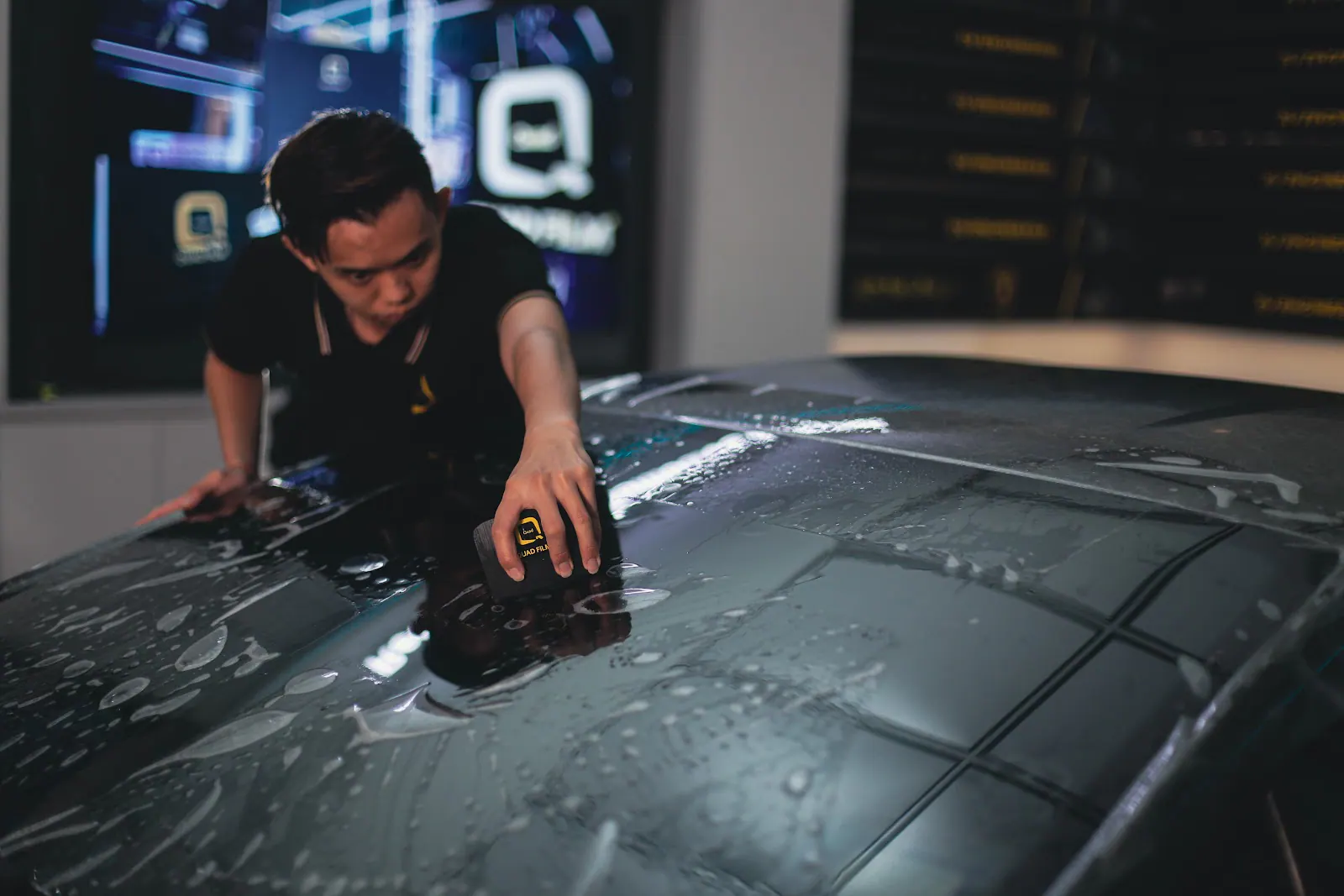
Fitting it is a different job from tinting a door, and worth knowing before you book. It goes on the outside, over a pane that curves in two directions and runs almost the length of the cabin, and it goes on as one piece. There is no B-pillar to hide a join behind and nowhere to lose a bad edge, so every millimetre of the trim line is visible from inside the car for as long as you own it. Ask to see a finished roof before you commit, and look along the edges from the driver's seat rather than from outside.
What a Hot Cabin Costs Your Battery
On a petrol car a hot cabin costs you comfort. On a Model Y it costs you range, because the air conditioning runs off the same battery that turns the wheels. Every degree the roof adds to the cabin is a degree the climate control has to pull back out, and it pays for that out of your driving range.
Quad ran the test. Ambient temperature 33 to 35 degrees, air conditioning set to 20 degrees, fan on level 10, starting battery 93 percent, 140 km covered. The car running Quad EV Sunroof PPF finished at 63 percent. The car running the comparison film finished at 53 percent. Ten percentage points of battery, over a single afternoon's drive, from nothing but what was on the roof.
That test was not run on a Model Y, so here is what the same saving is worth on one. A Model Y Standard Range carries roughly 78.4 kWh and is rated at 466 km, which works out at about 5.9 km for every kWh. Ten percent of that pack is about 7.8 kWh. Multiply it out and the saving comes to roughly 46 km of range still sitting in the battery when you arrive. That is Kuala Lumpur to Seremban and part of the way back, bought purely by keeping the roof cool. Panoramic roofs and EV range go together more than most owners expect, and we ran the same maths on the iCaur 03.
What to Fit on the Rest of the Glass
Once the roof is handled, the side glass is a much easier decision, and JPJ has already made half of it for you. Your front windscreen has to let at least 70 percent of light through. Your front side windows have to let at least 50 percent through. The rear side windows and the rear windscreen have no limit at all.
METALUX and MAGNETRON are the two series Quad officially recommends, and for a Model Y in Malaysia METALUX is the one to ask for. It runs 24 sputtered layers, blocks 99 percent of UV at every shade, and holds the highest optical clarity in the range, which is what you want on a car this quiet where you notice everything you see at night.
The windscreen has one extra condition on a Tesla. The car's cameras look forward through the top of the glass, so the film has to be cut cleanly around the housing and the shop has to know it is there before they start. Get that wrong and you are peeling a fresh windscreen film off a car you collected two days ago. This is a normal part of the job for anyone who works on Teslas regularly and a surprise for anyone who does not, which is most of the reason to ask the question up front.
| Pane | JPJ minimum light through | What to fit | Heat rejected | Why this one |
|---|---|---|---|---|
| Glass roof | No limit | Quad EV Sunroof PPF at 72 percent | 95 percent reflected | Sits on top of the glass and reflects before the pane heats up |
| Front windscreen | 70 percent | METALUX 70 | 70 percent | Clearest film in the range for night driving, and legal at the line |
| Front side windows | 50 percent | METALUX 50 | 74 percent | Four points more heat rejected than the same shade in MAGNETRON |
| Rear side windows | No limit | METALUX 20 | 80 percent | Privacy plus the strongest heat rejection you can run back there |
| Rear windscreen | No limit | METALUX 20 | 80 percent | Same reasoning as the rear sides |
One thing to check before you pay for the rear. Tesla ships the Model Y with factory privacy glass behind the B-pillar, so the back of your car is already dark and already stopping a good share of the heat before any film goes on. Adding METALUX 20 back there still buys you real heat rejection and near total UV blocking, but the jump you feel will be smaller than the jump you feel up front. If you are staging the work, the windscreen and front doors are where the money shows.
If you want the step above, MEGALUX runs 48 sputtered layers and adds two more points of heat rejection at every shade. If you would rather have a hybrid film with a ceramic layer in it, MAGNETRON is the one to ask about. All three block 99 percent of UV, so that part of the decision is already made whichever way you go.
Why TSER Beats IRR on a Spec Sheet
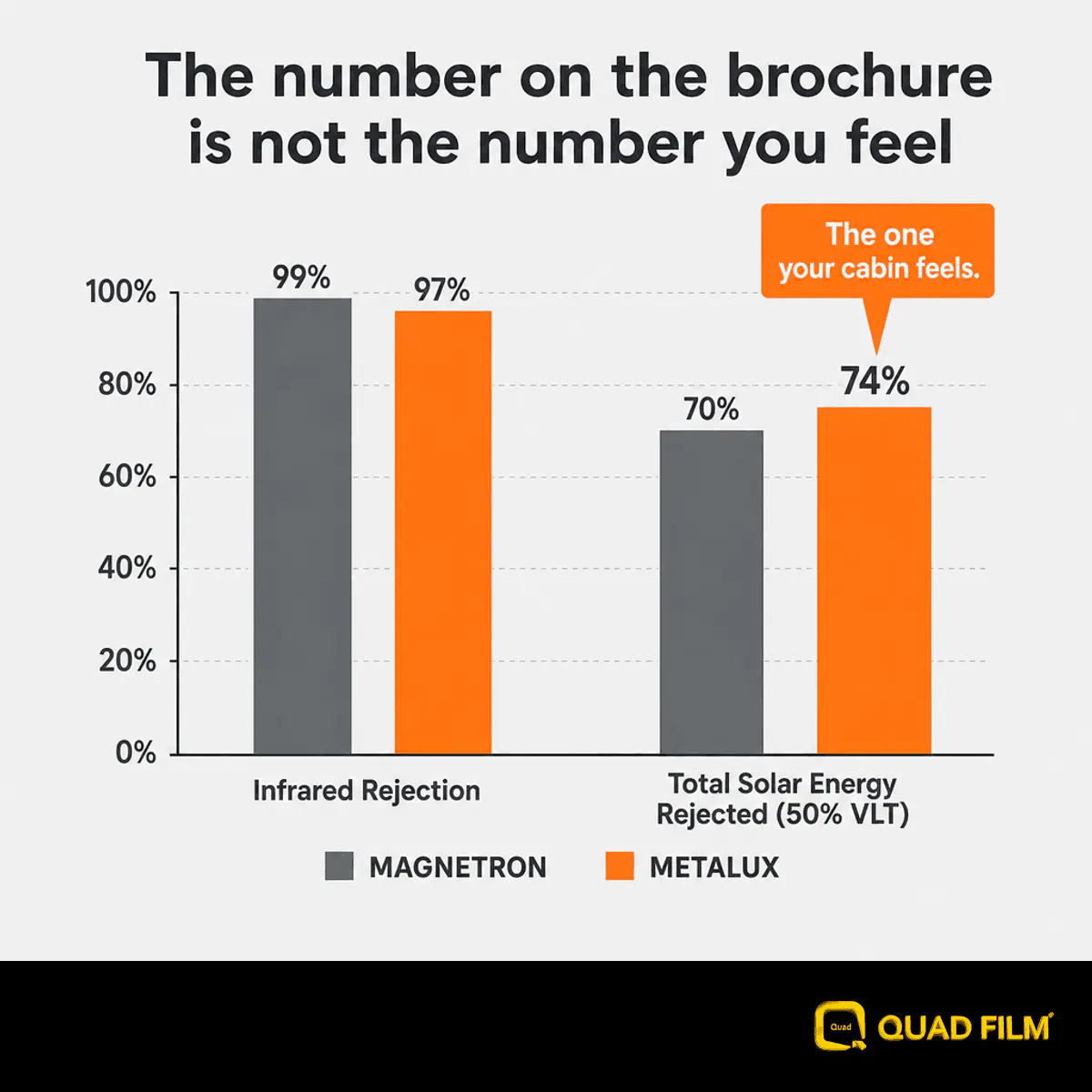
Walk into most tint shops and the first number you will be shown is infrared rejection. It is the biggest, roundest figure on the brochure and it sounds like the answer. It is not the number your cabin feels.
Infrared rejection only describes what a film does to one slice of sunlight. Total solar energy rejection, TSER, describes what it does to all of it, infrared and visible light and ultraviolet together. Sunlight arrives as a whole, your skin feels the whole thing, and a film can post a very high infrared number while letting plenty of the rest straight through.
Quad's own range proves the point better than any argument. MAGNETRON rejects 99 percent of infrared. METALUX rejects 97 percent. On the brochure MAGNETRON wins. Now look at TSER at the same shades. At 70 percent light through, METALUX rejects 70 percent of total solar energy against MAGNETRON's 66. At 50 percent, it is 74 against 70. At 20 percent, 80 against 76. METALUX is four points ahead at every single shade, on the number that decides how hot you feel, while losing on the number the sales script leads with. Ask for the TSER figure at the specific shade you are buying, not the headline infrared number, and if you want to understand why layer count changes any of this, sputtered versus multi-layer sputtered film covers it.
UV is the one number you can stop worrying about. Every series in the range blocks 99 percent of it, so nobody is going to win or lose your business on that line, and a shop leading with UV protection as though it were rare is telling you something about the shop rather than the film. Spend the conversation on TSER at your shade, on how many sputtered layers you are getting, and on who is doing the fitting.
Get the Roof Done Before the Rest
If the budget only stretches to part of the car right now, do the roof. It is the pane that changes how the cabin feels, it is the one you cannot shade any other way, and on an EV it is the one quietly costing you range every hot afternoon.
The side glass can follow later without any of it going to waste. Roof film and window film are separate jobs on separate panes, so nothing gets stripped and redone when you come back for the rest. Book them together if you can, because the car is in the bay either way and you only lose one morning instead of two.
When you call, ask three things. Whether the shop has fitted roof film on a Model Y before, whether they will give you the TSER figure at your chosen shade rather than the infrared headline, and how long the car needs to sit before you use the windows. A shop that answers all three without hedging is one that has done this properly, and very few installers handle sputtered film well.
Tesla Model Y Window Tint FAQ
Should you tint the Tesla Model Y glass roof?
Not with window tint. Window film goes on the inside of the glass and works largely by absorbing heat, which means the roof pane above it still heats up and radiates down at you. A reflective roof film fitted on the outside of the glass is the right tool for that pane.
Does the Tesla Model Y glass roof already block UV?
The factory roof is tinted and carries an infrared coating, so it is not bare glass. It is not the same as a dedicated film though. Quad EV Sunroof PPF blocks 99 percent of UV on top of whatever the factory glass is already doing.
What is the best film for a Tesla Model Y sunroof in Malaysia?
Quad EV Sunroof PPF. It is magnetron sputtered with 24 layers of rare earth metals including gold and silver, reflects 95 percent of heat, blocks 99 percent of UV, and keeps 72 percent light transmission so the roof still feels open.
Does a hot glass roof drain the Tesla Model Y battery?
Indirectly, yes. The air conditioning runs off the drive battery, so heat coming through the roof turns into range you do not get. Quad's own test over 140 km showed a 10 percentage point battery difference between a car with EV Sunroof PPF and one without.
Can you see through the Model Y roof after sunroof PPF?
Yes. Quad EV Sunroof PPF holds 72 percent light transmission, so it stays clearly see-through. You keep the open cabin feeling rather than ending up under a dark panel.
What tint percentage is legal for a Tesla Model Y in Malaysia?
At least 70 percent light through the front windscreen and at least 50 percent through the front side windows. The rear side windows, the rear windscreen and the roof have no legal limit.
Is sunroof PPF the same as window tint?
No. They sit on opposite sides of the glass and work differently. Window tint is fitted inside and mostly absorbs heat. Sunroof PPF is fitted outside and reflects it, and at 7 mil it also holds a large pane of glass together in a way tint does not.
Protect your Investment today
Don't wait for stone chips to ruin your paint. Speak to our experts about custom PPF and Tinting solutions.