
- Ceramic is the default recommendation in most shops because it is easy to install, high margin, and hard for a customer to judge on day one.
- The problem is rarely real nano-ceramic, it is cheap dyed or infrared-absorber film labelled as ceramic.
- Fade and heat loss usually show up only at year one to two, long after the shop has been paid and the install is forgotten.
- Ceramic still has a genuine place, so the answer is to ask the right questions, not to avoid the category.
If you have ever wondered why tint shops sell ceramic film to almost everyone who walks in, the honest answer is that ceramic often suits the shop as much as the customer. It is easy to fit, it carries a comfortable margin, and a buyer cannot tell a cheap version from a premium one on the day it goes on. That does not make ceramic bad, since genuine nano-ceramic has a real role, but it does mean the default quote deserves a few sharp questions. This guide explains the supply-side reasons behind the ceramic push and arms you with what to ask before you accept it.
The Ceramic Default: Why Every Shop Recommends the Same Thing
Walk into ten tint shops and you will likely hear the same recommendation, a ceramic film at a mid-range price. There is a reason it is so consistent. Ceramic film is forgiving to install, widely stocked, and easy to describe in simple terms a customer accepts. It is the path of least resistance for a busy shop. None of that is sinister on its own, but it does mean the recommendation is shaped by what is easy to sell, not only by what your car needs.
To see why this default is so consistent, it helps to break down what makes ceramic the comfortable choice for a busy shop floor.
- Forgiving on curved glass: Ceramic film conforms to rear screens and door glass with less skill than a metal stack demands, so a shop can train staff faster and turn cars around quicker.
- Always in stock: Because it sells in volume, ceramic-labelled film is kept on the shelf in every common shade, which means no waiting and no special order for the customer.
- Easy to describe: A salesperson can sell ceramic in one line about heat and clarity, while a multi-layer sputtered film needs a longer technical explanation most walk-in buyers will not sit through.
- Quietly profitable: The label covers a wide quality range, so the same word can sit on a cheap film and a genuine one, and only the shop knows which is on your car.
The Margin Math Behind Ceramic
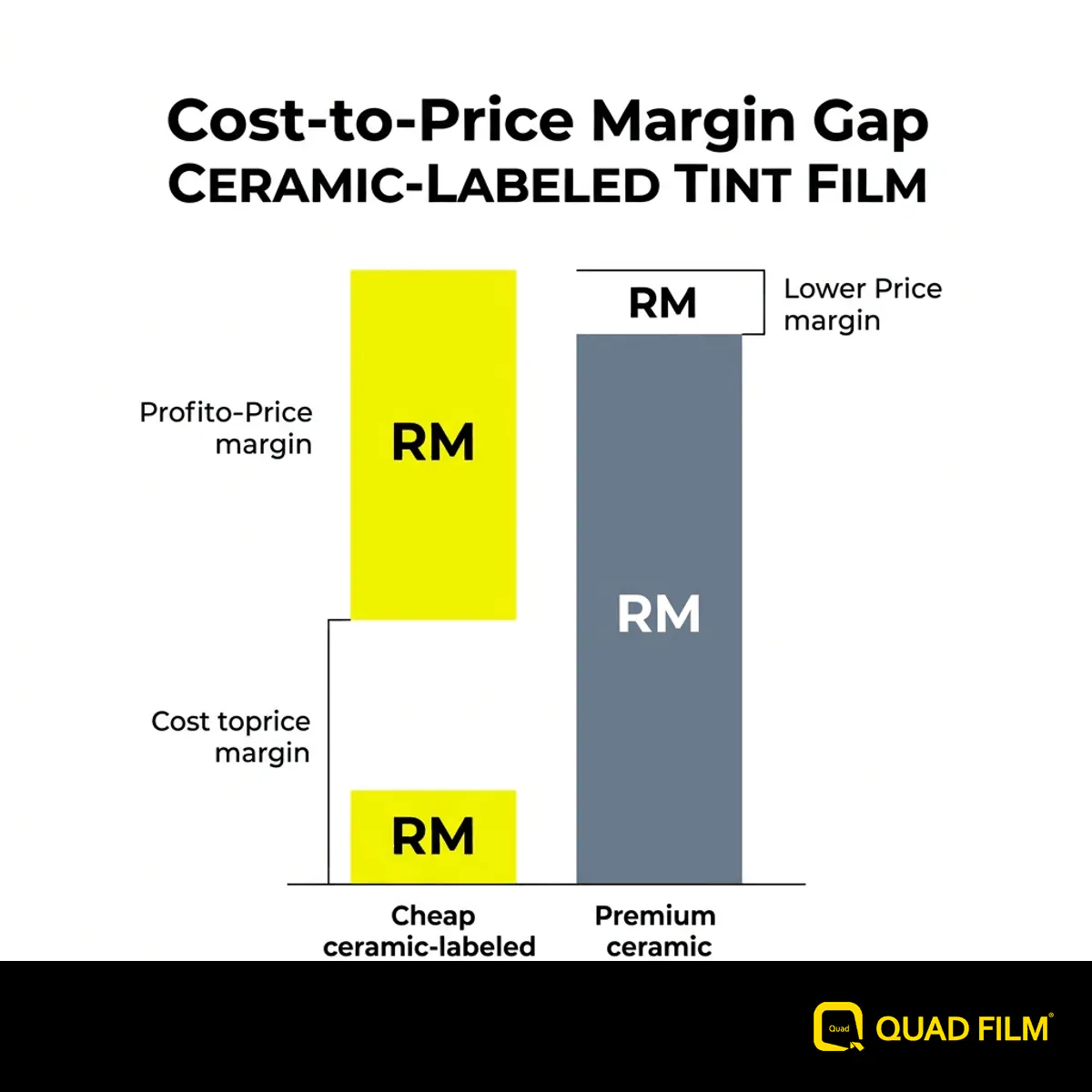
The commercial logic is simple. Film labelled as ceramic spans a huge quality range, from genuine nano-ceramic down to cheap dyed or infrared-absorber film that costs the shop very little. Because most customers judge tint by darkness and feel rather than by a spec sheet, a shop can fit a low-cost film under a premium-sounding name and keep a healthy margin. The wider the gap between what the film costs and what the customer will accept, the more attractive it is to push. This is why the cheapest ceramic-labelled options are recommended so often.
This is also where price anchoring quietly works against you. A shop can quote a ceramic film at a number that sounds premium yet still sits well below what an engineered film costs to buy and fit. For reference, genuine nano-ceramic from Quad Film, the MATRIX line, starts from around RM1,000 for a full car in the Standard range, while multi-layer sputtered film like METALUX runs around RM3,200 and the flagship MEGALUX around RM4,600. A vague ceramic quote landing between those numbers tells you nothing about what is actually going on the glass unless the series and warranty are named.
What the Margin Hides
The margin gap is not only profit, it is the reason corners get cut elsewhere.
- Material grade: A cheap film labelled ceramic may be dyed or carry a basic infrared absorber rather than engineered nano-ceramic particles, which is where the cost is saved.
- Warranty exposure: A film with a short or unwritten warranty costs the shop nothing in future claims, so a wide margin today carries no liability tomorrow.
- Install time: Ceramic fits faster than a metal stack, so labour cost per car is lower even before the film cost is counted.
Cheap Ceramic vs Premium Nano-Ceramic: Why You Cannot Tell at Year 0
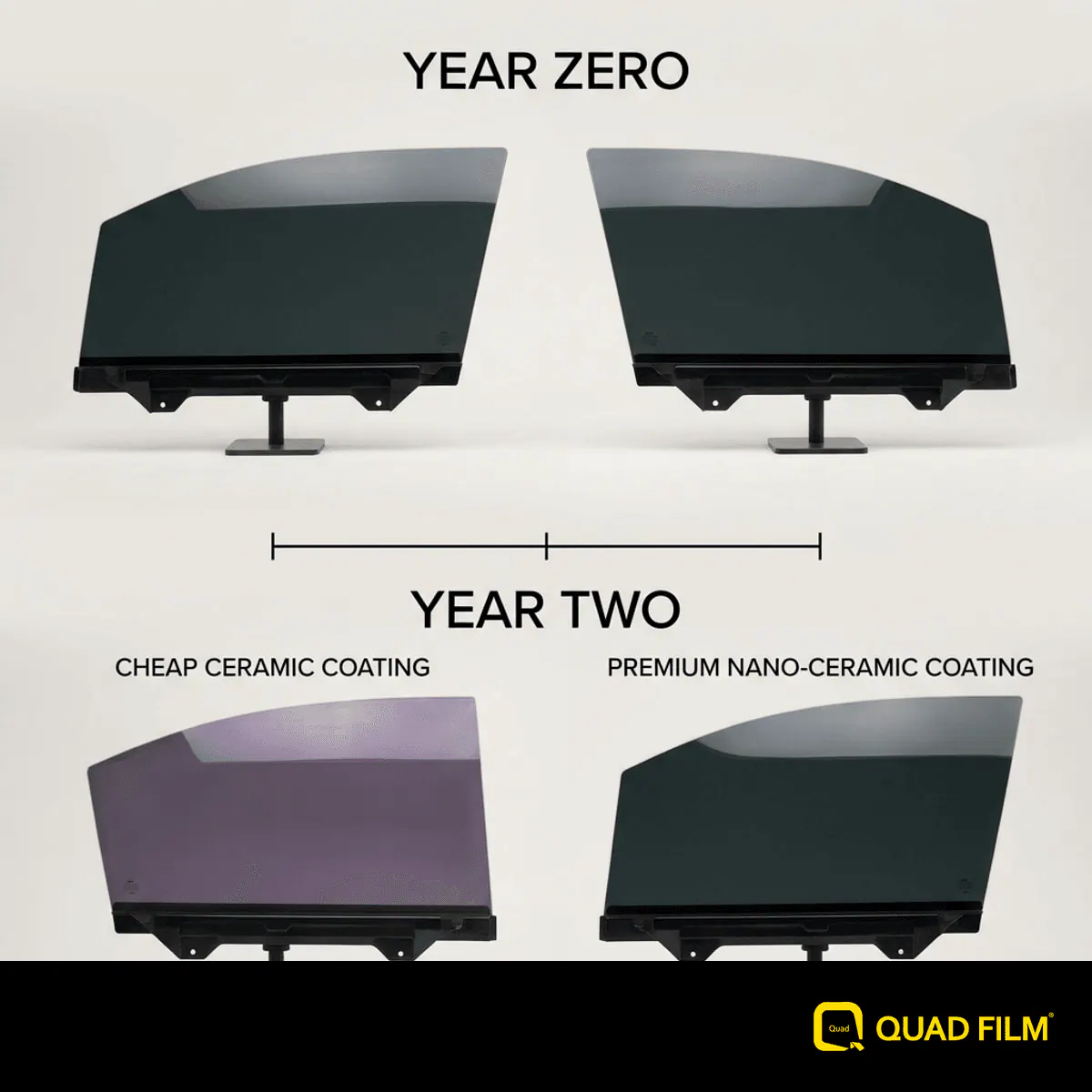
On installation day, a cheap ceramic film and a genuine nano-ceramic film can look almost identical. Both are dark, both feel smooth, and both cut some glare. The difference lives in the materials and shows up only with time. Genuine nano-ceramic uses engineered particles for stable heat rejection and colour. Quad Film MATRIX, for example, is a nano-ceramic film built from titanium nitride and zirconium oxide at 2 mil, with a 5-year warranty, a TSER of 60 to 73 percent, 99 percent infrared and ultraviolet rejection, and it is documented as SmartTag and RFID friendly. A cheap film carrying the ceramic label has none of that engineering, so it fades and loses heat rejection while the genuine film holds. You cannot see that gap at year zero, which is exactly why it is easy to sell the cheaper film. For the deeper material comparison, see our guide on nano-ceramic versus sputtered tint.
What Changes Between Year Zero and Year Two
The gap is invisible on install day and obvious by the second year. Here is what separates the two films as they age under Malaysian sun.
- Colour stability: Genuine nano-ceramic holds its neutral tone, while cheap film often drifts toward purple or bronze as the dye breaks down under UV that regularly hits 11 to 13 on the index.
- Sustained heat rejection: A real nano-ceramic film like MATRIX keeps its TSER of 60 to 73 percent, whereas a cheap absorber film loses heat performance as it degrades, so the cabin feels hotter each year.
- Clarity and haze: Quality film stays optically clean, while lower grades can haze or develop a milky cast that you notice most at night.
- Documented signal safety: MATRIX is non-conductive and documented as SmartTag and RFID friendly, which matters most on the windscreen where toll tags and cameras sit.
The No-Callback Advantage for Shops
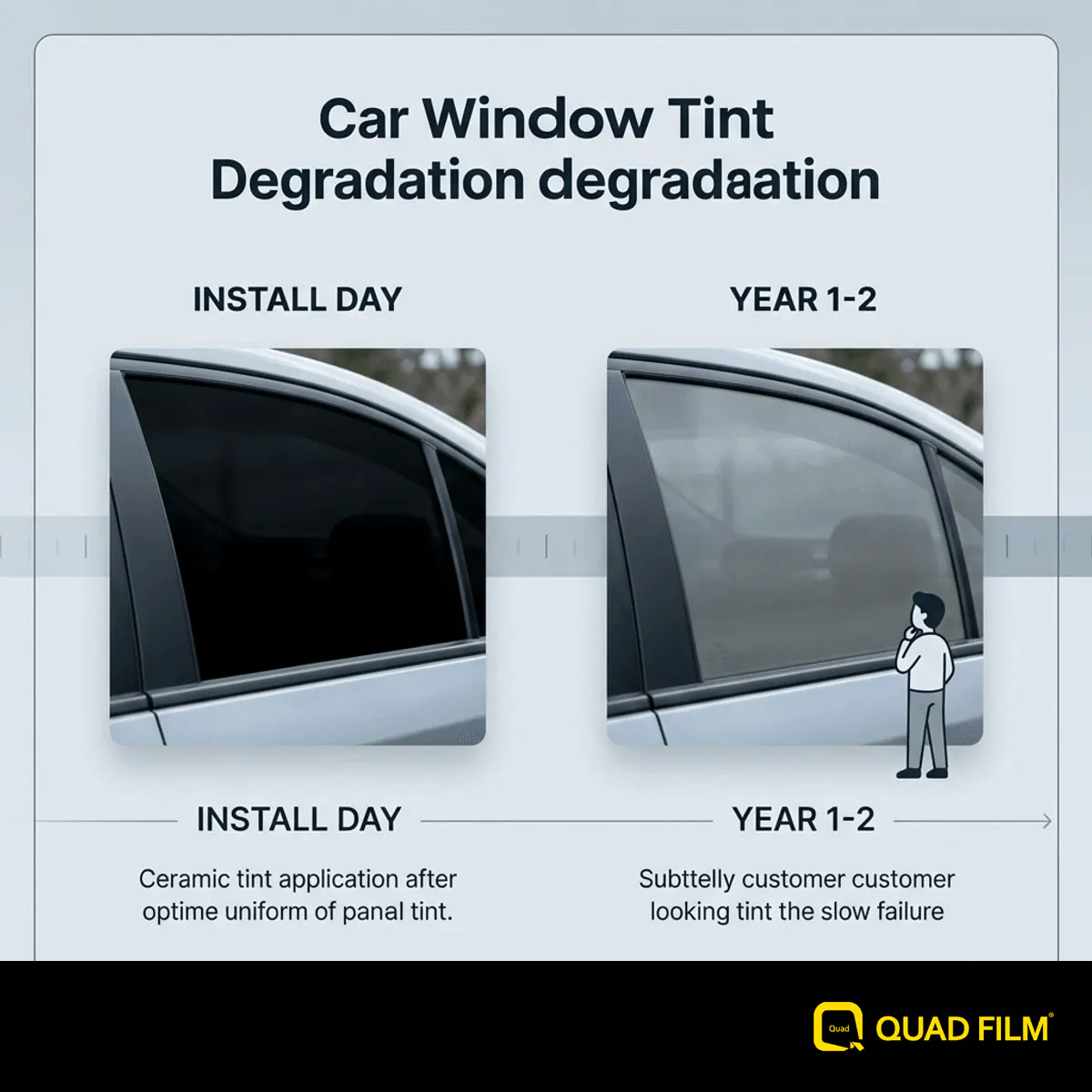
There is a quieter reason ceramic is convenient for shops. When a cheap film fades, it does so gradually around year one to two, not in the first weeks. By then the customer rarely connects the fade to the shop, blames general wear, and simply pays again somewhere else. A film that fails slowly and silently generates few warranty callbacks and little friction, which is good for the shop and bad for the buyer. A film with a real, long warranty does the opposite, since the shop has to stand behind it for years.
This dynamic is sharpened by how Malaysians use their cars. Daily heat above 35 degrees, open-air parking at mall lots, and long sun exposure on the daily commute all accelerate the fade of a weak film, yet the decline is gradual enough that it reads as normal ageing rather than a product fault. By the time the tint looks tired, the receipt is long gone and the shop faces no claim. A film with a genuine multi-year warranty, by contrast, ties the shop to your car for the life of that promise, which is exactly why a low-commitment film is the easier sell.
Why Shops Avoid Multi-Layer Sputtered Film
The flip side of the ceramic default is that many shops steer away from multi-layer sputtered film. It is harder to install, since the metal stack must be molded around curved glass without damaging the layers, and it carries a longer warranty the shop must honour. For a shop optimising for speed and low risk, that is less attractive even though the film lasts far longer for the customer. Quad Film multi-layer sputtered options like METALUX, a 24-layer film with a 10-year warranty and a TSER of 70 to 83 percent, and MEGALUX, a 48-layer film with a 15-year warranty and a TSER of 72 to 85 percent, hold their performance for years. The longevity that benefits you is exactly what makes them less convenient to push. You can read more in our guide on sputtered versus multi-layer sputtered tint.
How the Quad Film Range Compares
If you want to judge a quote on specification rather than sales language, it helps to see the three Quad Film options side by side using their published figures.
| Film | Construction | TSER | Warranty | Full Car from |
|---|---|---|---|---|
| MATRIX | Nano-ceramic, titanium nitride and zirconium oxide, 2 mil | 60 to 73 percent | 5 years | RM1,000 (Standard) |
| METALUX | 24-layer multi-layer sputtered | 70 to 83 percent | 10 years | RM3,200 |
| MEGALUX | 48-layer multi-layer sputtered | 72 to 85 percent | 15 years | RM4,600 |
The pattern is clear. MATRIX is the right genuine nano-ceramic choice for clarity, signal safety on the windscreen, and a sensible city price, while the sputtered films trade a higher price and a longer install for stronger sustained heat rejection and warranties that run for a decade or more. A shop optimising for a quick turnaround has every reason to steer you toward the faster fit, even when the longer-lived film is the better fit for a highway commuter.
What to Ask Before You Accept a Ceramic Quote
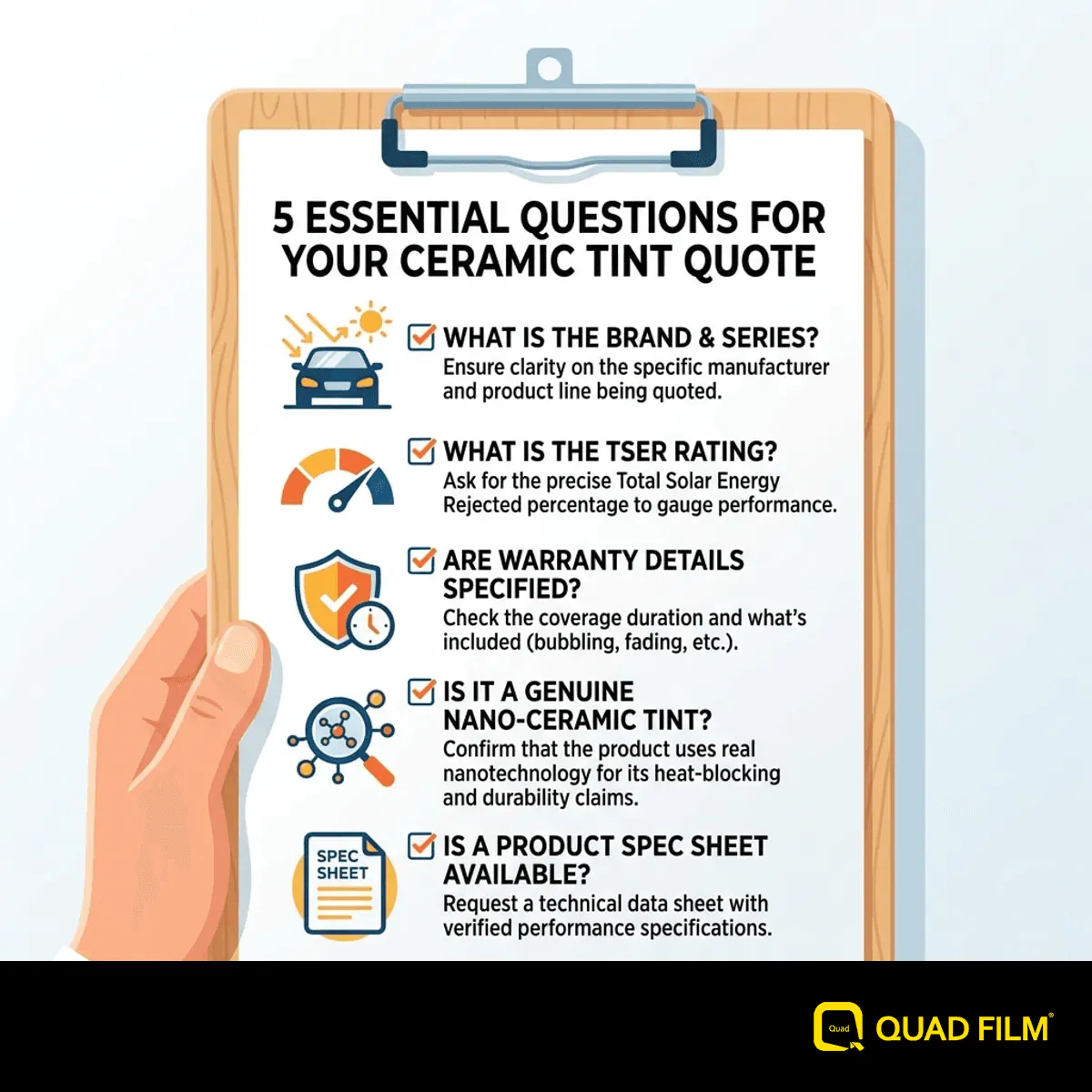
You do not need to reject ceramic, you need to qualify it. Before you accept a ceramic quote, ask these questions.
- What is the exact brand and film series, not just the word ceramic.
- What is the TSER figure, not only an infrared rejection number.
- What is the written warranty length, and does it cover fading and delamination.
- Is this genuine nano-ceramic, or a dyed or infrared-absorber film labelled as ceramic.
- Can you show the spec sheet and the warranty card before I pay.
A shop selling a genuine film will answer these without hesitation. Hesitation is your signal.
Red Flags to Walk Away From
Beyond the questions above, a few warning signs tell you the quote is built on the label rather than the film.
- No named series: If the shop will only say ceramic and cannot name the exact film line, you have no way to verify anything later.
- Infrared rejection only: A headline infrared number with no TSER figure hides total heat performance, which is the figure that actually reflects cabin comfort.
- No written warranty card: A verbal or lifetime claim with no document is not a warranty you can ever enforce.
- Price that looks too good: A premium-sounding film at a budget price usually means a cheap film under a borrowed name.
- Pressure to decide today: A genuine film at a fair price survives a day of thinking, so urgency is often a sign the margin depends on you not checking.
When Ceramic Is Actually the Right Choice
To be fair to the category, genuine nano-ceramic is the right film in several cases. It is non-conductive and signal friendly, which makes it the smart pick for the windscreen where cameras and toll tags sit. It suits city drivers who park indoors and want strong clarity at a sensible price, with MATRIX Full Car starting from around RM1,000 in the Standard range. The issue is never real nano-ceramic, it is paying a premium price for a cheap film hiding behind the ceramic name. Choose ceramic on purpose, not by default.
Where MATRIX Earns Its Place
Genuine nano-ceramic is not a compromise, it is the correct answer in specific situations.
- The windscreen: Because MATRIX is non-conductive and documented as SmartTag and RFID friendly, it is the safe pick for the front glass where toll tags, dashcams, and driver-assist cameras sit.
- City and indoor parking: Drivers who mostly commute in town and park in covered bays get strong clarity and a TSER of 60 to 73 percent without paying for the longest-life film.
- Real film on a sensible budget: At a full car from around RM1,000 in the Standard range, MATRIX lets you buy genuine engineered nano-ceramic rather than a mislabelled cheap film for a similar outlay.
The point is to choose it knowing what it is, with the series and warranty named, rather than accepting it because it was the only thing offered.
How to Choose
Decide based on how you drive and how long you keep the car. If you want the longest life and the strongest sustained heat rejection, ask specifically about multi-layer sputtered film and accept the longer install. If genuine nano-ceramic fits your needs, insist on a named series, a TSER figure, and a real warranty card. Either way, buy on the spec sheet, not the sales pitch. Ask a verified installer to quote a named film with its warranty in writing. You can compare the range on the Quad Film window tint page and find a vetted fitter through the installer directory.
Closing
The ceramic push is not a conspiracy, it is the predictable result of a film that is easy to fit, easy to mark up, and hard for a customer to judge. Knowing that, you can accept ceramic when it genuinely fits and reject it when it is just the convenient sell. Ask for the brand, the TSER, and the warranty, and the quote will tell you the truth. For more, start with our complete car tint guide, then read what cheap car tint actually gets you, the real cost of car tint in Kuala Lumpur, and why cheap film turns purple.
Frequently Asked Questions
Why do tint shops always recommend ceramic?
Because it is easy to install, widely stocked, carries a comfortable margin, and is hard for a customer to judge on day one. That makes it the convenient default, not always the best fit for your car.
Is ceramic tint worth it in Malaysia?
Genuine nano-ceramic is worth it, especially on the windscreen for clarity and signal safety. The trap is paying a premium price for a cheap film labelled as ceramic.
What is the difference between cheap and premium ceramic tint?
Premium nano-ceramic uses engineered particles for stable heat rejection and colour, while cheap ceramic-labelled film is often dyed or an infrared absorber that fades. They look similar at year zero but age very differently.
Is ceramic or sputtered tint better?
It depends on the glass and your goals. Nano-ceramic suits the windscreen and city use, while multi-layer sputtered film gives the longest life and strongest sustained heat rejection on the cabin glass.
How much should ceramic tint cost?
Genuine nano-ceramic such as Quad Film MATRIX starts from around RM1,000 for a full car in the Standard range. Judge value by the named series, the TSER, and the warranty, not the sticker alone.
Is ceramic tint better than sputtered tint for heat?
Not automatically. Quad Film MATRIX nano-ceramic delivers a TSER of 60 to 73 percent, while multi-layer sputtered films reach higher, with METALUX at 70 to 83 percent and MEGALUX at 72 to 85 percent. For the strongest sustained heat rejection on cabin glass, sputtered film leads, while nano-ceramic shines on the windscreen and for clarity.
Will ceramic tint interfere with my SmartTag or GPS?
Quad Film MATRIX is non-conductive and documented as SmartTag and RFID friendly, so it is the safe choice for the windscreen where your toll tag and cameras sit. This signal-friendly property applies to nano-ceramic, which is why it is the recommended film for the front glass rather than a metal-based option.
How can I tell if my ceramic tint is genuine nano-ceramic?
You cannot judge it by eye at year zero, so ask for proof instead. Request the exact brand and film series, the TSER figure rather than an infrared number alone, and a written warranty card before you pay. A genuine film such as Quad Film MATRIX comes with all three on request.
Protect your Investment today
Don't wait for stone chips to ruin your paint. Speak to our experts about custom PPF and Tinting solutions.