
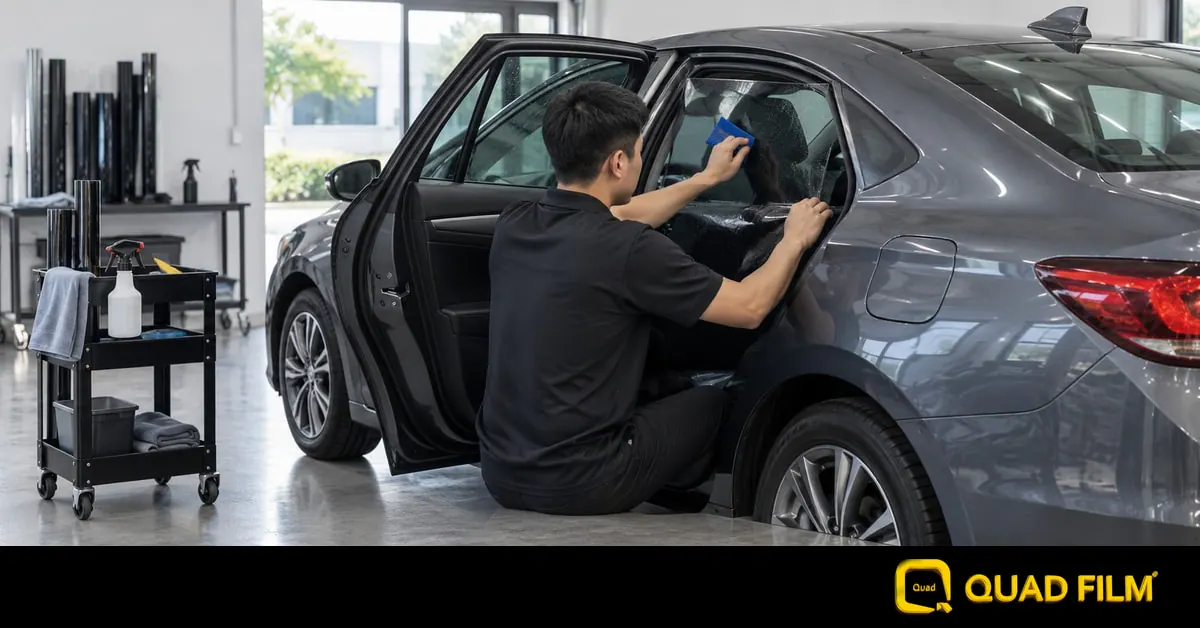
- Window tinting in Malaysia is about heat rejection and UV protection, not just privacy or looks. The right film keeps your cabin cooler and protects your skin and interior from sun damage year round.
- For private-use vehicles, visible light transmission (VLT) measures how much light passes through the glass and film together. JPJ requires at least 70% on the front windscreen and 50% on front side windows. Rear windows have no minimum under the applicable mirror conditions.
- TSER (Total Solar Energy Rejection) compares overall solar rejection when the test conditions match. Infrared rejection, or IRR, describes only infrared rejection and cannot predict cabin temperature by itself.
- Tint quotations depend on the film series, glass area, old-film removal and workmanship. Comparing the same coverage and written warranty terms makes quotes easier to judge.
- Before booking, you can check the installer’s warranty terms, JPJ compliance and film specifications.
For car tint in Malaysia, heat rejection and UV protection matter alongside how dark you want the windows. In hot, sunny conditions, the film does more than darken the glass. It affects how much solar energy and UV radiation pass through the windows, while cabin temperature also depends on parking conditions, ventilation and air conditioning.
If you are comparing tint shops, you can start with the film’s specifications, the installer’s workmanship and the written warranty terms. You can compare our window tint range by heat rejection, shade and the figures shown on each film’s spec sheet.
What window tint changes for your car
Window tint affects cabin heat, UV exposure, glare and privacy.
Malaysia sits near the equator, which means direct, intense solar radiation for most of the year. There is no mild season here. Your car is exposed to strong UV and infrared heat whether it is January or July.
Here is what the wrong tint (or no tint at all) costs you over time:
- Cabin heat buildup. A car parked under open sun can become uncomfortable quickly. Heat-rejecting film reduces solar energy entering through the glass, but it cannot stop every source of cabin heat or guarantee a particular cooling time.
- UV damage. Prolonged UV exposure fades leather seats, cracks dashboard plastics, and discolours interior trim. It also increases your risk of skin damage during daily commutes.
- Glare and eye strain. Malaysian afternoon sun, especially when driving westbound, causes serious glare. The right film reduces visible light glare without making it hard to see at night.
- Privacy and security. Darker rear windows keep valuables out of sight and add a layer of personal privacy for passengers.
How the five tint types differ
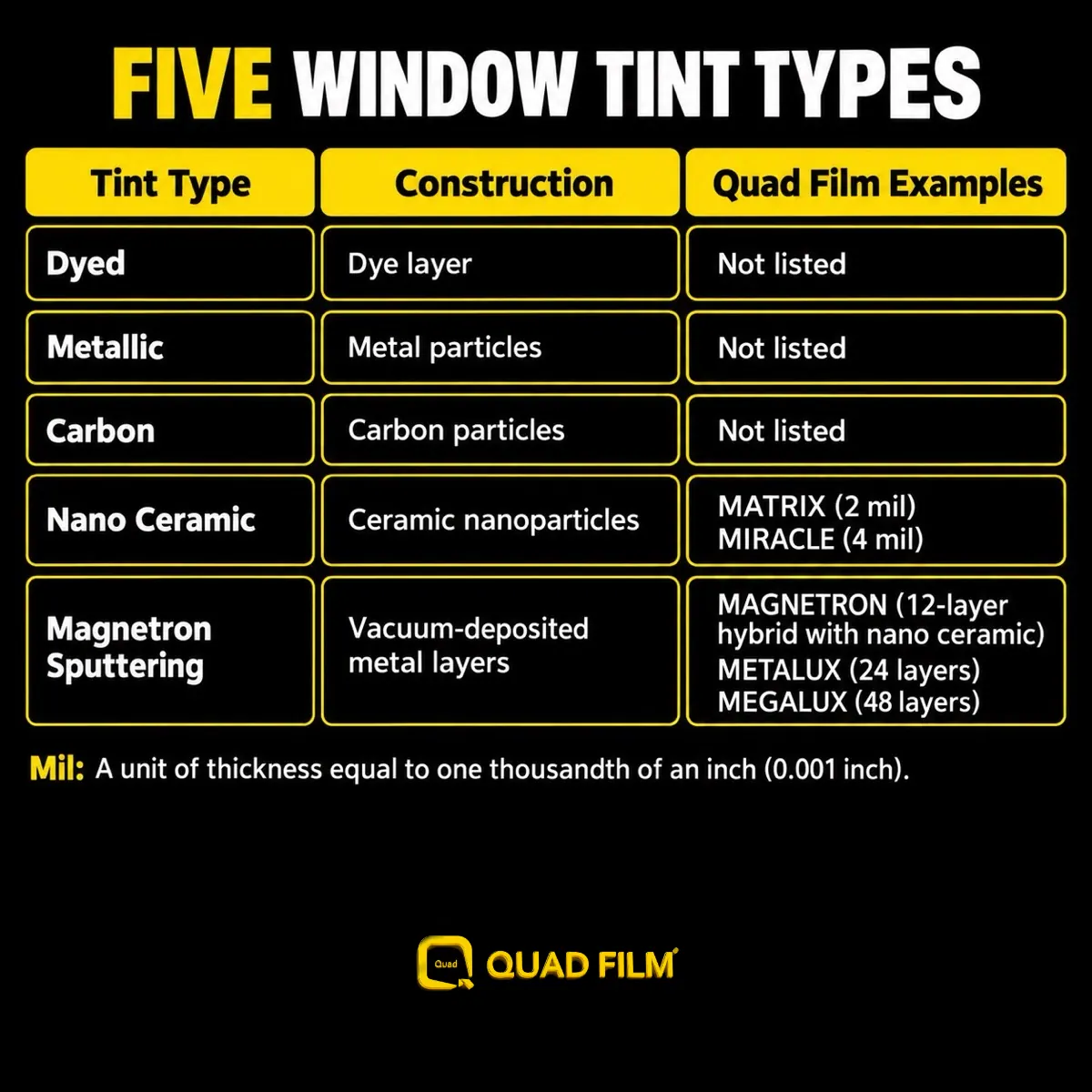
Not all window films are made the same way. The technology behind the film determines how well it blocks heat, how long it lasts, and how much it costs. Here is a breakdown of the five main types you will find in Malaysian tint shops.
Dyed Film
Dyed films are usually a budget option. They use a dye layer between an adhesive layer and a protective coating to darken the glass and reduce glare. Colour stability, heat rejection and warranty cover vary by product, so the spec sheet and written terms matter more than a category label.
Metallic Film
Metallic films contain metal particles that can reflect solar energy. Their heat rejection and durability depend on the product. The metal can also weaken radio-frequency signals used by GPS, phones and RFID. These signal problems are a tradeoff worth discussing with the installer, rather than assuming every metallic film behaves the same way.
Carbon Film
Carbon films use carbon particles rather than a metallic layer. That avoids the metal-related RF concern, but does not guarantee reception for every device. Their heat rejection, colour stability and price vary by product. They are another option for drivers comparing dyed, ceramic and sputtered films.
Nano Ceramic Film
Nano ceramic films use ceramic nanoparticles to reject solar energy and UV while maintaining clarity. Our non-metallic MATRIX and MIRACLE films are listed in our product data as allowing radio-frequency (RF) signals through, unlike our metallic sputtered series. Reception still depends on the device and installation. MATRIX uses Titanium Nitride (TiN) and Zirconium Oxide (ZrO2) nanoparticles and is rated at 99% IRR.
Magnetron Sputtering Film
Magnetron sputtering uses a vacuum chamber to deposit thin metal layers onto a PET plastic base. Our range includes MAGNETRON’s 12-layer sputtered and nano-ceramic hybrid, METALUX’s 24-layer dual-cycle construction and MEGALUX’s 48-layer four-cycle construction. Their IRR figures range from 97% to 99%, with TSER up to 85% for MEGALUX’s darkest listed option. Layer count describes construction, not a universal performance ranking.
Ceramic and sputtered films use different constructions, but the category name alone does not settle which will work better for your car. Solar energy can be reflected, absorbed or transmitted. Comparing TSER at the same VLT and under matching test conditions is more useful than assuming every sputtered film outperforms every ceramic film. After long outdoor parking, the cabin will still need ventilation and air conditioning.
JPJ Tint Regulations: VLT Limits You Need to Know
JPJ (Jabatan Pengangkutan Jalan) sets minimum light-transmission levels for vehicle glass. PUSPAKOM’s clarification confirms that inspections assess the combined VLT of the original glass and added film, not the film rating alone. Non-compliant readings can lead to enforcement action or a failed applicable inspection.
For private-use vehicles, the Ministry of Transport’s explanation gives these limits. The rear-window allowance depends on the vehicle having the required rear-view mirrors. Owners of commercial or other vehicle classes need to confirm the applicable rules rather than assume the private-use allowance applies.
- Front windscreen: Combined VLT of at least 70%
- Front side windows (driver and passenger): Combined VLT of at least 50%
- Rear side windows: No minimum VLT under the private-use mirror conditions
- Rear windscreen: No minimum VLT under the same conditions
What this means in practice: A film labelled 70% VLT does not automatically keep a windscreen legal, because the glass already blocks some light. The finished windscreen must measure at least 70% combined VLT and the front sides at least 50%. Rear darkness remains a visibility choice even where the private-use rules allow it.
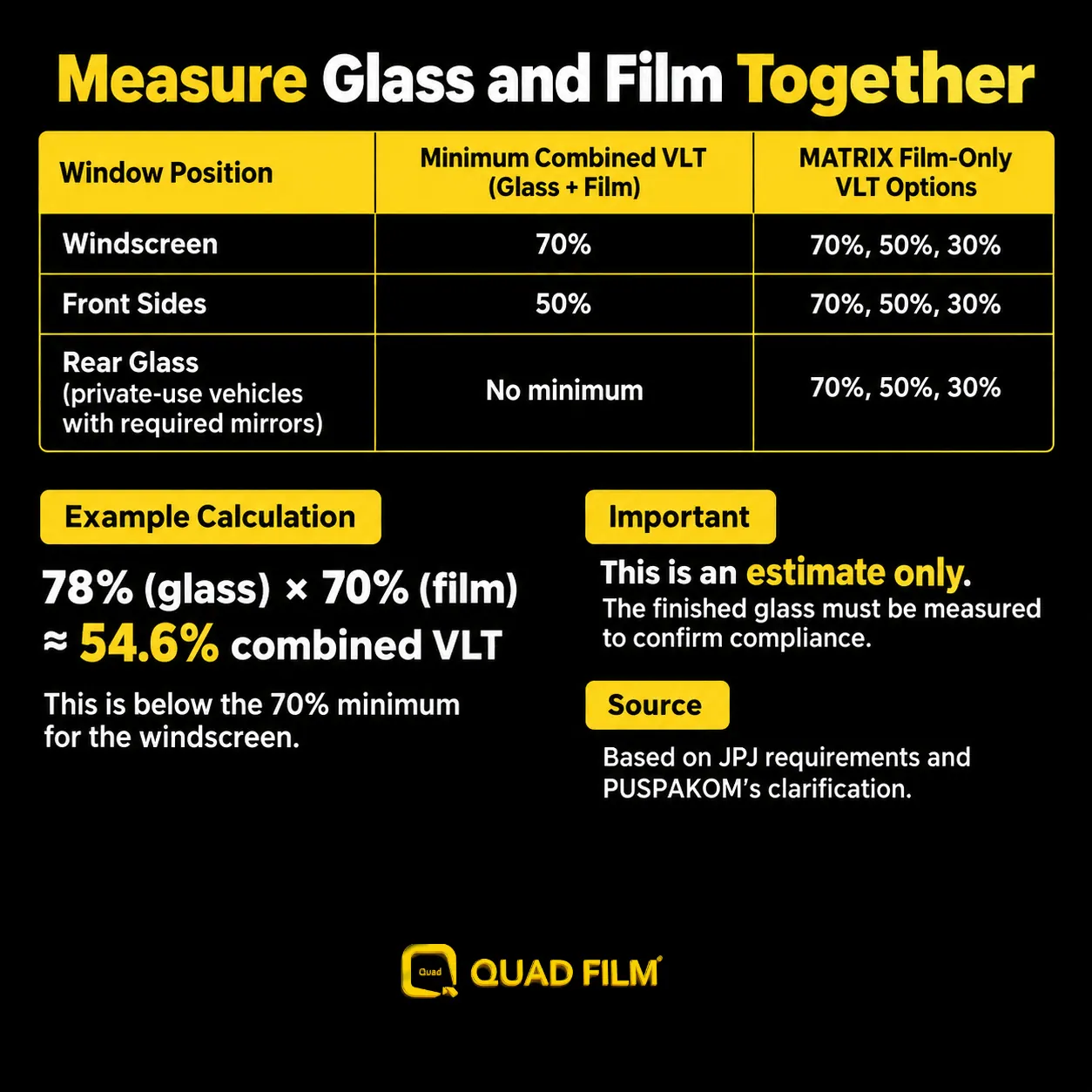
The film’s stated VLT and your car’s glass VLT are separate figures. For a hypothetical example, 78% glass VLT multiplied by 70% film VLT gives approximately 54.6% combined VLT. That is below the windscreen minimum. This calculation is an estimate, not a substitute for measuring the finished glass with a VLT meter.
What the tint specifications tell you
You can compare window films using four numbers: VLT, IRR, TSER and UV rejection. VLT describes how dark the film looks, while the other figures describe heat and UV rejection. Looking at all four gives you more useful information than judging a film by darkness alone.
VLT (Visible Light Transmission)
VLT measures the percentage of visible light that passes through the film. A 50% VLT film lets half the light through. A 5% VLT film is very dark, often called "limo tint." VLT affects how bright or dim your cabin looks and how well you can see at night. Lower VLT means more privacy but reduced night visibility.
IRR (Infrared Rejection)
IRR describes how much infrared radiation a film rejects within the tested wavelength range. A 90% IRR result therefore needs its test range and method for context. It does not cover all solar energy. Two films can share an IRR figure yet have different TSER values, so IRR alone is not a reliable prediction of cabin temperature.
TSER (Total Solar Energy Rejection)
TSER describes the share of total solar energy rejected by the tested glass-and-film combination, including visible light, infrared and UV. A 65% TSER result means 65% of the incoming solar energy is rejected under those test conditions. Comparisons need matching glass, VLT and test methods. It does not mean your cabin will be 65% cooler or predict a particular temperature.
UV Rejection
UV rejection measures how much ultraviolet radiation the film blocks within the tested range. Our five series list 99% or 100% UV rejection. MIRACLE’s stated 100% figure covers the UVA and UVB range of 280 to 400 nm. These are film specifications, not a guarantee against every source of UV exposure or interior ageing.
Quick Reference: What Good Specs Look Like by Tier
The figures below compare our five window tint series, from the entry-level MATRIX to the flagship MEGALUX. These figures give you a starting point for comparing films.
| Tier and series | Technology | IRR | TSER at VLT 30% | UV rejection |
|---|---|---|---|---|
| Entry: MATRIX | Nano ceramic | 99% | 68% | 99% |
| UV specialist: MIRACLE | SPF 100 nano ceramic | 99% | 70% | 100% |
| Mid-premium: MAGNETRON | 12-layer sputtered + nano-ceramic hybrid | 99% | 74% | 99% |
| High-end: METALUX | 24-layer dual-cycle sputtering | 97% | 78% | 99% |
| Flagship: MEGALUX | 48-layer four-cycle sputtering | 99% | 80% | 99% |
Although the entry-level MATRIX and flagship MEGALUX share the same 99% IRR, their listed TSER values differ: 68% versus 80% at VLT 30%. These product figures show why IRR alone is not enough for comparison. They are not a promise of a particular cabin temperature. If your cabin still feels hot after parking, you can also compare heat rejection and heat dissipation.
Car Tint Pricing in Malaysia by Tier (2026)
Pricing for a full car tint job in Malaysia depends on the film series, glass area, preparation and workmanship. A useful quotation identifies the exact film, windows covered and any old-film removal. Comparing those details alongside the written warranty terms is more helpful than treating a tier label as a fixed market price.
| Tier | Options to compare | What the quotation should clarify |
|---|---|---|
| Budget | Dyed or basic metallic films | Exact film identity, heat specifications and signal tradeoffs |
| Mid-range | Carbon or nano ceramic films | Series, shade, measured VLT and included windows |
| Premium | Hybrid or multi-layer sputtered films | Matched-VLT specifications, reception concerns and preparation |
| Flagship | Top series such as MEGALUX | Same coverage as other quotes, workmanship and written warranty terms |
What drives the price up:
- More sputtering layers and advanced manufacturing processes
- Warranty scope, exclusions and claim support, which need checking in the written terms rather than assuming a higher tier covers everything
- Car size (SUVs and MPVs need more film material and more installation labour)
- Installer reputation and workmanship quality
The real cost of cheap tint: A low quote can be poor value if the film is unidentified, preparation is rushed or removal and reinstallation become necessary. An entry-level nano ceramic option such as MATRIX is worth comparing on its specifications and workmanship, not price alone. The written warranty should explain covered defects, exclusions, claim requirements and who handles a problem after fitting.
Which tint suits your driving?
Your driving and parking habits can help narrow the choice of car tint. Heat rejection matters when you sit in traffic or park outdoors, while visibility matters when you drive at night. Budget and rear privacy may also affect which film you consider.
If you commute daily in city traffic (KL, PJ, JB):
You spend a lot of time sitting in slow-moving traffic with the sun on your windows. TSER and UV rejection are useful figures to compare at a legal VLT. Higher tested solar rejection can reduce energy entering through the glass, but traffic conditions, air conditioning and the rest of the vehicle still affect comfort.
If you park outdoors all day (office lot, university, airport):
Your car sits under direct sun for much of the day, allowing heat to build up in the dashboard, seats and other surfaces. Heat-rejecting film can reduce solar energy entering through the glass, but it does not actively remove heat already stored inside. Ventilation and air conditioning still matter when you return to the car.
If you drive long distances regularly (North-South highway, interstate):
Night visibility matters. For long-distance driving, the front side windows must remain at least 50% combined VLT, and the windscreen at least 70%, unless you have the applicable JPJ approval. Optical clarity and internal reflection also matter. A darker film rating is not proof of better heat rejection or safer night driving.
If you have an EV with a panoramic sunroof:
A panoramic sunroof adds another glass area through which solar energy can enter. A dedicated sunroof product is worth comparing for that surface rather than assuming a side-window film is suitable. Our EV Sunroof PPF uses a 24-layer sputtered construction, with gold and silver among its deposited metals, for heat reflection. Product suitability and the roof’s existing glass need checking with the installer.
If you mainly want rear privacy:
For private-use vehicles with the required rear-view mirrors, JPJ has no minimum VLT for rear side windows and the rear windscreen. Darker rear film can increase privacy, but rearward visibility still matters. The front glass must meet its combined VLT limits even when the rear film is much darker.
5 Warning Signs of a Bad Tint Job
You can assess a tint job by the film’s paperwork and how it looks and works after fitting. Missing film details, persistent bubbles or creases, early colour changes, signal problems and missing warranty documents are the warning signs covered below.
- No brand or spec sheet provided. A reputable shop will show you the film brand, a spec sheet with VLT, TSER, IRR, and UV figures, and a warranty card. If the shop cannot identify the film, you may want to consider another installer.
- Bubbles or creases that are not settling. Small moisture pockets or haze can occur while fresh film dries. Bubbles that are not shrinking, creases or lifting edges warrant an installer’s assessment. Their cause cannot be established from a generic deadline alone.
- Film turning purple or brown within a year. A noticeable colour change is a reason to have the film inspected. It can point to poor colour stability, but the cause and any warranty cover need checking against the identified product rather than assuming every ceramic or sputtered film can never change colour.
- Signal interference after installation. A change in GPS, phone or RFID reception is worth checking with the installer, but it does not by itself prove a defective film. Our non-metallic MATRIX and MIRACLE films are listed in our product data as allowing radio-frequency (RF) signals through. Metallic sputtered MAGNETRON, METALUX and MEGALUX can weaken RF signals. RFID sticker placement on the headlamp is one mitigation listed for metallic films.
- No warranty card or receipt. Written documents should identify the film, installation date, vehicle and warranty terms. Missing paperwork can make a claim harder to establish. Covered defects, exclusions and the claim process need to be clear before you book.
What to Expect During a Professional Tint Installation
Installation time varies with the vehicle, film and preparation needed. During the appointment, the installer cleans the glass, cuts and applies the film, and checks the finished edges. The film continues drying after you collect the car.
- Surface cleaning. The installer thoroughly cleans all glass surfaces to remove dust, grease, and contaminants. Any debris left on the glass will cause visible spots under the film.
- Film cutting. Film may be computer-cut or hand-cut to fit the glass. The installer’s method needs to suit the vehicle and avoid damaging the glass or surrounding trim.
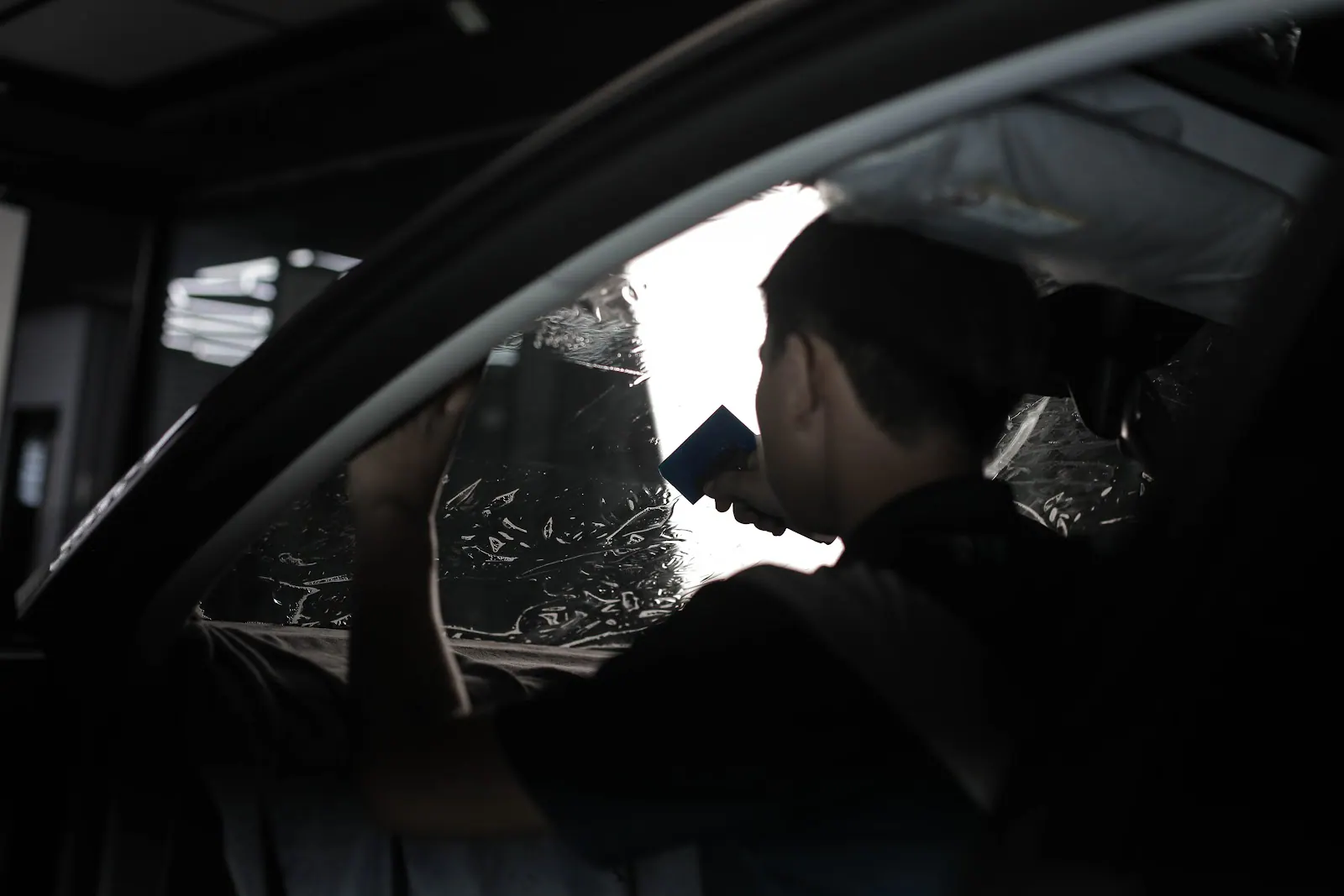
- Application and squeegee work. The film is applied wet using a slip solution, then squeegeed from centre to edges to push out air and water bubbles. Some cars can be tinted without removing the door panel, while others need trim loosened or removed to reach the lower glass.
- Window-use waiting and drying. The waiting period before lowering the windows is separate from complete drying. The windows need to stay closed for the waiting period specified by the installer for your film and conditions. Moisture pockets or slight haze can occur as the film dries. Bubbles or creases that are not settling need an installer’s assessment rather than a guessed universal deadline.
- Final check. A good installer will inspect all edges, check for debris under the film, and verify that the film sits flush within the glass perimeter without peeling corners.
How our window tint series differ
Our series use nano ceramic, hybrid and multi-layer sputtered constructions. The differences include heat-rejection specifications, UV protection and optical clarity. The comparison below keeps the shade and measurement context visible, rather than treating a technology name as proof that one film is always better for every driver.
Our window tint range offers five series, from entry-level to flagship, with different film constructions. Thickness is measured in mil, meaning thousandths of an inch, not millimetres.
- MATRIX is our entry-level nano ceramic series, 2 mil thick, with 99% IRR, 99% UV rejection and TSER up to 73%. It uses Titanium Nitride and Zirconium Oxide nanoparticles.
- MIRACLE is our SPF 100 nano ceramic UV specialist, 4 mil thick, with 99% IRR, 100% UV rejection across the stated UVA and UVB range of 280 to 400 nm, and TSER up to 75%.
- MAGNETRON is our mid-premium hybrid, combining 12-layer sputtering with nano ceramic. It is 4 mil thick, with 99% IRR, 99% UV rejection and TSER up to 79%. It is one of our recommended series.
- METALUX uses 24-layer dual-cycle sputtering and is positioned for optical clarity and night driving. It is 4 mil thick, with 97% IRR, 99% UV rejection and TSER up to 83%. It is also one of our recommended series.
- MEGALUX is our flagship, using 48-layer four-cycle sputtering. It is 4 mil thick, with 99% IRR, 99% UV rejection and TSER up to 85%.
MATRIX is the entry series and MEGALUX is the flagship. Between them, MIRACLE focuses on UV protection, MAGNETRON combines ceramic and sputtered technology, and METALUX is positioned for optical clarity and night driving. The maximum TSER figures above apply to the darkest listed VLT option, 5%. The comparison below uses VLT 30% for every series instead.
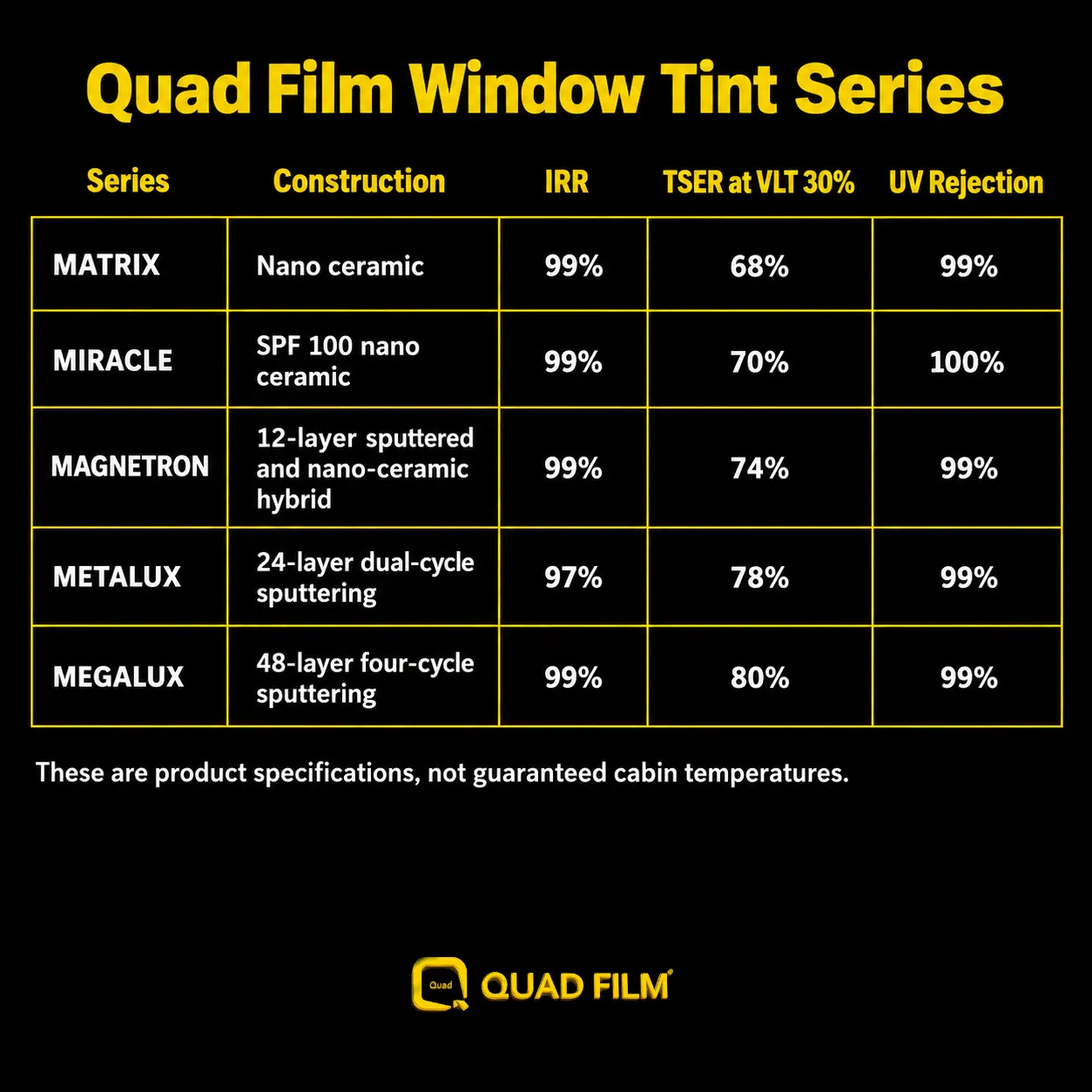
MAGNETRON, METALUX and MEGALUX use German Leybold dual-vacuum chamber manufacturing in our product data. Their sputtering layer counts differ, and MAGNETRON also includes nano ceramic. Because these constructions contain metal, they can weaken RF signals. MATRIX and MIRACLE are the non-metallic options to compare if reception is a priority.
For EV owners with panoramic sunroofs, we also offer a dedicated EV Sunroof PPF. Our recorded comparison lists ambient temperature of 33 to 35°C, an A/C setting of 20°C, fan level 10, a starting charge of 93% and a distance of 140 km. It reports 63% charge remaining with our product and 53% with the comparison product: a ten-percentage-point difference in remaining charge. That result belongs to the recorded comparison, not a guaranteed 10% energy saving for every EV.
Choosing car tint for your needs
Your main priority might be heat rejection, night visibility, UV protection or budget. You can then compare the TSER and VLT ratings of films within your price range against JPJ limits for your car. For a head-to-head comparison, you can look at how 3M, LLumar, V-Kool and Quad Film differ in specifications and pricing.
If you want to compare options in person, you can bring your car to a Quad Film authorized installer and ask for a spec comparison across the series that match your budget. A good installer will measure your existing glass VLT and recommend a film that keeps you within JPJ limits while giving you the best heat rejection for how you actually use your car.
Frequently Asked Questions
Does darker tint always block more heat?
No. Darkness (low VLT) and heat rejection (TSER) are different measurements. Our MATRIX and MEGALUX both have a listed VLT 30% option, but their TSER figures are 68% and 80% respectively. Comparing TSER at the same VLT is more useful than assuming the darker film always rejects more heat.
Will car tint affect GPS, phone or RFID reception?
It can. Our product data identifies MATRIX and MIRACLE as non-metallic films that allow radio-frequency (RF) signals through. MAGNETRON, METALUX and MEGALUX contain metallic sputtered layers that can weaken RF signals. Actual GPS, phone and RFID reception also depends on the device and installation. The installer can discuss film choice and suitable RFID sticker placement before fitting.
Will my condo parking sticker still be visible after tinting?
Your condo parking sticker may still be visible after tinting, but the guard may not be able to read its small print. Tint shade, reflections, how clearly the print stands out and where the guard stands all affect what they can read. Your condo management decides which display positions are allowed. Your installer can advise how to handle the existing sticker before tinting and whether it can go on your chosen film. No tint percentage guarantees that the sticker will be readable.
How long does car tint last in Malaysia?
There is no single lifespan for every film in Malaysia. Product construction, installation, exposure and care all affect its condition. Fading, peeling, persistent bubbles or declining clarity are reasons to have it inspected. A warranty is separate from predicted lifespan, so the written terms need checking for covered defects, exclusions and the claim process.
Can I tint my front windshield in Malaysia?
Yes, but the combined VLT (film plus factory glass together) must remain at least 70%. Most drivers use a clear or near-clear UV and IR rejection film on the windshield to stay within JPJ limits while still blocking heat and UV radiation. Your installer should measure the combined VLT after application.
What is the penalty for illegal tint in Malaysia?
Non-compliant tint can lead to enforcement action and a failed inspection where the combined VLT is checked. PUSPAKOM follows JPJ’s requirements rather than a separate tint standard. A warranty card cannot establish legal compliance by itself. If a reading fails, the installer needs to identify how to bring the glass-and-film combination within the applicable limits.
Protect your Investment today
Don't wait for stone chips to ruin your paint. Speak to our experts about custom PPF and Tinting solutions.