

- Published guidance is to wait at least three to four days before winding the windows down.
- Hot sunny climates sit at the fast end and cool ones stretch to a week or more. Malaysia is hot and humid at once.
- A 4 mil film has twice the thickness for trapped moisture to leave through as a 2 mil film.
- A slight haze in week one is the moisture leaving. A firm bubble that stays put is not.
- The damage from winding down early is at the top edge, and it does not heal.
How long after tint you can roll down windows is one of the few car questions with a published number attached. Wait at least three to four days. The reason nobody in Malaysia trusts that number is that it comes with two conflicting climate notes, and this country sits at the intersection of both.
Hot sunny conditions shorten the wait to two or three days because heat pulls moisture out faster. Cool conditions stretch it to a week and sometimes closer to two. Malaysia gives you the heat and the humidity together, which is why the honest local answer stays at the published minimum rather than the optimistic end of it.
Most people asking this have a freshly tinted car in front of them and a guard house between them and home, and want to know whether one quick wind down really ruins anything. Choosing the film in the first place is covered in our complete tint guide. What follows here is the week after it goes on.
How Long After Tint You Can Roll Windows Down
At least three to four days, and longer if your car lives in shade. That is the published recommendation and it is the one worth following, because the cost of being wrong is a permanent mark along the top edge of the film rather than a fixable inconvenience.
The wider cure runs two to five days in warm conditions. In cooler climates the same film can take up to around two weeks. Both figures describe the same process finishing at different speeds, and neither is a guess about your particular car.
It is also a different question to when you can wash the car. Film goes on the inside face of the glass, so the exterior can be washed the same afternoon without touching anything that matters. The wait is specifically about moving the glass and touching the inside face, which is why the two instructions get confused and only one of them is strict.
Which end you land on depends on where the car sits during those days. A car parked outdoors in the sun clears faster than one that lives in a basement carpark, because the heat that makes Malaysian afternoons unpleasant is the same heat that drives moisture out of the adhesive.
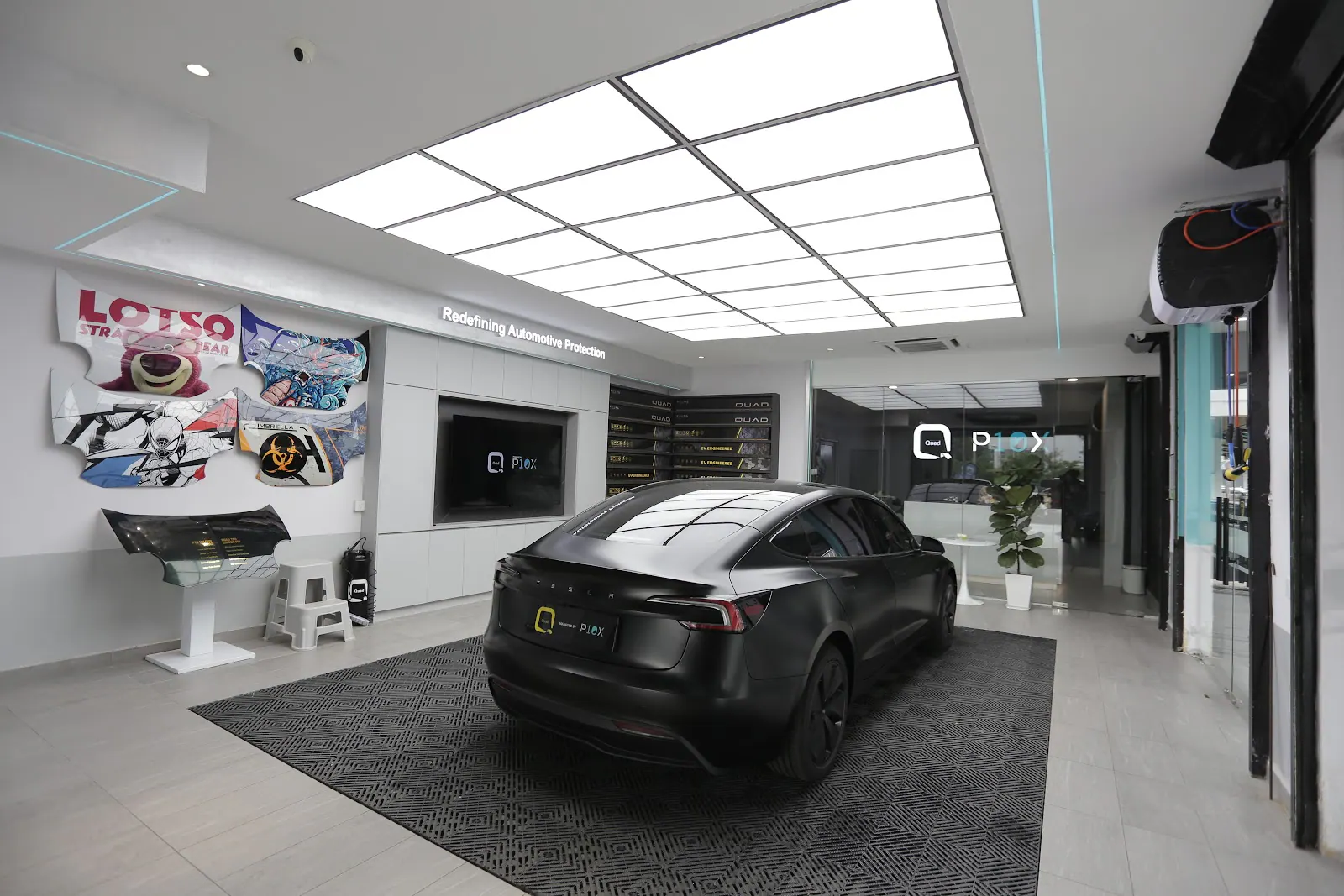
A shop that hands the keys back without mentioning the wind down window has left the most breakable part of the job to chance. It should be said out loud at collection, not written on a card you find a week later.
What Is Actually Happening Behind the Film
Film is applied wet. A slip solution lets the installer position the sheet on the glass, and once it is squeegeed down a thin layer of that moisture is still trapped between the adhesive and the pane. The cure is that moisture leaving.
Until it has gone, the adhesive has not reached full strength. The film is held in place well enough to look finished and not well enough to survive being dragged across a rubber seal. That gap between looking done and being done is the entire problem.
This is also why the instruction is about movement rather than time alone. A car that sits in a driveway untouched for four days has had an easy cure. A car doing four toll gates a day with the window going up and down at each one has been asking a soft adhesive to survive eight drags across a rubber seal before lunch.
The haze people panic about in the first few days is the same thing seen from outside. Small water pockets scatter light, the glass looks slightly milky, and as the moisture migrates out the haze goes with it. Our piece on what actually causes tint bubbling separates that normal stage from the marks that never clear.
Why Film Thickness Changes Your Waiting Period
Not every film asks the same thing of you, and the spread inside a single brand's own range is wider than most owners expect it to be. Across the Quad tint series, MEGALUX, METALUX, MAGNETRON and MIRACLE are all 4 mil thick, while MATRIX sits at 2 mil.
That is a doubling, not a rounding. A 4 mil film is twice the thickness of a 2 mil one, and the trapped moisture has to work its way out through all of it. A single blanket answer of three days applied to films that differ by a hundred percent in thickness is a rule of thumb, not a measurement.

The single short bar is the point. Thinner film gives moisture a shorter route out, so a MATRIX job on a car parked in the sun sits at the fast end of the published range. A 4 mil sputtered film on a car that lives underground sits at the slow end.
MIRACLE sits in the middle of this in a way worth knowing. It is a 4 mil ceramic film rather than a sputtered one, so it carries the full thickness without the layered stack. Thickness and construction are two separate variables and your film may be high on one and low on the other, which is exactly why a single blanket number never fits every car in the carpark.
Construction adds to it. MEGALUX carries 48 sputtered layers and METALUX carries 24, built up in a vacuum chamber into a laminated stack rather than a single sheet. More structure between the adhesive and the outside air is more structure for moisture to negotiate on its way out.
That is also why sputtered film is fitted differently in the first place. Our article on why so few installers handle multi layer sputtered film properly covers the fitting side of the same material difference.
That clip walks through the difference between the MATRIX ceramic film and the MIRACLE range under Malaysian sun. The choice changes what the film does for years, and it also quietly changes how long you leave the windows alone in week one.
Why Malaysian Weather Pulls the Cure Both Ways
Heat and humidity work against each other here. Warm air speeds evaporation, which is why hot sunny climates get the two to three day figure. Humid air is already carrying moisture, which slows the same process down.
Malaysia delivers both at full strength on the same afternoon. Quad's own local test conditions record ambient temperature at 33 to 35 degrees, and anyone who has stood in a Klang Valley carpark knows the air is not dry at those temperatures.
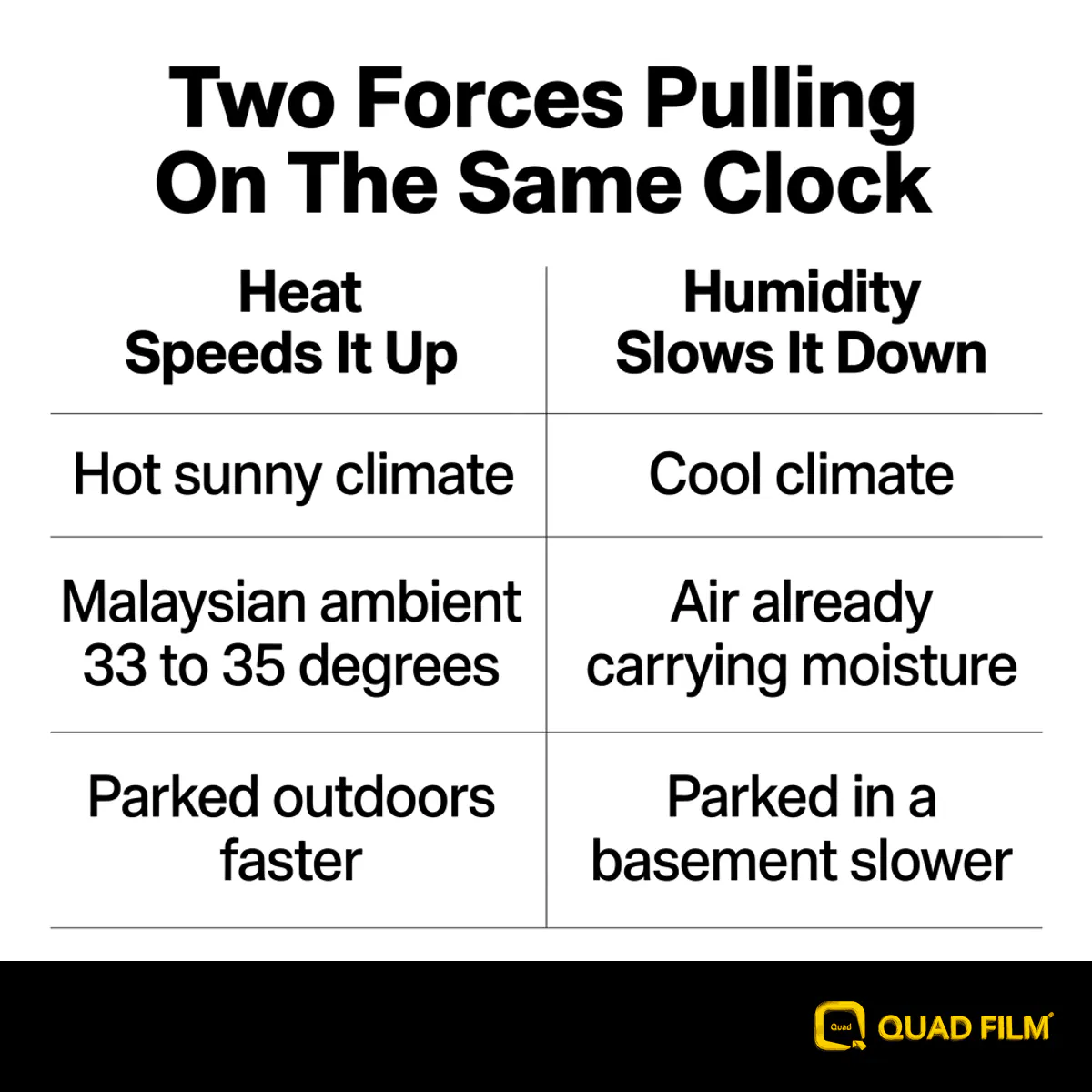
Read the bottom line rather than either column. The two forces do not cancel out into a shortcut. They cancel out into the published minimum, which is why three to four days remains the right answer here even though the heat alone would suggest less.
What that changes is where inside the window you sit, not whether the window applies. A car that sleeps in an open carpark and does the school run in afternoon sun will be ready at the three day mark. One that goes from a basement at home to a basement at the office should be given the full four days and then a little more.
What Happens If You Wind Them Down Early
The damage is always at the same place. Winding a window down pulls the top edge of the film past the rubber sweep at the top of the door, and while the adhesive is still soft that edge lifts, folds or scuffs against the rubber.
The rubber sweep is the strip that wipes the glass as it travels, and it applies constant light pressure along exactly the line where the film ends. That is a good design for keeping water and grit out of the door. It is a poor environment for a film edge that has not finished bonding, and the two only coexist once the cure is done.
None of that heals. Self healing describes a topcoat recovering from light surface scratches, and it has nothing to do with an edge that has been physically peeled back. Once the film has folded on itself the pane is a re do, not a repair.
Front door glass is where it happens most, because that is the window you use. Rear panes get wound down less often in the first week simply by habit, and the windscreen and rear screen do not move at all. If you are going to lose an edge, it will be on the driver's door, at a barrier, in a hurry.
It is also the one failure mode a shop cannot fairly be blamed for. A properly fitted pane with a lifted top edge three days after collection tells its own story, which is why the wind down instruction matters as much to your warranty conversation as it does to the glass.

Going back within the cure window is usually pointless, because the shop will tell you to wait and they will be right. Going back after it with a mark that has not moved is a real conversation and worth having promptly.
6 Things to Avoid in the First Week
The list is short and none of it is difficult, which is exactly why people get caught out. Almost every item here is a habit rather than a decision, and a habit does not stop to check whether the adhesive has finished bonding before it reaches for the window switch.
1. Winding Down at the Guard House
This is the one that catches almost everyone. Plan for it. Have the access card out before you arrive or park and walk to the intercom for a few days.
2. Winding Down at the Drive Through
Same problem, different queue. Order inside for a week, or accept that a two second convenience is being paid for with the top edge of your film.
3. Cleaning the Inside of the Glass
Any pressure on the inside face while the adhesive is soft can move the film. Leave the interior glass alone entirely until the haze has gone.
4. Parking Under a Cover Every Day
Heat is helping you here. A car left in the sun for a few hours clears faster than one hidden in shade, which is the one week of the year where a hot carpark is doing you a favour.
5. Poking a Bubble to See If It Moves
Pressing a water pocket does not release it and can crease the film. They resolve on their own or they were never water in the first place.
6. Rolling Down Just the Rear Windows
The rear panes cure like every other pane. There is no window on the car that is exempt, and rear door glass is often the last to clear because it sits in shade more of the day.
One more thing worth knowing if you park at an office tower. Some barriers read a card through the glass and some need the window down. Find out which yours is on the day you collect the car rather than at seven in the morning with a queue behind you, because that is the moment the list gets ignored.
Getting through a week on that list is easier than getting a pane re done. Our pre payment checklist covers the questions worth asking before any of this becomes relevant.
How to Tell the Tint Has Finished Curing
Look at the glass at a shallow angle in daylight rather than straight through it. When the haze has gone and the film reads as clear glass from outside, the moisture has left and the adhesive is at strength.
Compare panes rather than judging one in isolation. If three windows read clear and one still looks milky, that pane is simply further behind, often because it sits in shade for more of the day. If every pane looks the same, whatever you are seeing is the whole job at the same stage of the same process.
Timing wise, expect the haze to fade through days three to five and be gone by the end of the first week in Malaysian conditions. Anything still visible after two weeks is not moisture and will not clear with more patience.
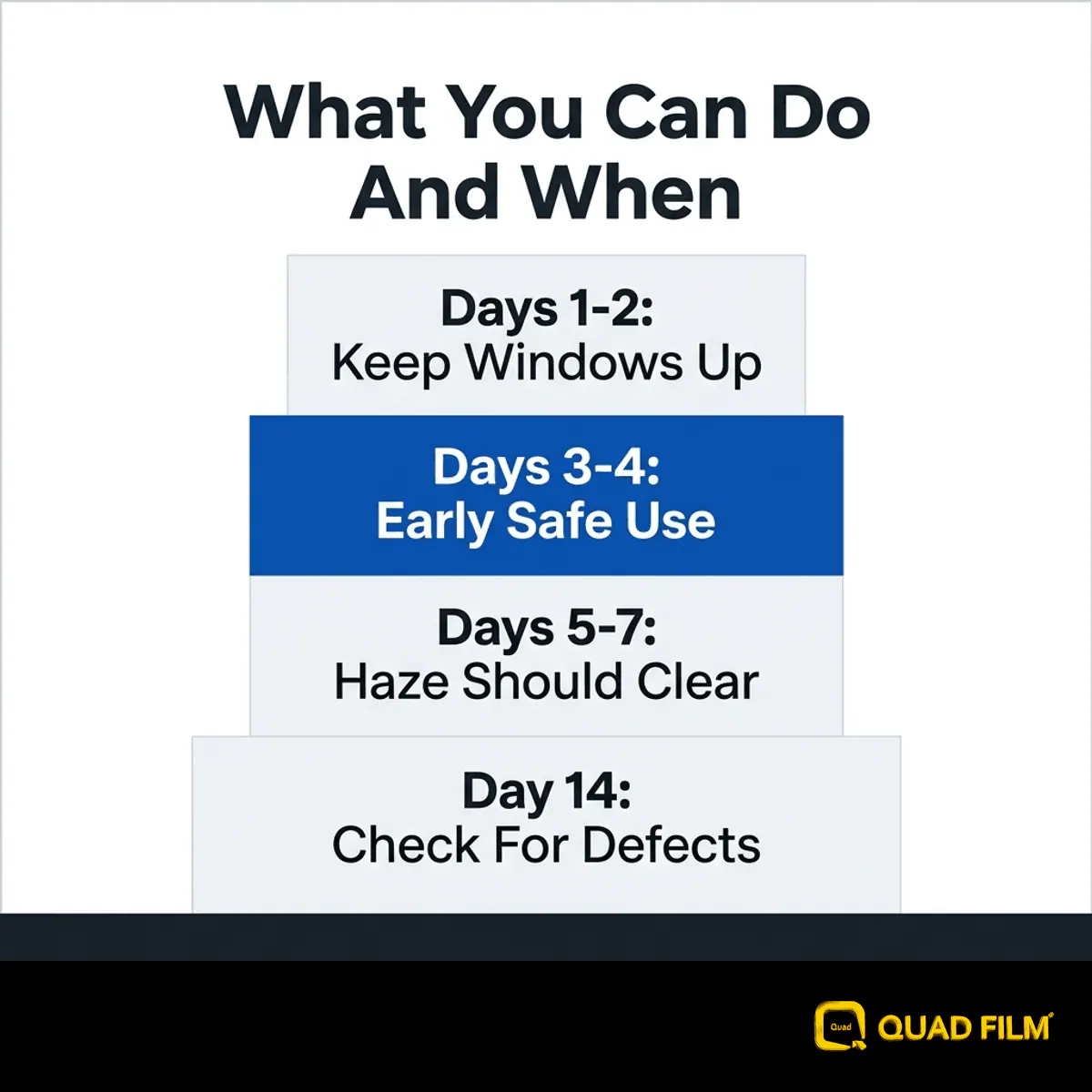
The last block is the one to diarise. Two weeks is a fair line to draw between being patient and having a defect, and a shop that fits film properly would rather see you at day fifteen than hear about it at month six.
Firm bubbles that keep their shape, dark specks that sit in one place, and any lifted edge are all preparation or fitting problems rather than cure problems. They do not improve, and the sooner they are looked at the simpler the fix.
The point made in that walkthrough is that a clean controlled bay and an unrushed process are what keep dust and defects out in the first place. A pane fitted that way gives you a cure window that behaves predictably, which is most of what this article is about.
Explaining the wind down window against the specific film going on your car, rather than reciting a blanket number at the counter, is part of the handover at Quad Film Malaysia by P10X. How ceramic and sputtered construction actually differ is in our film series comparison.
Questions Malaysian Owners Ask About Tint Curing
How long after tint can I roll down my windows?
Published guidance is to wait at least three to four days. In hot sunny conditions the film can be ready closer to two or three days, and in cool or shaded conditions it takes longer, so three to four days is the safe answer in Malaysia.
What happens if I roll down the window too early?
The top edge of the film gets dragged past the rubber sweep at the top of the door while the adhesive is still soft. That edge can lift, fold or scuff, and none of that damage heals or polishes out. The pane has to be re done.
How long does window tint take to cure?
Two to five days in warm conditions, and up to around two weeks in cool ones. Malaysia sits at the warm end for temperature but the humidity works against it, so most cars here finish somewhere inside the first week.
Why does my new tint look hazy or cloudy?
That is the slip solution still trapped between the film and the glass scattering light. It clears as the moisture migrates out, usually through days three to five, and it is a normal stage rather than a fault.
Are the small bubbles after tinting normal?
Soft water pockets that shrink over the first days are normal. Firm bubbles that hold their shape and do not change, or dark specks, are trapped contamination from fitting and will not clear with time.
Does the type of film change how long I wait?
It can. Across the Quad range MATRIX is 2 mil while MEGALUX, METALUX, MAGNETRON and MIRACLE are 4 mil, so a thinner ceramic film gives trapped moisture a shorter route out than a thicker multi layer sputtered one.
Can I wash my car while the tint is curing?
The outside is fine, since the film is on the inside face of the glass. Leave the interior glass completely alone, because pressure on the inside while the adhesive is soft can move the film.
Does parking in the sun help tint cure faster?
Yes. Heat drives the trapped moisture out more quickly, which is why hot sunny climates get the shorter published figure. A car that lives in a basement carpark should be given the full waiting period and a little extra.
Protect your Investment today
Don't wait for stone chips to ruin your paint. Speak to our experts about custom PPF and Tinting solutions.