
- Film is the only layer that stops impact damage. A coating changes how the paint behaves chemically, it does not absorb a stone strike.
- The iX3 case is a supply case. A CBU model with a 50-unit first allocation means a damaged panel costs you time before anything else.
- Coverage matters more than brand talk. Full front, hybrid and full body protect different amounts of the car, and only one of them reaches the long doors and rockers where iX3 grit actually lands.
- Thickness is delivered, not printed. Film thins as it stretches onto a panel, so the number on the box is not the number on your paint.
- The panoramic roof is a separate line. Body film and roof film are two different products on two different lines of the quotation.
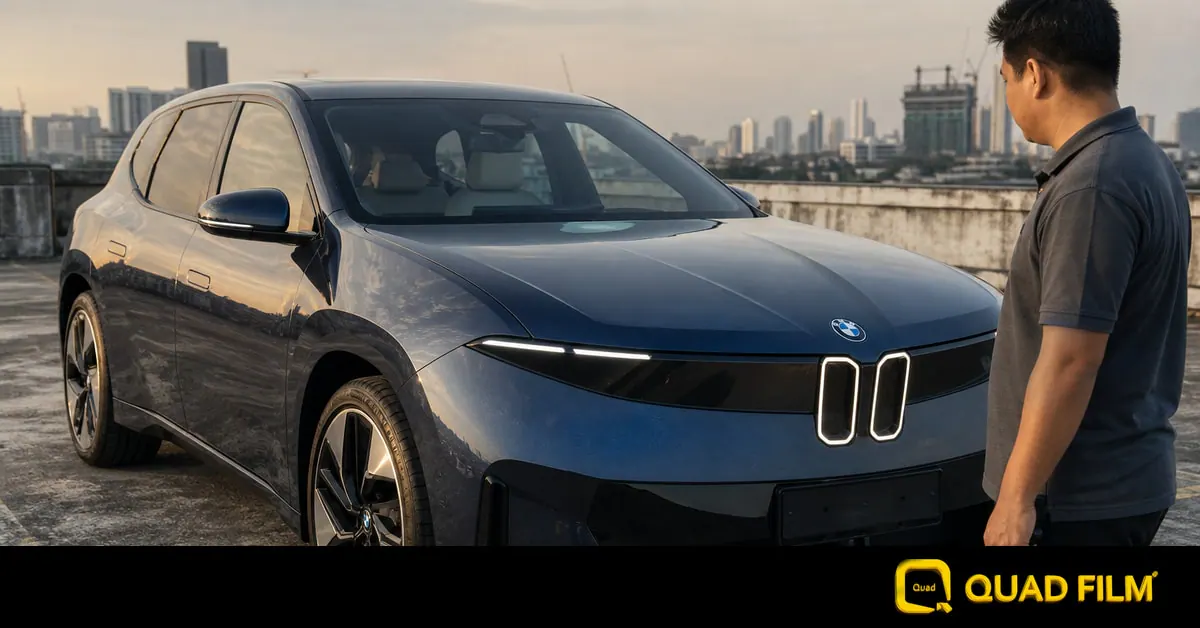
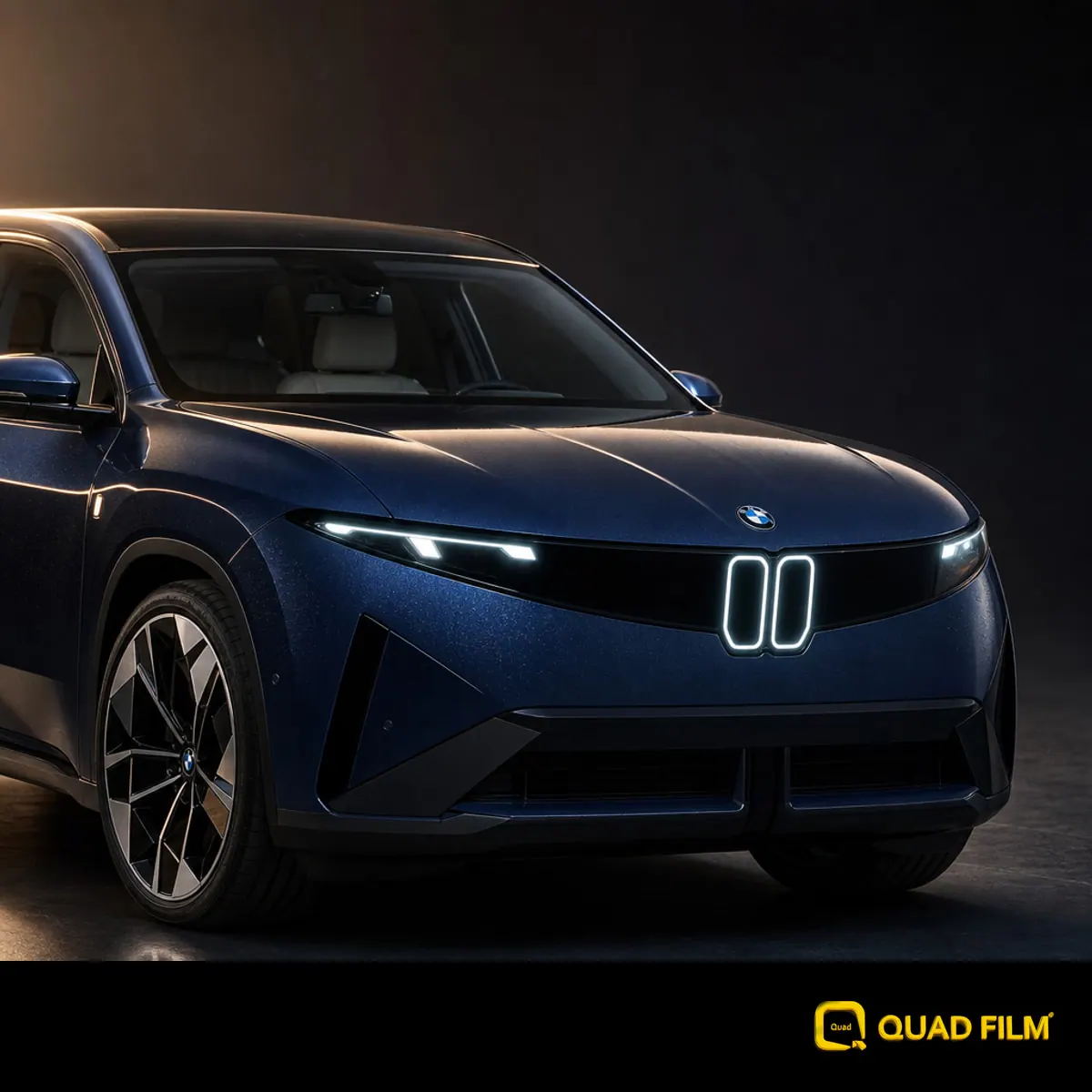
Paint protection film on a BMW iX3 in Malaysia is not a cosmetic upgrade, it is a hedge against a repair queue. The car reached local showrooms on 6 August 2026 as the first series-production Neue Klasse model sold here, it arrived as a CBU unit built in Hungary, and the first allocation of 50 units was taken almost immediately. On a car with that supply profile, a stone chip stops being a paint problem and becomes a waiting problem.
So does an electric car really need film? Yes, and the reason is mechanical rather than sentimental. Film is the only layer that physically absorbs impact energy before it reaches the factory clear coat, which is why PPF for electric cars in Malaysia has moved from indulgence to standard practice. A coating cannot do that job, and careful driving on the LDP will not do it either.
This guide is written for the owner who already has a quotation in hand or a collection date circled on the calendar. It covers what the film physically does, how road grit reaches an iX3 panel, the three coverage tiers worth comparing, which panels deserve film in the first week, and the exact lines to check before you sign. If you want the category background first, the complete guide to paint protection film in Malaysia covers the fundamentals.
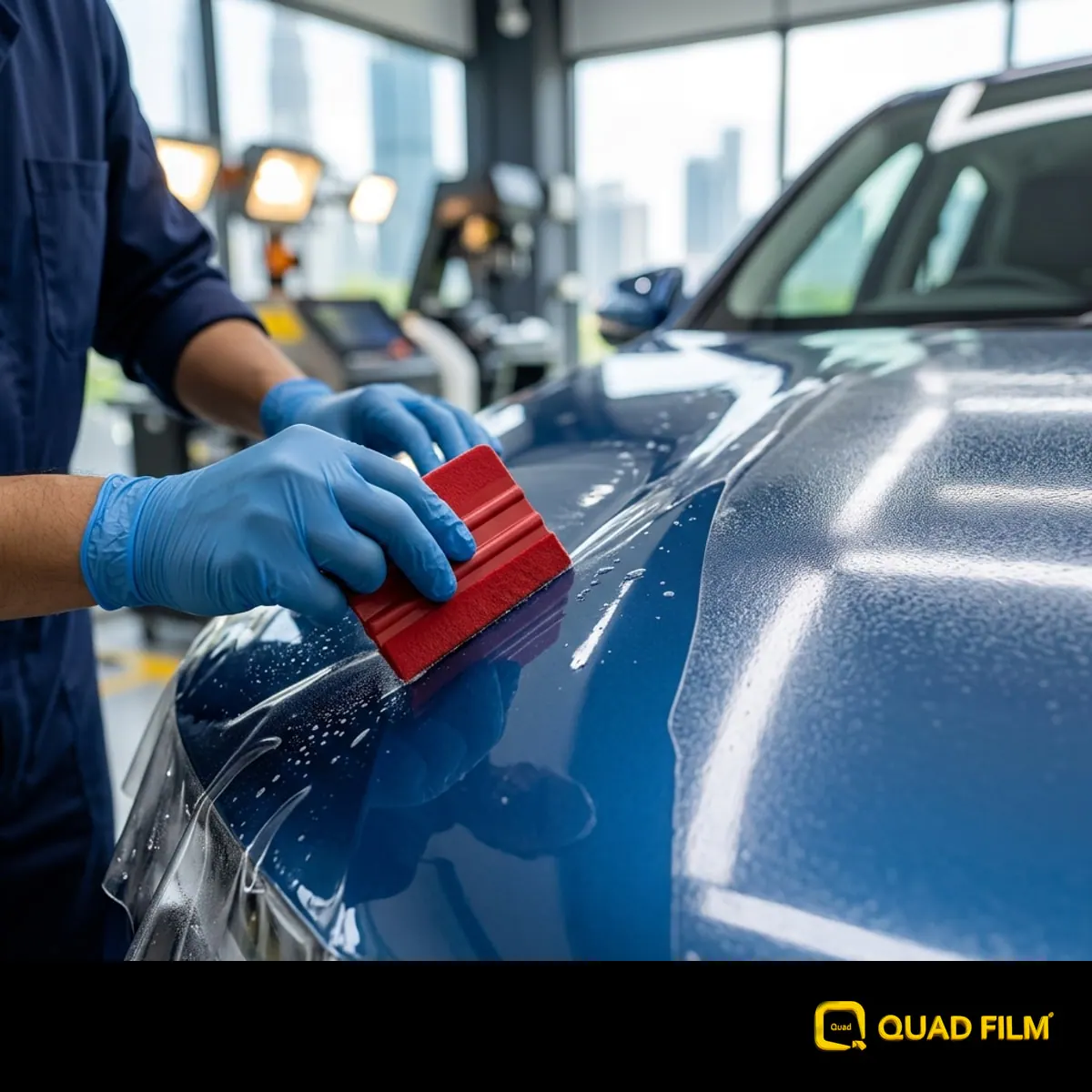
What Does Paint Protection Film Do on an EV?
Why Does a Brand-New iX3 Need Film Early?
The iX3 reached Malaysian showrooms on 6 August 2026 as the first series-production Neue Klasse model sold here, and the opening allocation of 50 units was gone before most buyers had seen the car in daylight. Every one of those cars is a CBU unit from BMW Group Plant Debrecen in Hungary, which matters more for paint than most owners expect. A chipped bonnet on a locally assembled model can usually be sorted with a panel that already sits in a regional warehouse. A chipped bonnet on a low-volume imported Neue Klasse car means a parts order, a wait measured in weeks rather than days, and a body shop blending a colour it has never sprayed before.
Two of the six launch colours make that blending job harder. Ocean Wave Blue and Polarised Grey are new metallics for the range, and metallic finishes with fresh pigment loads are exactly the ones that expose a mismatched repair under Malaysian midday sun. Alpine White and Black Sapphire are more forgiving on colour match, although Black Sapphire punishes swirl marks instead. In every case the best outcome is the panel that never needs touching at all, and film is the only thing that keeps a factory panel factory original while the car is still covering its first few thousand kilometres.
There is also the ownership pattern to consider. A new iX3 owner in Klang Valley typically covers 60 to 80 km a day in the first fortnight, and a good share of that is highway running rather than parking-bay crawling. That is the window where the paint is most exposed and least protected, because most owners only start thinking about protection after the first chip appears on the bonnet. Owner discussion on BMW forums about recent models chipping easily is sentiment rather than measured data, but it is consistent enough to be worth acting on before you find out whether it applies to your car. Booking film in the same week you collect the car removes the question completely.
How Do Road Chips Actually Reach iX3 Panels?
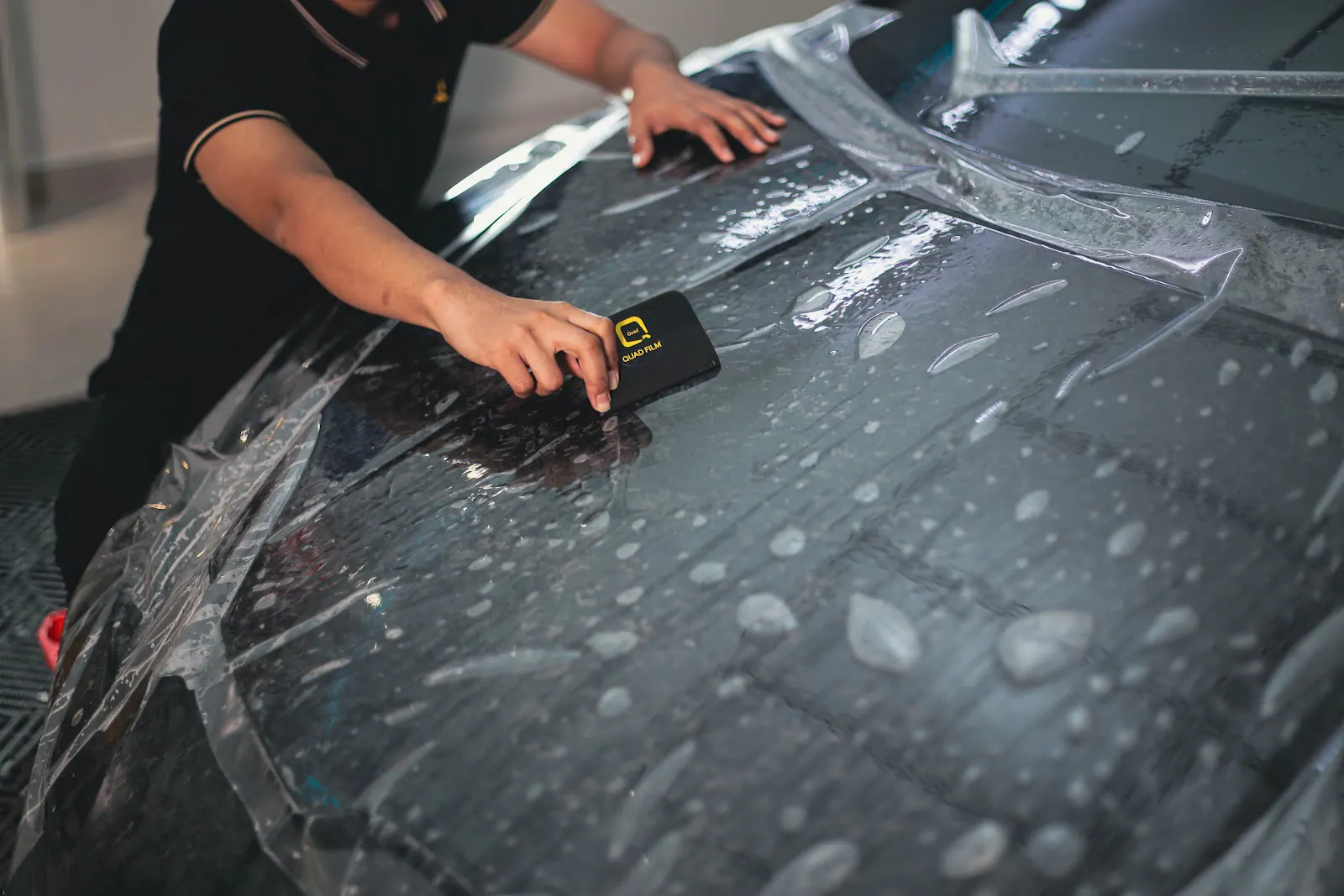
Picture a normal Tuesday run on the NKVE from Damansara towards the Jalan Duta interchange. Traffic is moving at about 90 km/h, and you are three car lengths behind a tipper truck with a half-covered load. That gap feels safe and it is safe for braking, but it is nowhere near enough for grit. Anything the truck sheds gets picked up by the airflow off its tailgate and delivered to the first upright surface it meets, which on an iX3 is the bonnet leading edge, the upper bumper, and the flat headlamp covers. Nobody hears the strike at that speed. You find it two weeks later in a carwash bay, as a white dot the size of a pinhead with a dark centre.
The second source of damage is the car itself. At 2,360 kg with 645 Nm available from a standstill, an iX3 puts far more load through its tyres in the first metre of movement than a comparable petrol SUV does. Instant torque means the tyres pick up loose material from the road surface and throw it rearward and outward, which is why the worst chipping on an electric SUV is rarely on the nose alone. Look at the rocker panels and the lower door skins, roughly 40 cm off the ground, and you will find a peppered zone that came from the car's own front tyres. The long, flat Neue Klasse door surfaces give that spray a big target.
The third source is uniquely local. Klang Valley expressways such as KESAS and SPRINT carry near-permanent roadworks, and the material dragged out of those sections onto the running lanes is sharper than ordinary road dust. Monsoon runoff then washes fine silt across the surface, and haze periods leave an abrasive film that turns every careless wipe into a light scratch. This is also where the difference between film and coating becomes obvious rather than theoretical, and the comparison of PPF against ceramic coating in Malaysia sets out where each one earns its place. Grit does not care how hydrophobic your paint is. It cares how much material stands between it and your clear coat.
Which Three Coverage Tiers Should Owners Compare First?
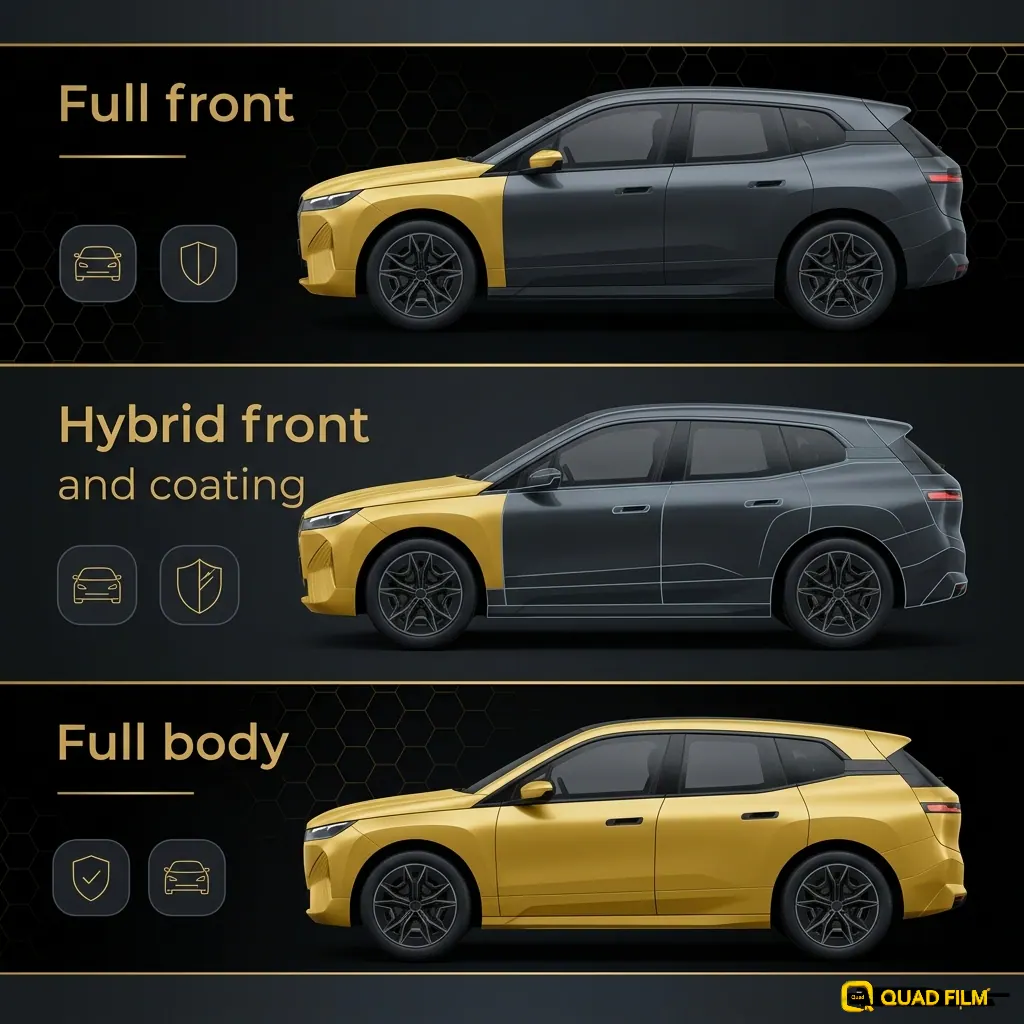
Most owners start by asking which film is best. That is the second question. The first one is how much of the car gets covered, because a thinner film across the right panels beats a premium film across the wrong ones. Three tiers cover almost every real decision, and they differ mainly in how far back along the car the protection reaches. Book the workshop slot before you collect the car, because the calendar matters as much as the choice. A full front job typically ties the car up for two to three days, and a full body job runs five to seven days once curing time is included. Turning up on a Saturday hoping for a same-day wrap is how owners end up driving unprotected for another month.
To choose between the tiers, answer three things honestly. How much highway running will the car actually do each week, where does it sleep at night, and how long do you plan to keep it. An iX3 that commutes on the NKVE five days a week and parks in an open condominium bay has a very different exposure profile from one that does school runs in Bangsar and sits in a covered porch. The first car needs film reaching past the A-pillars. The second can afford to be more selective.
Full front only
Full front means the complete bonnet, the front bumper and lower valance, the front fenders, the mirror caps and the headlamp covers. This is the tier that stops the damage you cannot avoid, because it covers every surface that meets the road head-on at highway speed. For an owner who wants the chip risk handled and nothing more, this is the honest minimum on an iX3, and QUATTRO at 8.5 mil is the natural fit for it. What full front does not do is protect the long door skins or the rockers, which is exactly where an electric SUV throws grit up from its own front tyres.
Hybrid front and coating
The hybrid approach puts film on the front impact zone and a professional-grade ceramic coating such as Gtechniq Crystal Serum Light across the remaining panels. The logic is sound. Impact protection goes where impacts happen, and chemical protection goes where the real enemy is tree sap, organic fallout and hard water spotting rather than stone strikes. On a dark car like Black Sapphire this combination also makes washing far less risky, because a slick coated surface releases dirt with less contact. It is still a compromise, and it helps to be blunt about which half does what. The coated panels are easier to clean and no harder to chip.
Full body coverage
Full body wraps every painted panel on the car, including the doors, the rockers, the rear arches and the boot lid. It is the only tier that addresses the grit pattern described earlier, because it is the only one that reaches the lower half of the car where an electric SUV throws material up from its own tyres. It is also the tier that matters most to owners who care about the condition of the car when they eventually sell it, and the case study on how PPF protects resale value on a Denza Z9GT shows what an unmarked panel set is worth at handover. On a low-volume Neue Klasse model whose first allocation was 50 cars, an original unrepainted body is likely to be a genuine differentiator in a few years rather than a bragging point.
Should You Pick Film or Coating on an EV?
This is the question that derails most first conversations at a workshop counter, usually because the two products get presented as rivals. They are not. A coating is a chemical layer measured in microns that changes how the surface behaves, making it slicker, easier to wash and more resistant to staining. Film is a physical layer measured in mils that stands between the road and your paint. Ask a coating to stop a stone and it will fail, because there is nothing there to absorb the energy. Ask film to make the whole car easier to wash and you are paying for impact protection on panels that never take an impact.
The practical difference shows up in the workshop calendar. A full ceramic coating on an iX3 is usually a four to six hour job once the paint has been decontaminated and machine polished. Film is measured in days, because every panel is patterned, wrapped, tucked and then left to cure. If the car is your only transport, that gap is worth planning around rather than discovering on the morning you hand the keys over. It is also why a fair number of owners end up with a coating they did not really need and no film on the nose, which is the wrong way round for a car that spends its week on Klang Valley expressways.
Here is the test that settles it. You are heading south on the LDP at 6pm behind a lorry throwing wet grit off its tyres, and you pull into a petrol station in Puchong for a thirty minute rinse before the dirt dries on. A coated panel rewards you for that stop, because the dirt lifts with far less contact and you drive away without adding fresh swirl marks. A filmed panel does not care about the stop at all, because the grit that arrived at 80 km/h already met a sacrificial layer instead of your clear coat. Both outcomes are worth having. Only one of them is protecting the paint from the road, and on a new iX3 that is the one to buy first.
Which iX3 Panels Deserve Film in Week One?
An iX3 has around twenty separately painted zones once you count bumper sections, mirror caps and pillar covers. Six of them absorb almost all of the damage. In order of how quickly they show it, they are the bonnet leading edge, the front bumper and lower valance, the headlamp covers, the front fenders behind the wheel opening, the mirror caps, and the A-pillars where the roof line begins. If your budget or your schedule only allows a first phase, that list is the first phase, and a good installer will pattern all six from the same series so the finish matches when the light hits the car side-on.
The headlamp covers deserve a separate mention because owners forget them and they fail visibly. Polycarbonate lenses pit rather than chip, so instead of one obvious mark you get a slow haze that scatters light at night and never polishes out properly. On a car whose entire front identity is built around slim illuminated elements, a hazed lens ages the whole face. Film on the lenses is cheap in effort terms, it goes on in the same session as the bumper, and it is the single easiest thing to leave off a quotation by accident. Ask for it in writing.
Two iX3-specific areas are worth naming because they are not on a generic panel list. The first is the flush auto-extending door handles, which retract into the door skin and present a shallow cup that your fingernails and rings reach into several times a day. That cup collects fine scratching faster than any other part of the door. The second is the boot loading lip above the rear bumper, which on a 520-litre boot meets luggage, groceries, bicycle frames and golf bags at an angle that scuffs the paint edge. Film on those two areas is a small addition to any coverage tier and prevents the two most annoying kinds of wear on the car.
Use the table below as the working list to bring to your installer, and ask them to mark which lines are included in the quotation and which are not.
| iX3 panel | Impact risk | Recommended Quad Film series | Coverage tier |
|---|---|---|---|
| Bonnet leading edge | Very high | QUATTRO 8.5 mil | Full front |
| Front bumper and lower valance | Very high | QUATTRO 8.5 mil | Full front |
| Headlamp covers | High | QUATTRO 8.5 mil | Full front |
| Front fenders | High | QUATTRO 8.5 mil | Full front |
| Mirror caps | High | QUATTRO 8.5 mil | Full front |
| Full bonnet past the leading edge | Moderate | QUATTRO 8.5 mil | Full front or full body |
| Rocker panels and lower doors | High | QUANTUM 10 mil | Full body |
| A-pillars and roof leading edge | Moderate | QUANTUM 10 mil | Full body |
| Door skins | Moderate | QUATTRO 8.5 mil | Full body |
| Door edges and handle cups | Moderate | QUATTRO 8.5 mil | Add-on to any tier |
| Rear arches | Moderate | QUANTA 7.5 mil | Full body |
| Boot loading lip | Moderate | QUANTA 7.5 mil | Add-on to any tier |
| Panoramic roof glass | Solar load, not impact | Quad EV Sunroof PPF | Separate line on the quotation |
| Any matte-finished panel | Matches its position | QUBOND matte or dedicated Matte PPF | Matches the tier chosen |
Two lines in that table are the ones owners argue about. The rockers and lower doors are given QUANTUM at 10 mil because that zone takes repeated small strikes from the car's own tyres rather than occasional highway hits, and thickness is what survives repetition. The panoramic roof glass sits on its own line because it is glass rather than paint, so it takes a different product entirely and should never be bundled silently into a body film figure.
Which PPF Grade Should an iX3 Owner Ask For?
With the coverage question settled and the panel list agreed, the last decision is which film goes on. Quad Film's gloss range gives you three genuine choices, and the difference between them is thickness and what that thickness buys. All three are built on the same double-layer TPU platform with the same Ashland adhesive, all three are anti-yellowing as a product characteristic, and all three remove without residue. Thickness changes how much impact energy the film can absorb before the paint underneath feels anything, and it also changes how the film behaves when it is stretched around a curve.
QUATTRO 8.5 mil
QUATTRO is the sensible default for an iX3 front end. It is a gloss film at 8.5 mil with a 98.5 percent self-healing restorative rate, 1,000 gf adhesion, 11.5 cm fracture growth resistance and 460 percent elongation, and Quad Film characterises it as the increased glossiness option in the range. In practice it gives you enough material to absorb highway grit without becoming difficult to lay into the tight radius around the iX3's wheel arches. If you specify one film for the bonnet, bumper, fenders, mirror caps and headlamps, this is the one to ask for by name.
QUANTA 7.5 mil
QUANTA is the thinnest of the three gloss films at 7.5 mil, with a 98 percent restorative rate, 1,000 gf adhesion, 10.5 cm fracture growth resistance and 460 percent elongation. Quad Film positions it as the invisible daily guard, and that description is accurate. It conforms beautifully to complex shapes, which makes it the right choice for rear arches and the boot loading lip where the shape is awkward and the impact risk is moderate rather than severe. Asking for QUANTA on the bonnet leading edge of a car that lives on the NKVE would be underspecifying the hardest-working panel on the car.
QUANTUM 10 mil
QUANTUM is the heavy-duty option at 10 mil, with the highest self-healing rate in the gloss range at 99 percent, 1,000 gf adhesion, 12 cm fracture growth resistance and 490 percent elongation. That extra elongation matters as much as the thickness, because a 10 mil film has to stretch further to sit flat without lifting. Quad Film describes it as heavy-duty armour, and the places it earns that title on an iX3 are the rocker panels, the lower door skins and the A-pillars, all of which take repeated small strikes rather than occasional big ones.
If you want a different finish rather than a different thickness, the range also includes QUATRIX in satin or semi matte and QUBOND in matte, which are two separate finishes and should never be quoted as the same thing. A hydrophobic gloss option, QUARMOR, is available on request.
How Much Thickness Survives Installation?
Here is the part of a PPF quotation nobody explains at the counter. The thickness printed on the box is the thickness of the film on the roll, not the thickness sitting on your paint after it has been fitted. Film is heated, pulled and conformed to the shape of a panel, and pulling a sheet of thermoplastic polyurethane makes it thinner. Quad Film is unusually open about this, publishing that a nominal 7 mil film typically finishes at 6 to 6.5 mil once installed. Work backwards from those two numbers and you get a real-world stretch of roughly 8 to 17 percent depending on how hard the panel makes the installer work.
That gives us an honest way to compare the three gloss films by what they actually deliver rather than by what they are called. The assumption used below is stated so you can argue with it. Take 10 percent stretch as typical for the flat surfaces on an iX3, meaning the broad Neue Klasse bonnet and the long, largely flat door skins, and take 20 percent as typical for the hardest-pulled areas, meaning the shoulder line where it turns into the rear haunch and the tight radius around each wheel arch. Everything else is arithmetic.
- QUATTRO, nominal 8.5 mil: about 7.7 mil on flat panels and about 7.1 mil at the hardest-pulled points, retaining roughly 91 and 83 percent
- QUANTA, nominal 7.5 mil: about 6.8 mil on flat panels and about 6.3 mil at the hardest-pulled points
- QUANTUM, nominal 10 mil: about 9.1 mil on flat panels and about 8.3 mil at the hardest-pulled points
Read the first two lines together and the coverage decision looks different. QUATTRO at its thinnest, most stretched point still delivers about 7.1 mil, which is more material than QUANTA delivers on a flat bonnet. That is the practical case for specifying QUATTRO on the front of an iX3 rather than saving material on the panel that meets every stone on the NKVE. It is also why a quotation that names a series and a nominal thickness is a better document than one that promises thickness in general terms, because the delivered figure is a consequence of both the film and the hands fitting it.
What Should You Verify on a PPF Quotation?
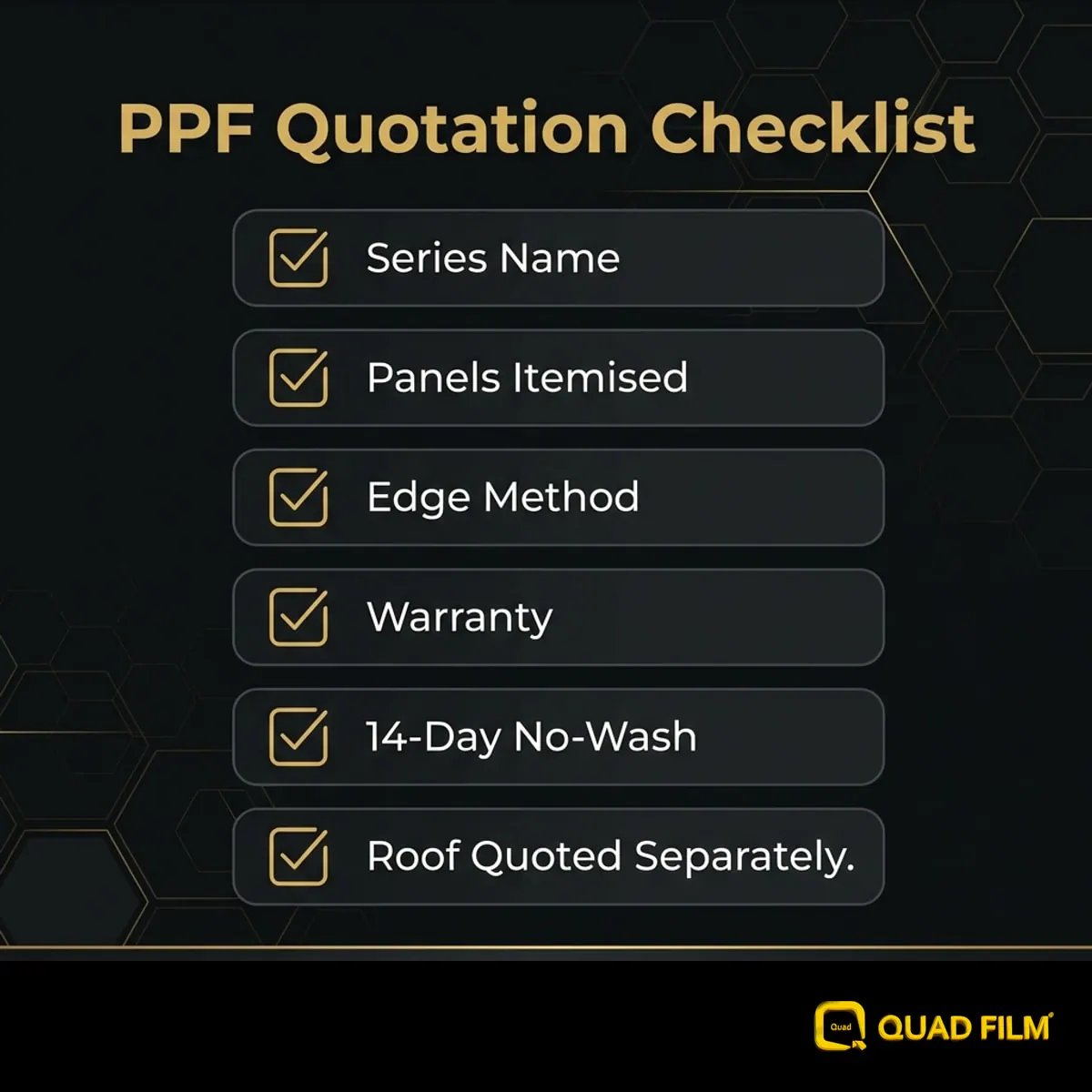
Everything decided so far lives or dies on the piece of paper you sign. Sitting in a workshop office in Puchong with a quotation in front of you, the useful test is whether a different installer could read that document and produce the same job. If it says full front protection with premium film and nothing else, it fails that test. The version that passes names the series and the nominal thickness, then lists the panels included as separate lines, so that bonnet, bumper, valance, fenders, mirror caps and headlamp covers each appear rather than hiding inside a phrase.
The second thing to verify is how the edges are handled, because edges are where film jobs are judged two years later. Ask whether the film is wrapped around panel edges and tucked into the gaps, or cut flush on the visible face. Wrapped edges cost more labour and look invisible from a metre away. Flush-cut edges are quicker and leave a visible line that collects dirt. Ask as well whether badges, mirror caps and the door handle assemblies are removed for fitting or worked around, since a handle cup wrapped without removal rarely stays down at the corners. On an iX3 the flush auto-extending handles make that question more relevant than usual.
The third thing is aftercare, in writing and with dates. Confirm the no-wash window, which is around 14 days, and confirm how long the car must stay out of heavy rain immediately after fitting, which is typically the first 48 hours while the adhesive cures. Ask what the workmanship warranty covers and get the answer on the document rather than in conversation, and ask specifically what it does not cover. Separately, and as a product matter rather than a warranty matter, Quad Film's PPF is built to be anti-yellowing and to remove without leaving adhesive residue. Those are characteristics of the film itself, and they should not be presented to you as warranty terms.
Before you pay a deposit, run the quotation against this list. Anything that cannot be answered on the document is worth resolving before the car goes into the bay rather than after.
- The series name and the nominal thickness in mil are printed on the invoice, not just a brand name
- Every panel is itemised as its own line, including the headlamp covers and the lower valance
- The edge method is stated, either wrapped and tucked into the panel gaps or cut flush on the face
- It says whether badges, mirror caps and the door handle assemblies are removed for fitting
- The workmanship warranty is confirmed in writing, together with a clear statement of what it excludes
- The no-wash window of around 14 days appears on the document with a date
- The first 48 hours away from heavy rain while the adhesive cures is stated
- Film for the panoramic roof glass is quoted as its own separate line rather than bundled into the body figure
Which PPF Mistakes Do New EV Owners Repeat?
The first mistake is waiting. A common plan is to run the car in for a few thousand kilometres, see how it goes, and then decide. In Klang Valley traffic 3,000 km takes about six weeks, and six weeks of NKVE and LDP running is more than enough to collect the first cluster of chips on the bonnet leading edge. Film applied afterwards protects the paint from that point forward, but it also seals in whatever damage is already there, because nobody fills and repaints a chip before wrapping a panel. The right week to fit film is the week you collect the car.
The second mistake is choosing by brand talk instead of by coverage and construction. Cheap film is cheap for a reason, usually a thinner or lower-grade polyurethane with an adhesive that does not survive tropical humidity. What follows is hydrolysis, where moisture breaks down the adhesive layer and the film clouds, bubbles and starts lifting at the edges, and the explanation of PPF hydrolysis in Malaysia shows what that looks like on a real car. Removing a failed film from a two-year-old panel is a worse afternoon than paying properly the first time.
The third mistake is stopping at the shoulder line. Owners protect the nose, admire the result, and forget the A-pillars and the leading edge of the roof, which on an iX3 take direct airflow at highway speed and are the first surfaces to show sandblasting after a year of monsoon driving. The same oversight applies to finish. If you want a matte or satin look rather than gloss, that is a different product family and needs to be specified from the start, as the guide to matte and colour PPF in Malaysia explains.
If it helps to see the same decision made on other new electric cars, the coverage walkthroughs for the MG S5 EV and the iCaur 03 work through identical logic at a very different price point, which is a useful reminder that this is a coverage decision rather than a luxury one.
Choosing PPF Coverage for a New BMW iX3 in Malaysia
So does an electric car need paint protection film? On a car like this one, in this country, the answer is yes, and the real decision is coverage rather than whether. Cover the six impact panels at minimum, add the doors and rockers if the car lives on expressways, treat the panoramic roof glass as its own line, and hold the quotation to a named series with a stated thickness so you know what is going on the paint. If you want to compare the Quad Film range or find an authorised installer near you, both are a good next step before your collection date arrives.
Frequently Asked Questions
Is PPF worth it on a BMW iX3 in Malaysia?
Yes, and the reason is specific to this car rather than general enthusiasm for film. The iX3 arrives here as a CBU import from Hungary in small numbers, so a damaged panel means a parts order and a colour-matching job on paint that local body shops have not sprayed before. Film is the only layer that physically absorbs a stone strike before it reaches the clear coat, so it removes that whole sequence rather than shortening it.
Is full front PPF enough for a BMW iX3?
Full front handles the damage you cannot avoid, covering the bonnet, front bumper and valance, front fenders, mirror caps and headlamp covers. It is a sound minimum. What it does not reach are the long door skins and the rocker panels, and on an electric SUV with 645 Nm from a standstill those lower areas take a steady peppering from the car's own front tyres. If the car does regular expressway mileage, plan on extending coverage past the A-pillars.
Should I apply PPF to a BMW iX3 before or after the first drive?
Before, or as close to collection as the workshop calendar allows. Film applied later still protects the paint from that day onward, but it also seals in any chips already there, because a chipped panel is not repaired before wrapping. In Klang Valley traffic the first 3,000 km takes roughly six weeks, which is more than enough exposure to collect the first marks on the bonnet leading edge.
Can I start with partial PPF on an iX3 and add panels later?
Yes, and it is a common and sensible approach. Start with the six impact panels, then add doors, rockers and rear arches in a second session. Tell the installer at the first visit that you intend to extend coverage, so the same series and batch logic is used and the finish matches across panels when the light hits the car side-on. Mixing series between sessions is what produces a visible difference in gloss.
Which Quad Film PPF series suits a BMW iX3 in Malaysia?
QUATTRO at 8.5 mil is the sensible default for the front impact panels, because it carries enough material to absorb highway grit while still conforming to the wheel-arch radius. QUANTUM at 10 mil belongs on the rocker panels, lower doors and A-pillars, where strikes are small but constant. QUANTA at 7.5 mil suits awkward shapes with moderate risk such as the rear arches and the boot loading lip. Satin and matte finishes are separate products and need to be specified from the start.
Does PPF affect the iX3's flush door handles or parking sensors?
Fitted properly, no. The flush auto-extending handles need the handle area worked carefully so the film sits into the cup without lifting at the corners, which is why it is worth asking whether the assemblies are removed for fitting. Parking sensors and radar apertures are not covered by paint protection film in the first place, so they are unaffected. Ask the installer to confirm in writing how the handle cups and sensor surrounds are treated.
How does PPF hold up on an iX3 in Klang Valley heat?
Quality film is built for exactly this. Quad Film's PPF uses a high-grade thermoplastic polyurethane with an Ashland single-component adhesive that has been aging-tested to the equivalent of more than ten years, and the film is anti-yellowing and anti-acid as product characteristics. Cheap film is where heat and humidity do damage, through hydrolysis that clouds and lifts the layer. The practical rule is to buy on construction rather than on price and to keep to the aftercare schedule.
Protect your Investment today
Don't wait for stone chips to ruin your paint. Speak to our experts about custom PPF and Tinting solutions.