
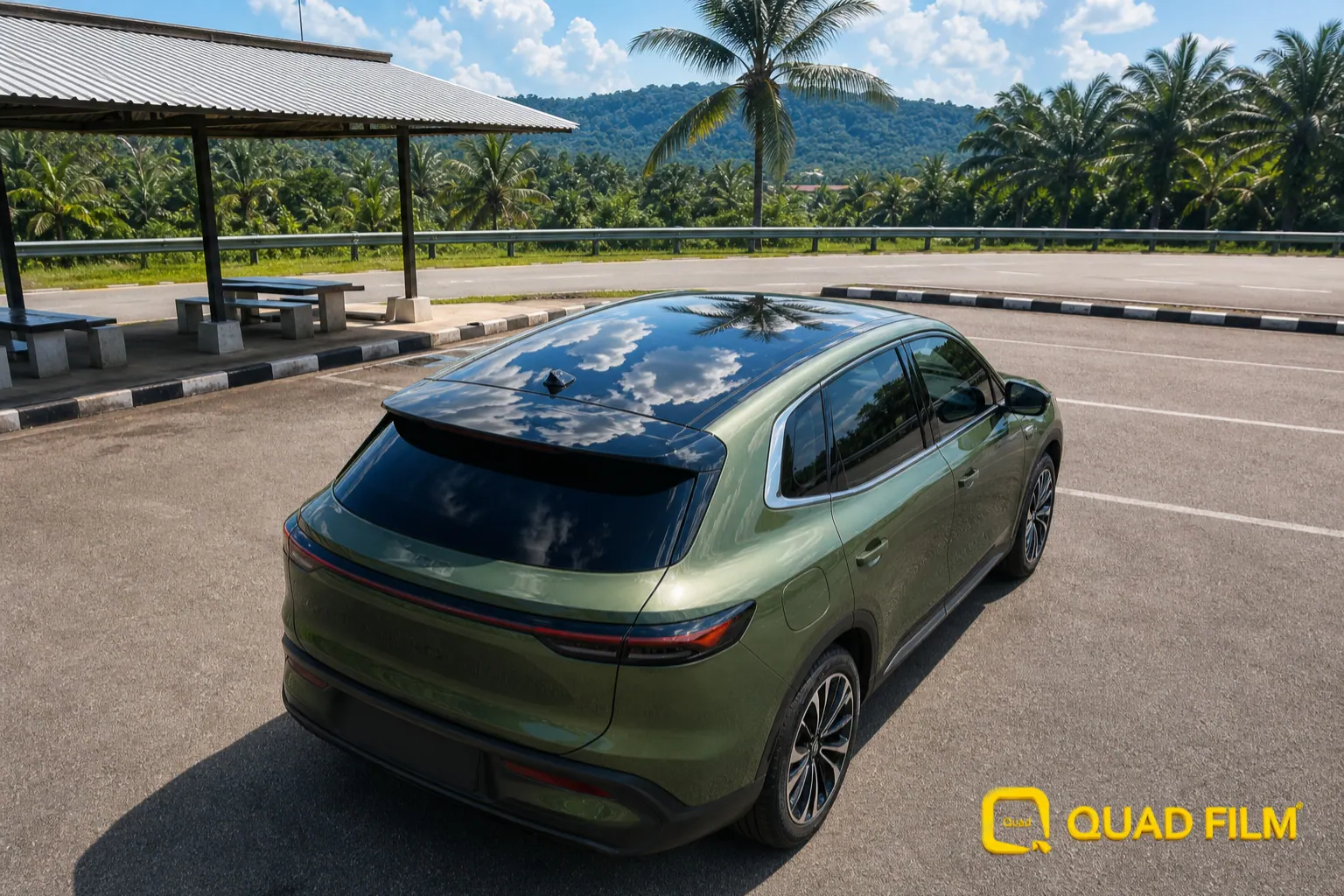
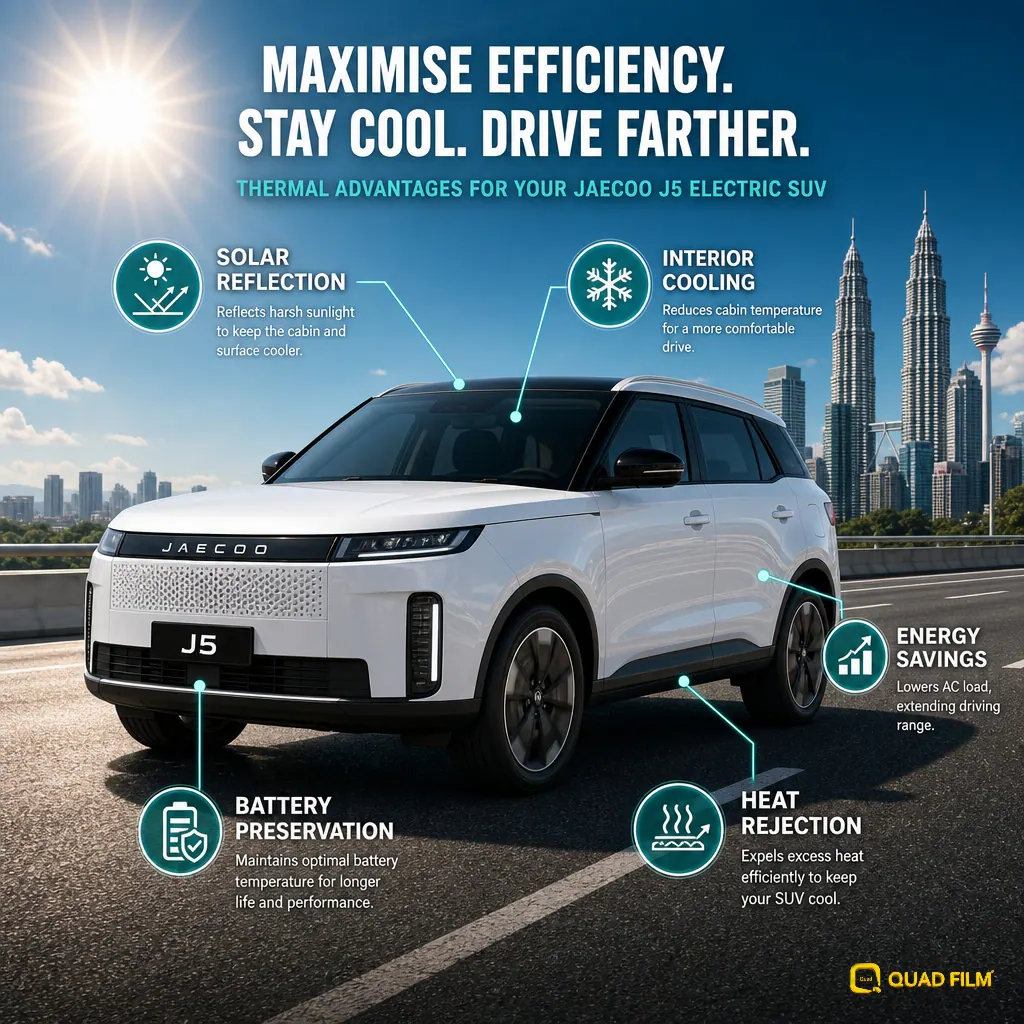
- On the J5 EV the air conditioning runs off the same battery that moves the car, so heat you let in is range you do not get.
- Heat rejection matters more on a small battery, not less. At 58.9 kWh and 402 km, this car has less slack than the EVs it gets compared with.
- Quad's own testing showed a 10 percentage point battery difference over 140 km. On a J5 EV pack that projects to roughly 40 km of range, or about six minutes at a DC charger.
- Pre-cooling from the app does not save range. It moves the spending earlier. Film is the only step that reduces the total.
- METALUX 70 on the windscreen, METALUX 50 on the front doors, METALUX 20 at the back. JPJ sets the first two, you choose the third.
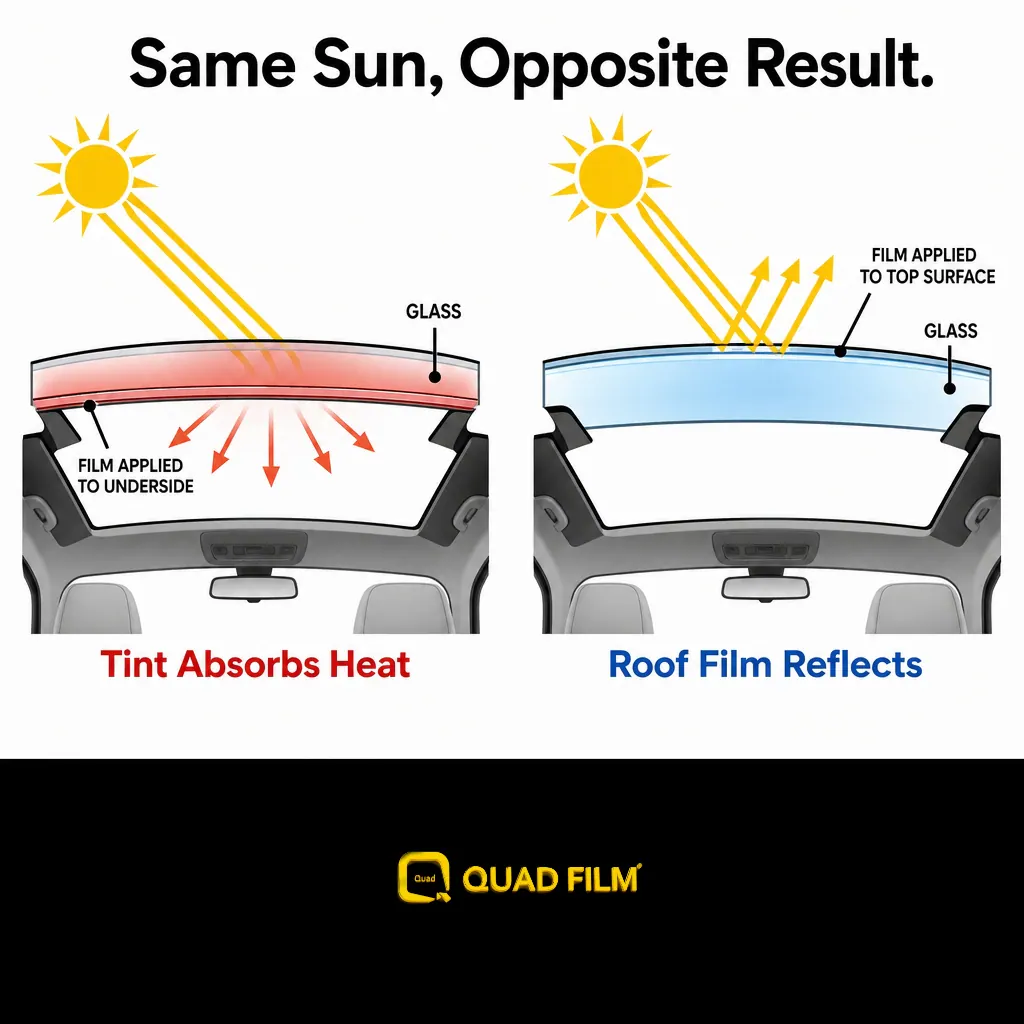
- The panoramic roof needs a different product entirely. Tint sits under the glass and absorbs. Roof film sits on top and reflects.
If you are pricing Jaecoo J5 window tint in Malaysia and you have the EV, the useful way to think about it is not comfort. It is kilometres. Every bit of heat that gets into the cabin has to be pulled back out by an air conditioner drawing from the same battery that turns the wheels.
That makes film a range decision as much as a comfort one, and it puts the J5 EV in an interesting spot. At 58.9 kWh and 402 km, this is not a car with a huge buffer to give away. For why EV owners choose differently from petrol owners, start with the best window tint for EVs in Malaysia.
This is the range-first plan. What heat actually costs you, why the app cannot fix it, and what goes on each pane.
Why Heat Costs More on the J5 EV
Everyone writes about tint and range on expensive EVs with big batteries. The argument is stronger on this car, and the reason is arithmetic.
A 10 percent air-conditioning saving on a 100 kWh pack and a 10 percent saving on a 58.9 kWh pack are the same percentage. What differs is what that percentage means to you on the day. A car rated at 600 km can lose 60 km to a hot cabin and you still arrive without thinking about it. A car rated at 402 km loses 40 km and you start doing sums at Tapah. Smaller battery, less slack, more of your attention spent on the readout. So the film earns its place faster here, not slower.
The J5 EV also carries a panoramic glass roof on a 4,380 mm body. That is a lot of glass over a small cabin, which means the same sun lands in less air and the temperature climbs faster before the climate control catches up. Park at an open-air rest stop on the PLUS at 1pm, come back after a twenty-minute break, and the system is starting from a much worse position than it would in a larger car. MG owners hit exactly the same thing, and we wrote up the same panoramic roof heat problem on another EV.
None of this is a fault in the car. A panoramic roof is a feature people pay for, and the J5 gives you one. It just means the heat decision is yours to make afterwards rather than one the factory already made for you.
What the Air Conditioning Actually Takes
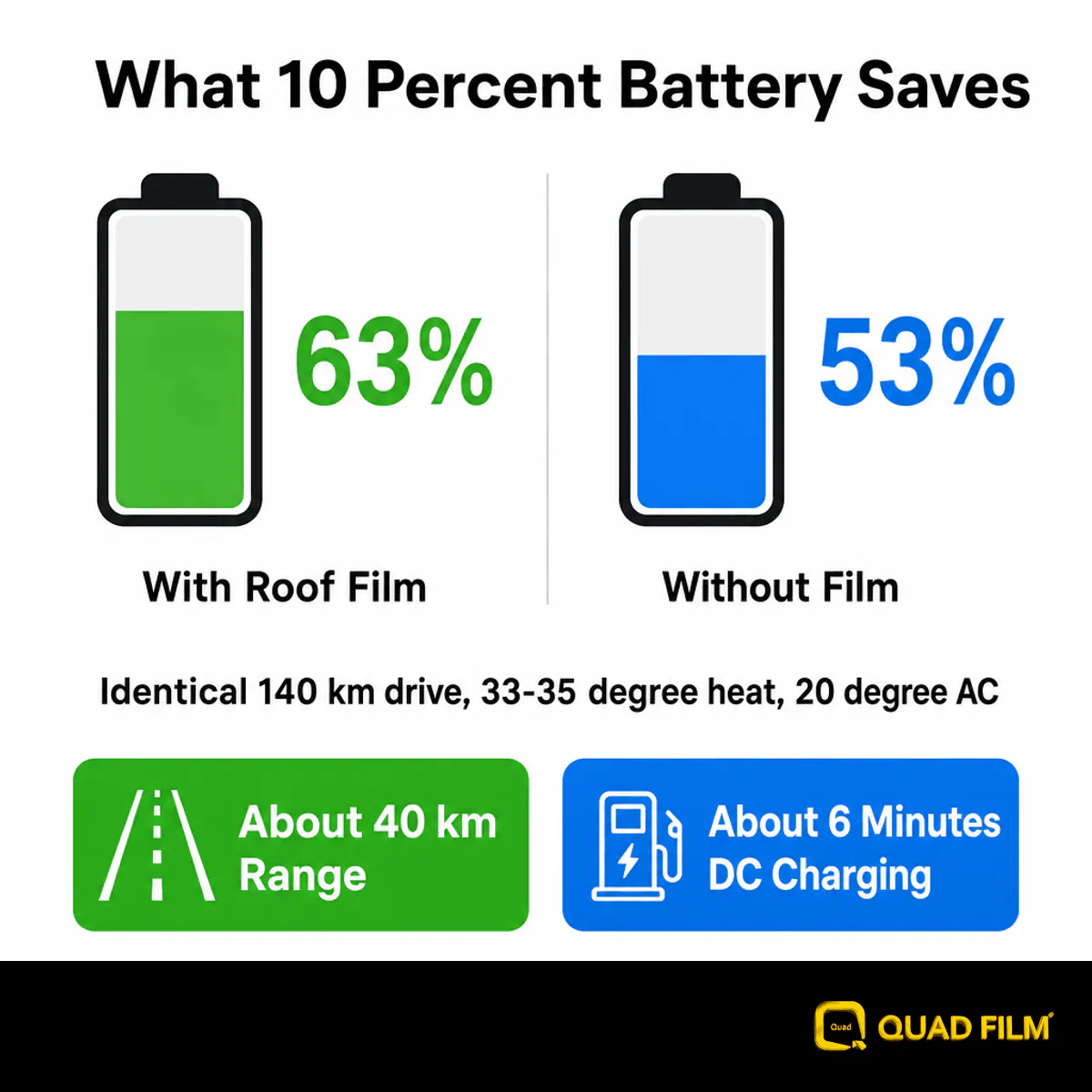
Quad ran the test rather than estimating it, which is the part that makes this worth reading. Ambient temperature 33 to 35 degrees, air conditioning set to 20 degrees, fan on level 10, starting battery 93 percent, 140 km covered.
The car running Quad EV Sunroof PPF finished at 63 percent. The car running the comparison film finished at 53 percent. Ten percentage points of battery, over a single afternoon's drive, from nothing but what was sitting on the roof.
That test was not run on a J5 EV, so here is what the same saving is worth on one. The J5 EV carries 58.9 kWh and is rated at 402 km, which works out at about 6.8 km for every kWh. Ten percent of that pack is roughly 5.9 kWh. Multiply it out and you get about 40 km of range still sitting in the battery when you arrive. That is Kuala Lumpur to Seremban with change, bought purely by keeping the heat out.
There is a second way to read the same number and it may land harder. The J5 EV charges from 30 to 80 percent in 28 minutes on a 130 kW DC charger, so 50 percentage points in under half an hour. Ten percentage points at that rate is about six minutes standing at a charger. Every hot long-distance run, six minutes of your life, spent replacing energy that went into cooling a cabin you could have kept cooler in the first place.
Why Pre-Cooling Does Not Save Range
Every EV owner gets told the same trick. Pre-cool the car from the app before you walk out of the mall. It is good advice for comfort and it is worth doing. It just does not do what most people think it does.
Pre-cooling takes the same energy out of the same battery. You are not avoiding the cost, you are paying it ten minutes earlier while the car is parked instead of while you are driving. The cabin is the same temperature, the sun did the same thing to it, and the compressor still has to move that heat out. What you gain is arriving to a comfortable car. What you do not gain is range.
Film is the only step in the whole chain that changes the total rather than the timing. Heat that is reflected off the glass never enters the cabin, so nothing has to remove it later, from the app or from the vents. That is a genuinely different mechanism, and it is worth reading alongside heat rejection versus heat dissipation, because shops sell those two as though they were the same thing.
The practical version is simple. Do both. Film cuts what arrives, pre-cooling handles what already got in before you fitted it, and the app is still the right way to walk into a 24 degree cabin at 3pm in a Mid Valley carpark. Just do not expect the app to show up in your range figure, because it never will.
Best Quad Film for Every J5 Window
Once you accept that heat is the thing you are buying against, the shade choice gets easier. JPJ has already decided two of the five panes for you.
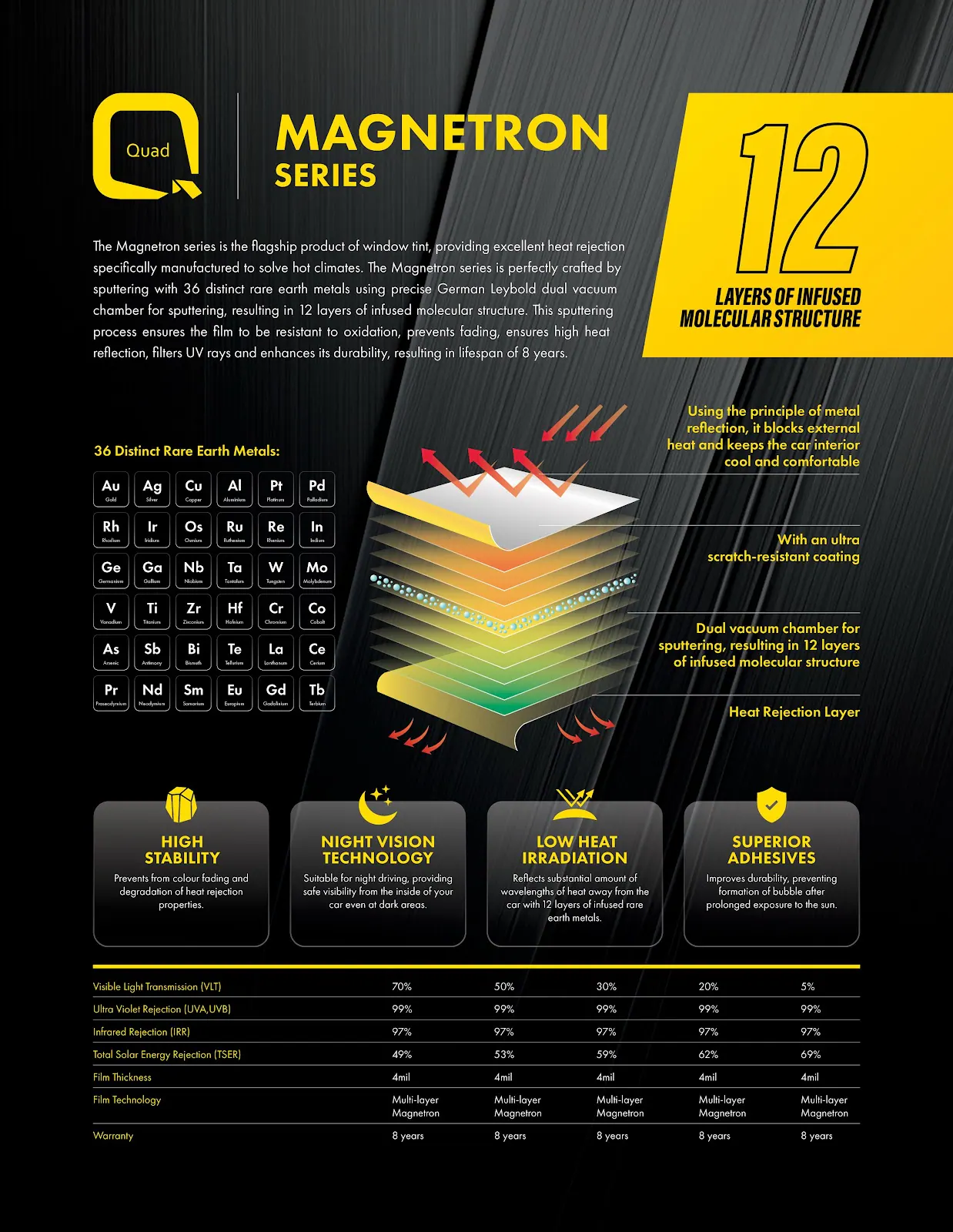
Your front windscreen has to let at least 70 percent of light through and your front side windows have to let at least 50 percent through. The rear side windows, the rear windscreen and the roof have no limit at all. METALUX and MAGNETRON are the two series Quad officially recommends, and for a J5 EV METALUX is the one to ask for. It runs 24 sputtered layers, blocks 99 percent of UV at every shade, and rejects four more points of total solar energy than MAGNETRON at every matching shade.
| Pane | JPJ minimum light through | What to fit | Heat rejected | Why this one |
|---|---|---|---|---|
| Panoramic roof | No limit | Quad EV Sunroof PPF at 72 percent | 95 percent reflected | Sits on top of the glass and reflects before the pane heats up |
| Front windscreen | 70 percent | METALUX 70 | 70 percent | Clearest film in the range for night driving and legal at the line |
| Front side windows | 50 percent | METALUX 50 | 74 percent | Four points more heat rejected than the same shade in MAGNETRON |
| Rear side windows | No limit | METALUX 20 | 80 percent | Privacy plus the strongest heat rejection you can run back there |
| Rear windscreen | No limit | METALUX 20 | 80 percent | Same reasoning as the rear sides |
If you want the step above, MEGALUX runs 48 sputtered layers and adds two more points of total solar energy rejection at every shade. On a petrol car those two points are a comfort upgrade. On an EV they convert into range, because every point of heat you stop is load the compressor does not draw from the pack. It is the one place where paying for the flagship has an argument beyond feeling good about it. Layer count is what drives the difference, and sputtered versus multi-layer sputtered film explains why.
One number you can stop worrying about is UV. Every series in the range blocks 99 percent of it, so nobody is winning your business on that line. Spend the conversation on total solar energy rejection at your exact shade instead, and ask for the figure rather than the headline.
If you are in the petrol J5 rather than the EV, every shade above still applies and the table does not change. What changes is what you get back. On the petrol car the film buys you a cooler cabin and an air conditioner that stops working so hard, which shows up as comfort rather than as a number on a screen. On the EV the same film buys you both. That is the only real difference between the two cars here, and it is why an EV owner can justify going up a series where a petrol owner might reasonably stop at the recommended one.
One last note on the rear glass. It has no legal limit, so this is the pane where personal preference actually gets a say. Go to METALUX 20 if you want privacy and the strongest heat rejection available back there. Stay lighter if you reverse into tight condo bays at night and want the camera view supported by your own eyes rather than only by the screen. Neither choice affects your range meaningfully, so pick the one that suits how you drive.
Why the Roof Needs a Different Film
The roof is the pane that decides how this car feels, and it is the one place where window tint is genuinely the wrong tool.
Window film goes on the inside of the glass. It has to, because the outside of a door window passes through a rubber sweep every time the glass drops. Being on the inside is fine on a door. On a roof it is a problem, because most of a tint's heat performance comes from absorbing energy and then shedding it, which means the roof glass above the film has to get hot first. Then that hot glass radiates downward, straight at the heads of everyone in the car. You have not stopped the heat, you have moved where it is stored.
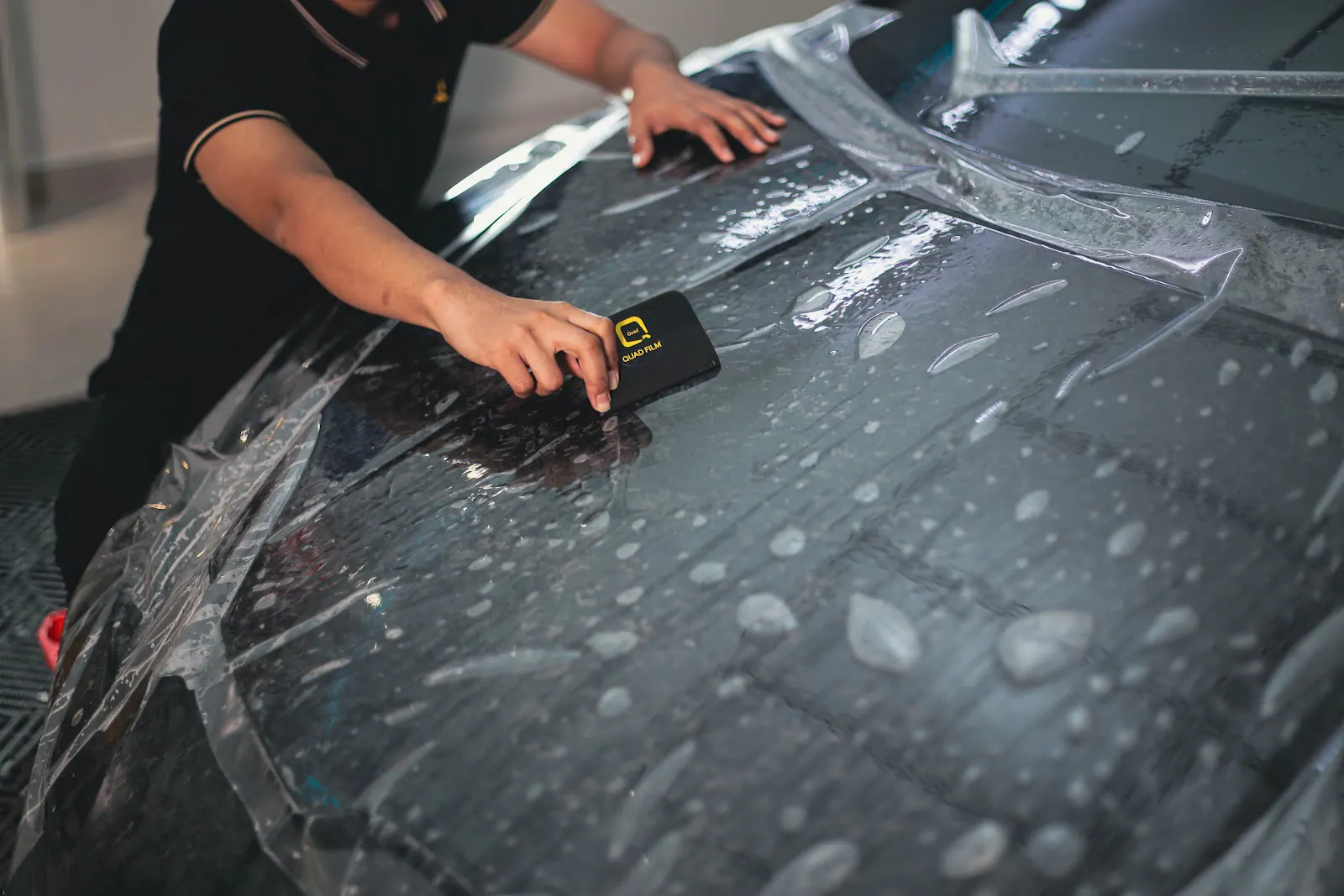
Quad EV Sunroof PPF goes on the outside and reflects instead. It is magnetron sputtered with 24 layers of rare earth metals, gold and silver among them, and it bounces 95 percent of the heat away before it reaches the glass at all. It blocks 99 percent of UV. It holds 72 percent light transmission, so the roof still reads as a roof rather than a dark lid, which matters on a car where the panoramic glass is part of what you bought.
It also does something tint cannot. At 7 mil it is thick enough to hold a large pane together, absorbing and spreading impact rather than letting the glass let go all at once. On a fixed panoramic roof with no frame breaking it into sections, that is worth having over your passengers. The interplay between panoramic roofs and EV range shows up on every car with this layout, and we ran the same argument on the iCaur 03.
Mistakes J5 EV Owners Make With Tint
Four keep coming up, and all four cost either money or range.
The first is buying on the infrared number. Infrared rejection is the biggest figure on the brochure and it only describes one slice of sunlight. Total solar energy rejection describes all of it, and it is the number that turns into kilometres on an EV. A film can post a very high infrared figure and still let plenty of the rest through. Ask for the total solar energy figure at the exact shade you are buying, which is the first thing on our checklist of what to look at before you pay.
The second is skipping the roof to save on the job. It is the largest pane, it takes the sun square on at midday, and on this car it is the single biggest contributor to the load your compressor has to fight. Cutting the roof out of the quote to keep the total down is the one economy that undoes the reason you are tinting at all.
The third is going illegally dark up front and thinking it helps. It does not help range in any meaningful way, it risks a compound and an on-the-spot strip at a roadblock, and it comes back again at Puspakom. The legal shade on your front doors already rejects 74 percent of total solar energy. There is nothing worth buying past it.
The fourth is opening the windows too early. Fresh film has not fully bonded for the first few days and the door glass runs through a tight rubber sweep every time it moves. Leave the windows shut for about three days. A scratch dragged down new film does not buff out.
Get It Done Before the First Long Trip
If the car is new or the booking is in, sort this before the first proper drive north. The difference between a filmed car and an unfilmed one on the PLUS at 2pm is the difference between watching the range readout and not thinking about it.
Order it by what it buys you. Roof first, because that is the biggest single pane and the biggest single load. Front doors next, because that is where you sit and where the legal shade happens to be the strong one. Rear glass last, because it is the cheapest gain and the one you can add later without disturbing anything already fitted.
Book it as one visit if you can. The car occupies the same bay whether it is having glass done, roof film done, or both, so doing them together costs you one morning instead of two. Ask three things when you call. Whether they have fitted roof film before, whether they will give you the total solar energy figure at your shade rather than the infrared headline, and how long to leave the windows shut. A shop that answers all three straight has done this properly, and very few installers handle sputtered film well.
Jaecoo J5 Window Tint FAQ
Does window tint improve the Jaecoo J5 EV range?
Indirectly and measurably. The air conditioning draws from the drive battery, so heat the film stops never has to be removed. Quad's own test over 140 km showed a 10 percentage point battery difference, which projects to roughly 40 km on a J5 EV pack.
What tint percentage is legal for a Jaecoo J5 in Malaysia?
At least 70 percent light through the front windscreen and at least 50 percent through the front side windows. The rear side windows, the rear windscreen and the panoramic roof have no legal limit.
Should you tint the Jaecoo J5 panoramic roof?
Not with window tint. Tint goes on the inside of the glass and works largely by absorbing, so the roof pane still heats up and radiates down at you. A reflective roof film fitted on the outside is the right product for that pane.
Does pre-cooling the Jaecoo J5 EV from the app save battery?
No. It takes the same energy from the same battery, just earlier. It is worth doing for comfort, but it moves the cost rather than removing it. Film is the only step that reduces the total.
What is the best window film for a Jaecoo J5 EV?
METALUX is the one to ask for, at 70 on the windscreen, 50 on the front doors and 20 at the back. MEGALUX is the step up if you want the highest total solar energy rejection, which converts more directly into range on an EV than on a petrol car.
Does the Jaecoo J5 EV need different tint from the petrol J5?
The legal limits and the shades are the same. What changes is the payoff. On the petrol car heat costs you comfort, and on the EV it costs you range as well, so the case for the stronger film and for doing the roof is simply harder to argue against.
How long after tinting a Jaecoo J5 before you can open the windows?
About three days. The door glass passes through a tight rubber sweep every time it drops, and film that has not finished bonding will pick up a fine scratch from it.
Protect your Investment today
Don't wait for stone chips to ruin your paint. Speak to our experts about custom PPF and Tinting solutions.