
- Ask for the shade and the heat rejection figure of each pane separately, not one number for the whole car.
- Ask which two panes carry a legal minimum before you agree to anything darker.
- If you have a Flagship, ask what goes on the roof and make them quote it as its own line.
- Ask whether the film being quoted is metallic or ceramic. It changes more than the price.
- Get the series name written on the job sheet, not just a percentage.
Proton X50 window tint in Malaysia is really three separate decisions wearing one name. Two of your panes are capped by law, three are entirely open, and on a Flagship the largest pane on the car is not a window at all in the way the rules mean it.
In the X50 owners' group on Facebook, a member asked outright whether X50 owners need to tint the sunroof to stop the heat. PCauto runs a standing page answering nothing more than whether the car has one. The question keeps coming up because the answer is not on any brochure.
You are probably reading this either before collection or after a hot afternoon in a car you already tinted. Either way the fix starts with knowing which pane is doing what, and our breakdown of heat rejection against heat dissipation explains why a car with good film can still feel wrong when you first get in.
What JPJ Sets and What It Leaves Open
Two panes carry a minimum. The front windscreen must let at least 70 percent of visible light through, and the front side windows at least 50 percent. The rear side windows and the rear windscreen have no minimum at all, so those are your decision entirely.
The rule is about the driver being seen, not the cabin being comfortable. It covers the glass in front of you and the two windows either side of you, and it stops there. Everything behind the B-pillar sits outside the regulation.
Which means most of the choice on an X50 is unregulated, and that is where people get it wrong in the opposite direction. Freedom on the rear glass becomes an argument for fitting the darkest film available, which trades away heat rejection for privacy without anybody saying so out loud.
Worth knowing what enforcement actually looks at too. A roadblock check is a meter held against the windscreen and the driver's window, because those are the two panes with a number attached to them. Nobody is measuring the rear doors of a family SUV. That is not permission to fit anything you like back there, it is just a reason to make the rear decision on comfort and visibility rather than on fear.
There is one more thing the rules do not mention, and on a Flagship it is the important one. Nothing in the regulation covers the roof panel. The largest single sheet of glass on the car sits completely outside the conversation about legal minimums, which is exactly why it deserves a decision of its own.
Why the Flagship Roof Is a Different Problem
Only the Flagship gets the panoramic sunroof. Proton lists it as a feature of the X50 and the 2025 facelift coverage confirms it is exclusive to the range topper alongside the two-tone interior and the black roof. If you have an Executive or a Premium, skip this section.
If you do have it, that panel behaves differently to every other piece of glass on the car. Side windows meet the sun at a steep angle that shifts through the day, so a lot of the energy arriving at them comes in off-axis. The roof faces the source almost square on between about eleven and three.
The factory shade does less than owners expect. It sits under the glass. It stops light reaching your head, which makes the cabin darker and easier on the eyes, but the pane above it still absorbs energy and still radiates it downward. Darker is not the same as cooler when the fabric is on the wrong side of the glass.
That is the case for treating the roof as its own line item rather than an afterthought at the end of a tint quote. Different area, different angle, different heat path, and quite possibly a different product to the one going on your doors.
That clip works through exactly this, comparing what window film does on a sunroof against what a dedicated sunroof product does, which is a comparison most counters never actually put in front of you.
How to Pick a Shade for Each Pane
Front to back, one pane at a time. The first two are capped, the next two are open, and the fifth is a separate product decision. Treating all five as one purchase is how a car ends up with the wrong film in the place it matters most.
Step 1: Windscreen Within the Legal Cap
Seventy percent visible light is the floor, so this pane takes the lightest film in whichever series you pick. MEGALUX at VLT 70 rejects 72 percent of total solar energy, which is the strongest figure available inside the limit.
Step 2: Front Doors at the 50 Percent Floor
The legal minimum here is 50 percent light transmission. MEGALUX at VLT 50 rejects 76 percent of total solar energy, MAGNETRON rejects 70 percent, and both carry 99 percent infrared rejection.
Step 3: Rear Doors for the People Back There
No minimum applies. VLT 30 is the usual landing spot for families, giving real privacy without turning the rear cabin into a cave when you are reversing at night.
Step 4: Rear Windscreen for the Mirror
This is the pane you look through every time you change lane on the Federal Highway. VLT 30 keeps the interior mirror genuinely usable while giving up nothing meaningful on heat.
Step 5: Panoramic Roof as Its Own Product
This is not a shade decision. It is a decision about whether you want the roof to stay see-through, and it belongs on the quote as a separate line with its own numbers.
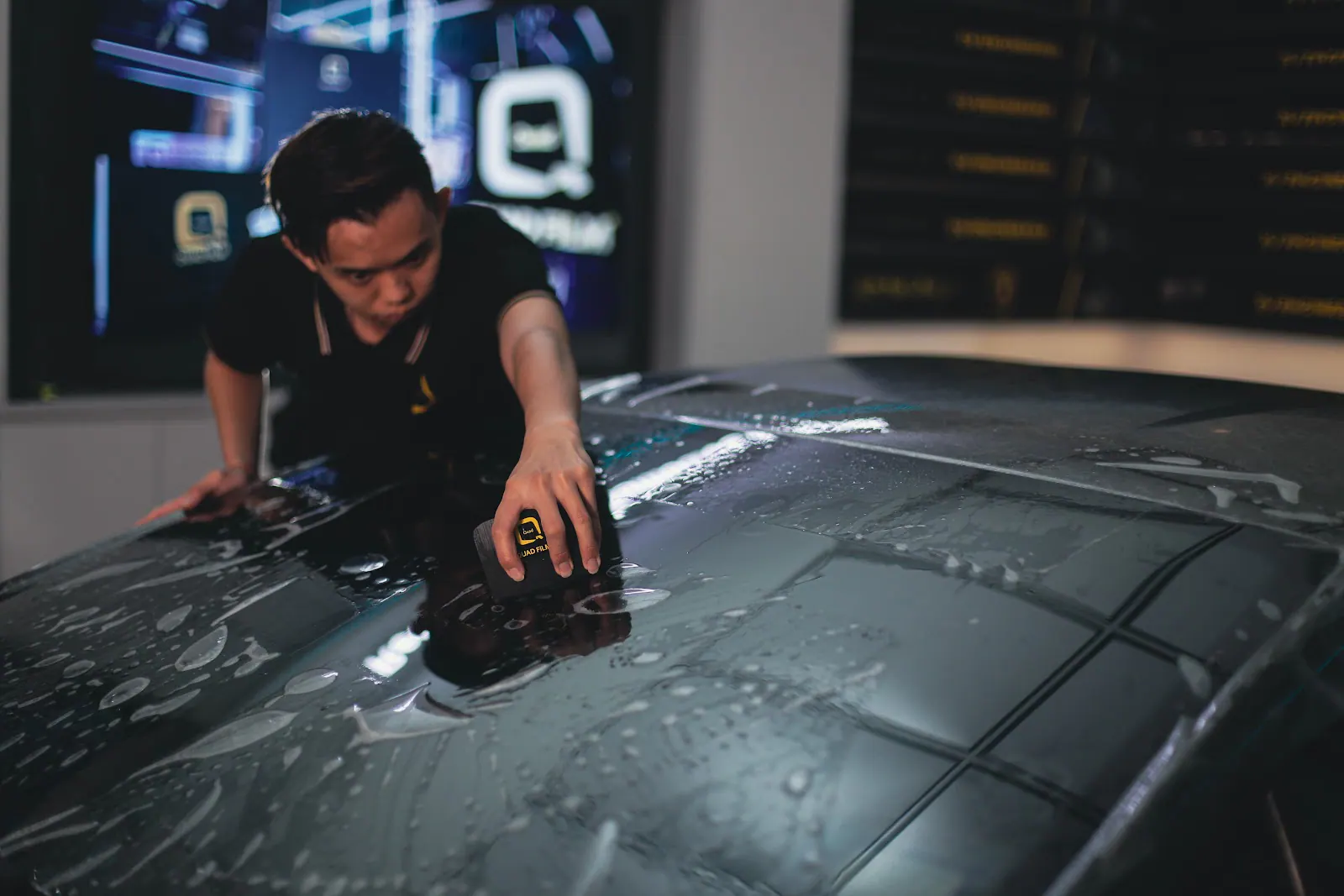
Roof work is harder than door work for one reason. The installer is working above their own head against gravity across a large single sheet, and there is nowhere to hide a mistake on a pane that size.
It is also the pane where preparation shows up most. Dust that would disappear into the pattern of a door window sits in plain view on a roof panel you look up at from underneath, lit from behind by the sky. Shops that rush the clean stage get caught out here first, and it is the reason a roof job takes longer than its area suggests it should.
What 30 Degrees Off the Cabin Looks Like
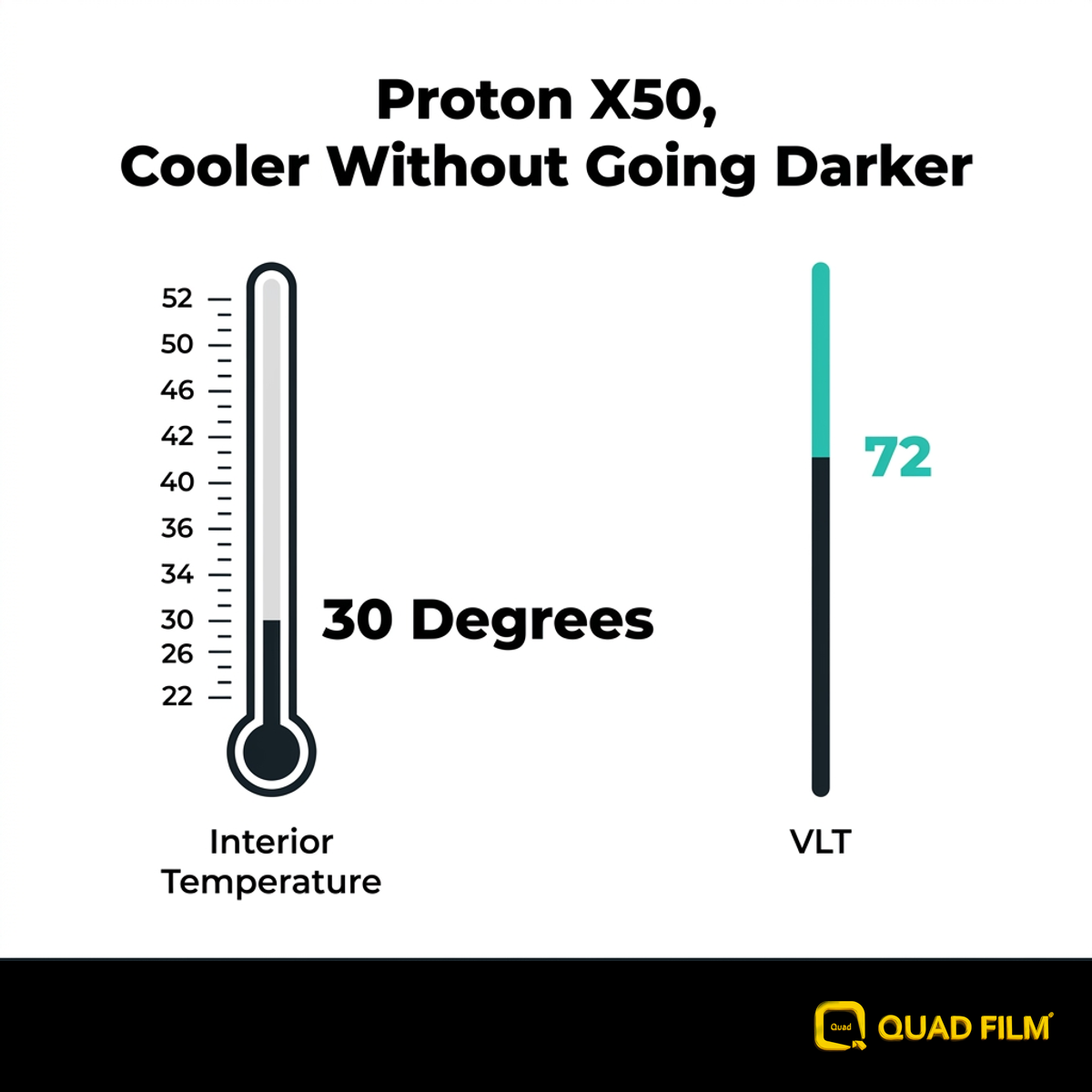
Quad EV Sunroof PPF is a 7 mil film built with magnetron sputtering and 24 layers of rare earth metals including gold and silver. It reflects more than 95 percent of heat, blocks more than 99 percent of ultraviolet, and reduces interior temperature from 52 degrees to 22 degrees, while holding visible light transmission at 72 percent.
That last pairing is the whole point. Seventy-two percent light transmission means the roof stays a roof you can see through. You are not trading the view for the temperature, which is exactly the trade a dark tint would force you into on that pane.
Here is the comparison in numbers. Across the MEGALUX range, total solar energy rejection climbs from 72 percent at VLT 70 to 85 percent at VLT 5. So chasing 13 more points of heat rejection with tint costs you 65 points of visible light transmission. The sunroof film holds VLT 72 and still takes the interior from 52 degrees to 22, a drop of 30 degrees, with no darkening trade at all.
None of that changes what you should put on the side glass, where the legal cap does most of the deciding for you. It changes what you put overhead, which is the pane nobody quotes properly and the one you sit under every day.
3 Mistakes X50 Owners Make Choosing Film
Buying one film for the whole car, treating high infrared rejection as the finish line, and letting the roof come last. All three end the same way, with a car that was expensive to tint and still hot at two in the afternoon.
Buying One Number for Five Panes
Every pane on the car has a different job and two of them have a legal cap. A single shade across all five means at least one pane is either illegal or underspecified, and usually it is the roof.
Reading Infrared Rejection as the Whole Story
Infrared rejection is 99 percent on MEGALUX, MAGNETRON, MIRACLE and MATRIX, and 97 percent on METALUX. Those numbers are close enough across the range that they cannot be your deciding factor. Total solar energy rejection is what separates the series.
Leaving the Roof Until Last
By the time the side glass is done, the budget conversation has usually already happened. The roof gets postponed, and postponed becomes never, and the largest pane on the car ends up as the only untreated one.
Our checklist of things to verify before paying for tint covers the rest of what to confirm at the counter, and it is a five minute read that saves a long argument later.
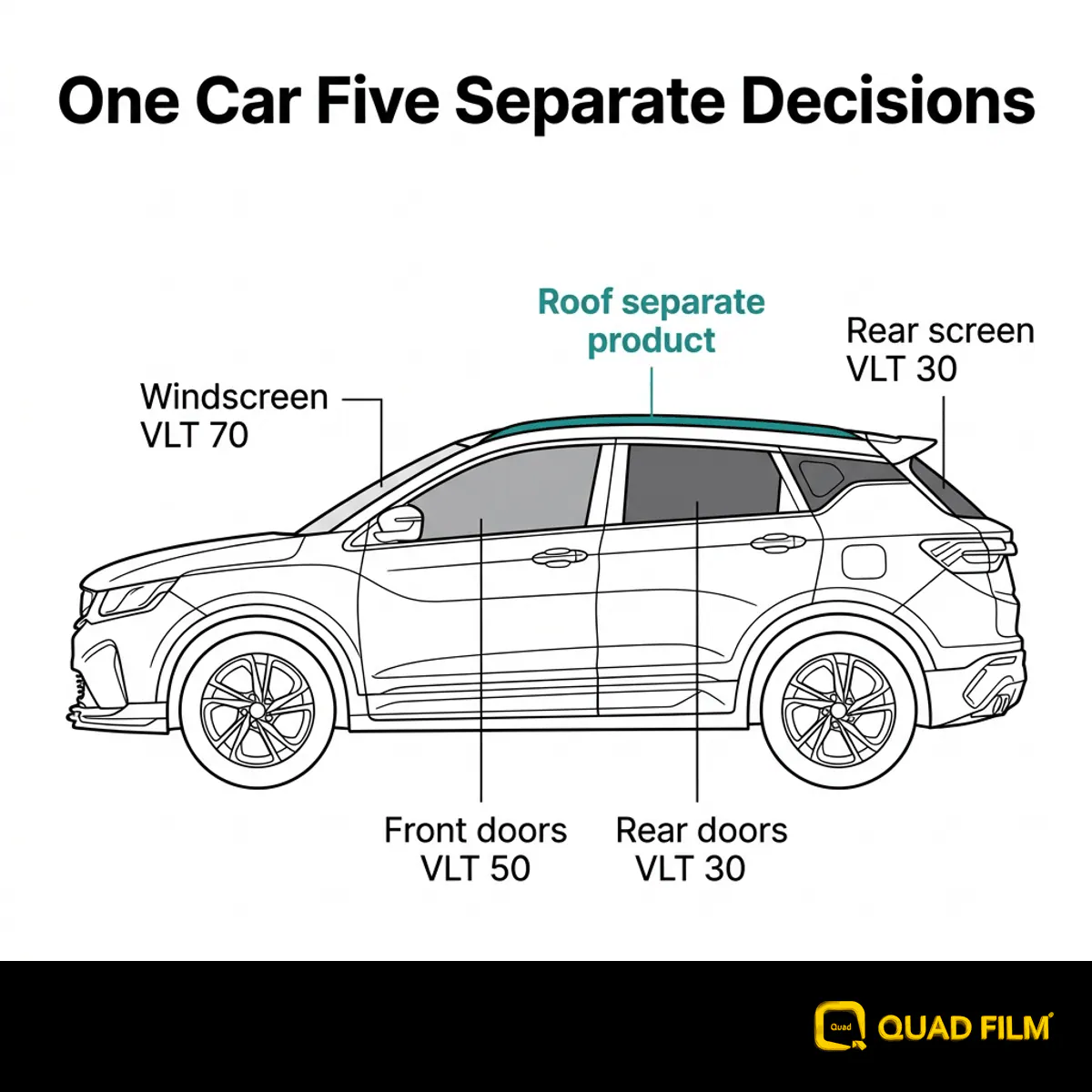
Screenshot that before you go. The most common version of this conversation ends with a single number written across a job sheet, and the point of the layout above is to make that impossible.
Which Quad Series Suits a Petrol SUV
METALUX and MAGNETRON are the officially recommended series, and on an X50 they cover the two things owners actually complain about. METALUX leads on optical clarity and night driving. MAGNETRON leads on total solar energy rejection at the same shade.
METALUX is a 24 layer multi-layer sputtered film using 36 rare earth metals through a German Leybold dual-vacuum chamber. Infrared rejection is 97 percent, ultraviolet rejection 99 percent, and total solar energy rejection runs from 70 percent at VLT 70 up to 83 percent at VLT 5. It is the clarity and night vision film rather than the highest infrared figure in the range.
MAGNETRON is a hybrid, combining 12 sputtered layers with nano-ceramic. Infrared rejection is 99 percent, ultraviolet 99 percent, and total solar energy rejection runs 66 percent at VLT 70 up to 79 percent at VLT 5. The hybrid construction is built for colour stability and consistent heat rejection over time.
MEGALUX sits above both as the flagship, with 48 sputtered layers across four cycles, 99 percent infrared rejection and the highest total solar energy rejection in the range at every shade. MIRACLE is the ultraviolet specialist at 100 percent ultraviolet rejection, and MATRIX is the entry nano-ceramic film at 2 mil.
| Glass | JPJ minimum VLT | Suggested spec | TSER | IRR | Why this pane |
|---|---|---|---|---|---|
| Front windscreen | 70 percent | MEGALUX VLT 70 | 72 percent | 99 percent | Best figure available inside the legal floor |
| Front side windows | 50 percent | MEGALUX VLT 50 | 76 percent | 99 percent | Legal floor with the strongest heat rejection |
| Rear side windows | No minimum | MAGNETRON VLT 30 | 74 percent | 99 percent | Privacy for rear passengers with stable colour |
| Rear windscreen | No minimum | METALUX VLT 30 | 78 percent | 97 percent | Clarity through the pane you use to reverse |
| Panoramic roof (Flagship) | No minimum | EV Sunroof PPF, VLT 72 | Reflects over 95 percent of heat | Blocks over 99 percent UV | Stays see-through and drops interior temperature |
Every figure in that table is the published specification for that series at that shade. There is no range and no hedging in any of them, which is deliberate, because a spec quoted as a range is a spec nobody can hold anyone to.
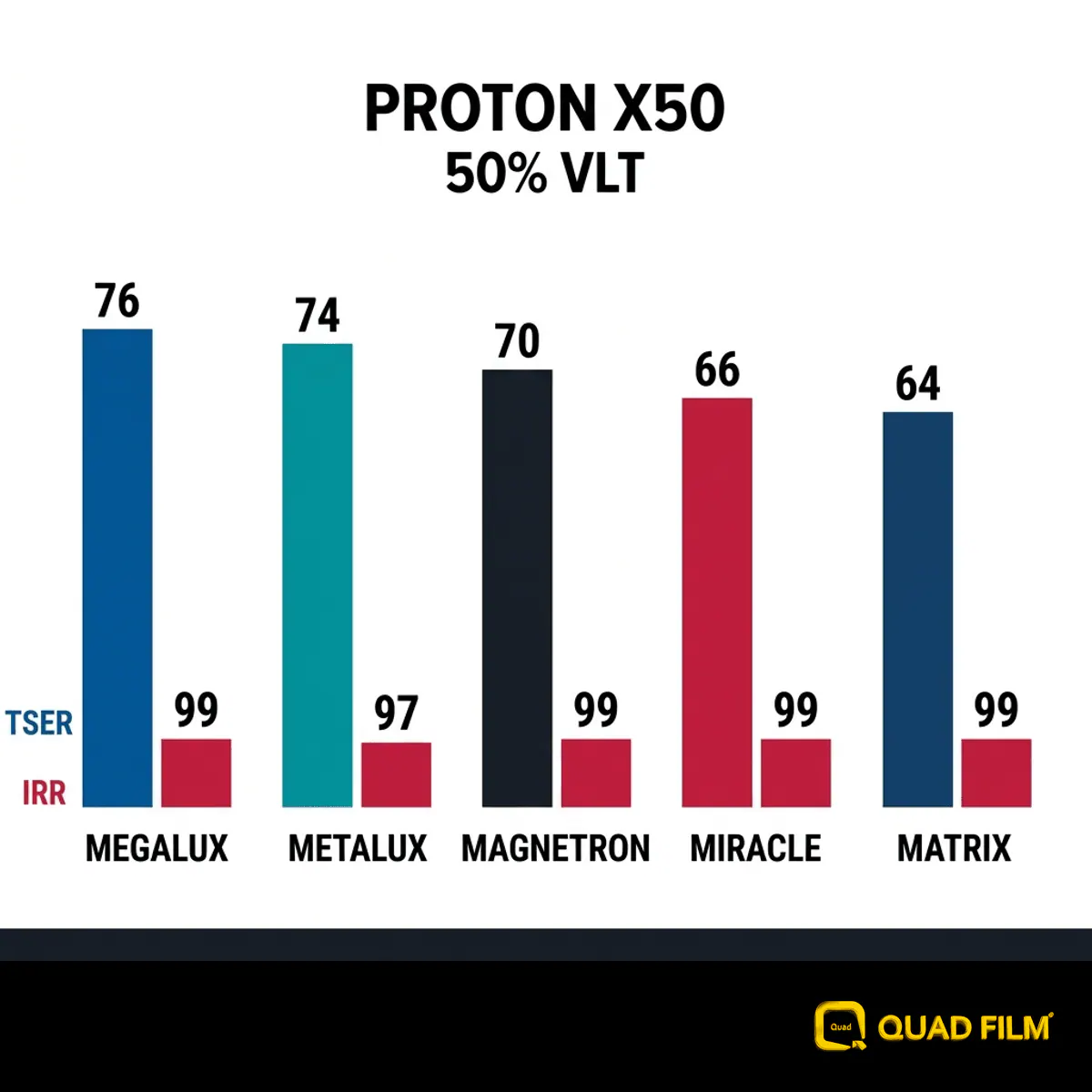
Look at how flat the infrared line is across all five series and how much the heat bar moves. That gap is the reason infrared rejection cannot be the number you choose on, and it is the single most useful thing to understand before you walk into a shop.
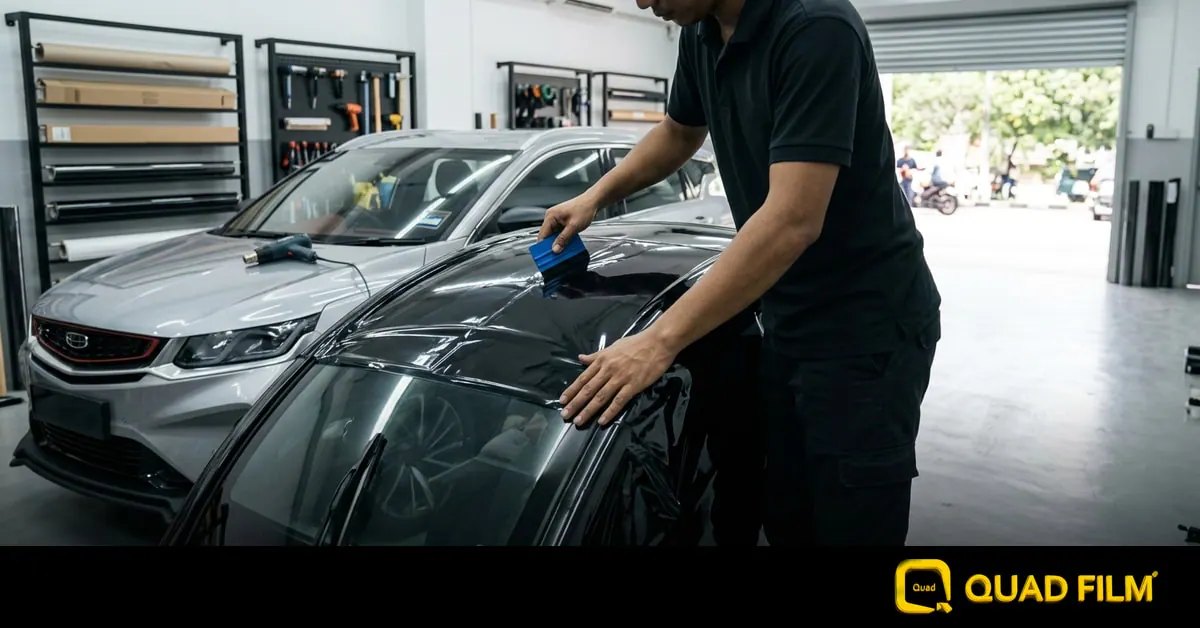
Watching a real installation end to end is worth more than any spec sheet when you are trying to judge a shop. The preparation, the cutting, the way the door card is handled, all of it is visible in the first two minutes of a job.
Getting Your X50 Spec Written Down
Write five lines before you call anyone. Windscreen, front doors, rear doors, rear screen, roof. Next to each one put the series name and the shade, and next to that put the total solar energy rejection figure you were quoted.
Then check the job sheet says the same thing. A percentage on its own is not a specification, because VLT 30 in one series and VLT 30 in another are different films with different numbers behind them. The series name is what makes the line checkable a year from now, and our explainer on sputtered against multi-layer sputtered film covers why that distinction matters more than the shade does.
Take a photo of the job sheet before you hand the keys over. It costs you two seconds and it is the only version of the agreement that survives if anyone remembers the conversation differently later on.
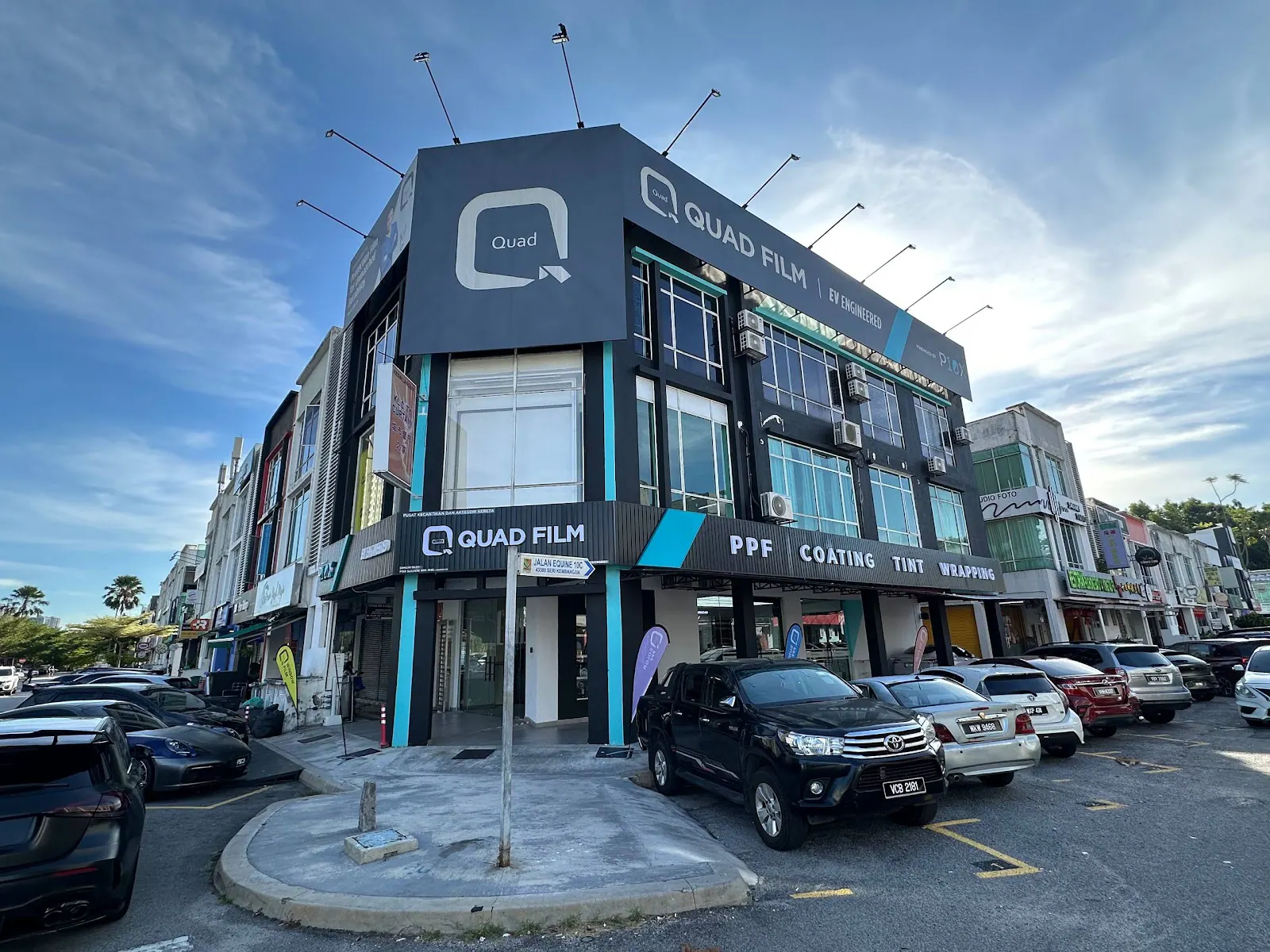
Every decision on this page gets made across a counter like that one, before the car goes anywhere near a bay. Once film is cut to a pane it is cut, and a change of mind at that point stops being a conversation.
Decide the roof before the rest, not after. If the Flagship panoramic pane is going to be part of the job, it changes the shape of the whole quote, and it is much easier to plan around at the start than to bolt on at the end. Quad Film works through the panes one at a time if you ask for it that way.
Proton X50 Window Tint Questions Owners Ask
What is the best tint percentage for a Proton X50 in Malaysia?
Seventy percent on the windscreen and 50 percent on the front doors, because those are the legal floors. Behind the B-pillar there is no minimum, and VLT 30 is the usual choice for the rear doors and rear screen because it gives real privacy without hurting the mirror view at night.
Does the Proton X50 have a panoramic sunroof?
Only the Flagship. Proton lists a panoramic sunroof on the X50 and the 2025 facelift coverage confirms it is exclusive to the range topping variant, along with the two-tone interior and the black roof. The Executive and Premium do not have one.
What is the legal window tint limit for a Proton X50?
The front windscreen must transmit at least 70 percent of visible light and the front side windows at least 50 percent. The rear side windows and the rear windscreen carry no legal minimum.
Should I tint the sunroof on my Proton X50?
The roof is the largest single pane on the car and the only one facing the sun almost square on in the middle of the day. A dedicated sunroof film reduces interior temperature from 52 degrees to 22 degrees while still transmitting 72 percent of visible light, so the pane stays see-through.
Is 99 percent infrared rejection the number to buy on?
No, because it barely moves across the range. MEGALUX, MAGNETRON, MIRACLE and MATRIX are all 99 percent, and METALUX is 97 percent. Total solar energy rejection is the figure that separates them, and at VLT 50 it spans from 76 percent down to 64 percent.
Does window tint help fuel consumption on a petrol X50?
Not directly, but it reduces how hard the air conditioning has to work to bring the cabin down and hold it there. On a car that parks outside all day, that is a real and repeated load rather than an occasional one.
What is the difference between METALUX and MAGNETRON?
METALUX is a 24 layer sputtered film built for optical clarity and night driving, with 97 percent infrared rejection. MAGNETRON is a hybrid of 12 sputtered layers plus nano-ceramic, with 99 percent infrared rejection and a construction aimed at colour stability. Both are officially recommended.
How long does a full car tint take on a Proton X50?
Budget most of a working day for five panes done properly, including shrinking the windscreen film to the curve and letting everything settle before the windows get wound down. A quote of an hour and a half for a full car is not a job that includes those steps.
Protect your Investment today
Don't wait for stone chips to ruin your paint. Speak to our experts about custom PPF and Tinting solutions.