
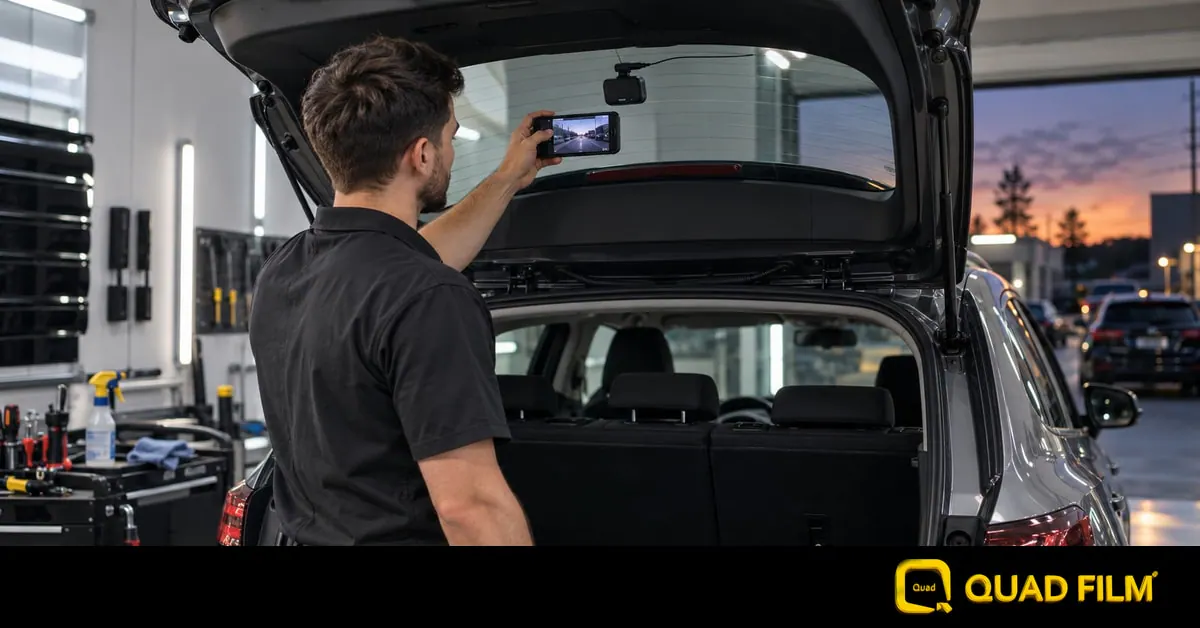
- Dark rear tint can leave a rear dashcam with less detail at night, even when the shade is legal.
- Factory glass and film both reduce visible light. A film rating alone cannot tell you the finished window reading or camera performance.
- Brighter footage is not always clearer footage. Exposure controls cannot recover detail that was never recorded.
- Private-use cars with both exterior side mirrors fitted have no minimum rear-window VLT, or visible light transmission, under the Malaysian rules.
- Your own saved night recordings, before and after fitting, are more useful than a promise that one shade suits every camera.
A rear dashcam behind dark tint can still record useful night footage, but a legal shade is not a promise that you will see the detail you need. Your camera, the light passing through the finished window and the roads you drive all matter. A bright carpark recording does not tell you what the same camera will capture on a dark road.
Before choosing from our window tint range, it helps to know what your rear camera records now. A clip that shows which car moved into your lane may still have an unreadable number plate. Those are different jobs, and it is better to decide which matters to you before the film goes on.
You may want more privacy for passengers or less sun through the rear glass without losing a useful recording of the car behind. There is no single shade that guarantees all three. You can compare the camera's current recordings with the result after fitting, rather than relying on how clear the glass looks to your eyes.
Dark tint leaves night cameras less light
Dark tint reduces the light reaching a rear dashcam in daylight and after dark. In bright conditions, the camera may still record plenty of detail. On a poorly lit road, losing more light can make vehicles harder to distinguish, even when the same shade looked clear during the afternoon.
Depending on the camera's automatic exposure, the picture may become grainier, moving objects may blur, or dark areas may lose detail. Bright headlights can also leave a plate washed out. A recording can look bright enough overall while the letters you need are missing. Even an untinted window does not guarantee readable plates at night.
Your rear camera may not have the same sensor, lens or recording settings as the front unit. A sharp front recording is therefore not proof that the rear unit will cope with darker glass. BlackVue's DR900S guidance, for example, distinguishes its front HDR, or high dynamic range, processing from the rear camera's night mode. A feature advertised for a two-camera kit may not work in the same way on both cameras.
When choosing car tint in Malaysia, visible light and heat rejection need separate attention. Films can use different materials, but the material alone cannot tell you how your rear camera will record at night. Neither a premium label nor a clear daytime view proves how your particular unit will capture a moving vehicle after dark.
Factory glass changes the finished tint shade
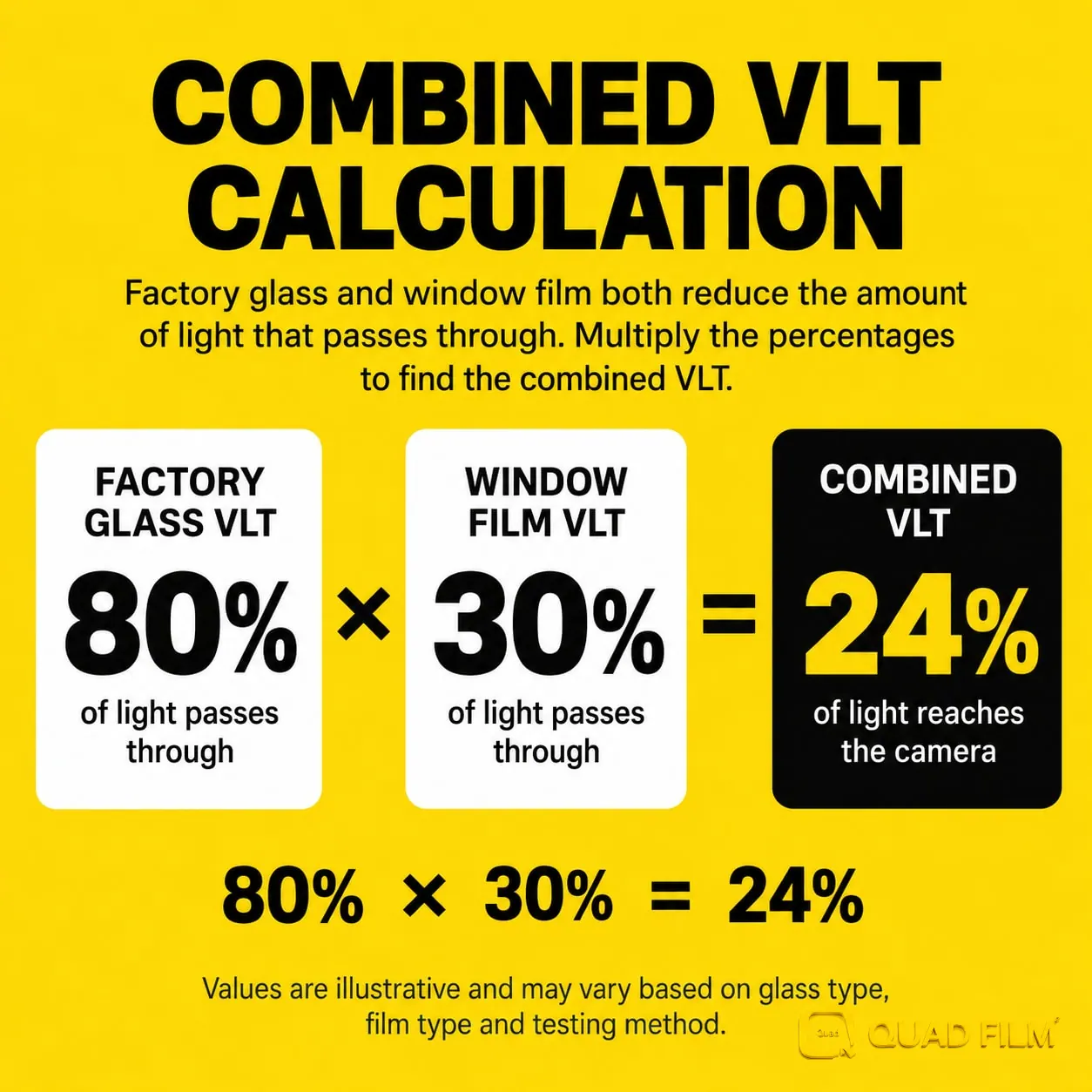
VLT stands for visible light transmission, or how much visible light passes through. Factory glass already reduces that light before film is fitted. A film marked 30% VLT therefore does not mean your completed rear window will measure 30%, and that label does not predict the detail in your recordings.
For an illustrative estimate, suppose the bare glass is 80% VLT and the added film is 30% VLT. Multiplying 0.80 by 0.30 gives 0.24, or roughly 24% combined VLT. Our METALUX range includes a 30% film option, but the 80% glass figure here is an assumption, not a specification for your car.
That calculation shows why the starting glass matters. It is not a finished-window meter reading, a laboratory test of that combination or a percentage of usable camera detail. Your installer can measure the glass before and after fitting. The result tells you how much visible light the meter records through the window, not whether your rear camera will identify a plate.
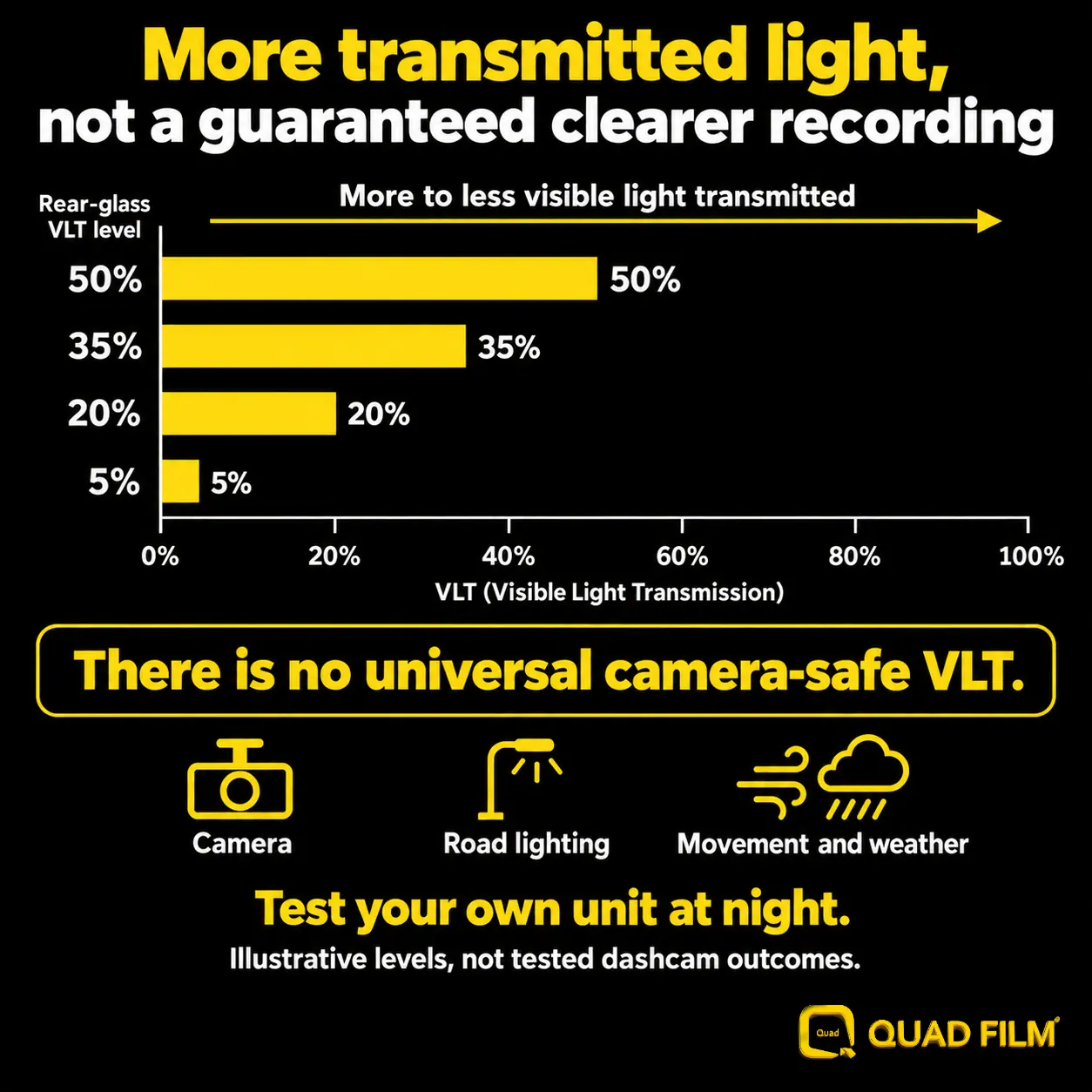
Factory privacy glass starts darker, so another layer of film can leave much less light than you expected. A comparison between 50%, 35%, 20% and 5% combined VLT simply shows more or less visible light passing through. None of those percentages is a universal camera-safe line. You may hear that 20% is enough for any dashcam, but cameras, movement and road lighting vary too much for that promise.
JPJ sets no minimum VLT for rear side windows or the rear windscreen on private-use cars with both exterior side mirrors fitted. The Ministry of Transport’s 2019 parliamentary reply confirms the private-car limits and mirror condition. The front windscreen still needs at least 70% VLT and the front side windows at least 50%. These are legal limits, not camera recommendations. You still need to be comfortable seeing behind you when reversing at night.
Camera settings cannot replace missing detail
Rear-camera exposure or brightness controls may improve a dark recording, but they cannot recover detail the camera never captured. A small adjustment is useful only if the saved clip shows more of what you need. A brighter road with a white, unreadable plate is not necessarily an improvement over the original setting.
Your camera manual can help you check which controls actually affect the rear recording:
- Does the exposure adjustment apply to the rear camera or only the front?
- Can rear brightness be changed separately?
- Does the advertised night mode work on both cameras?
Dashcam retailer BlackboxMyCar’s brightness guidance explains that the control changes exposure, with rear adjustment available where supported. Comparing saved rear recordings before and after one change makes it easier to see what helped. Changing several settings at once can leave you unsure which one made the picture worse.
WDR means wide dynamic range. It tries to retain detail across bright and dark parts of a scene. HDR, or high dynamic range, is another term you may see, but the processing and available controls depend on the model. BlackVue's guidance also notes that its HDR processing can produce visible artefacts around fast moving bright objects. A night mode is worth judging by the resulting clip, not just by its name.
A CPL, or circular polarising filter, can reduce reflections but also blocks some incoming light. VIOFO's filter guidance warns that night footage may become darker or noisier, especially on poorly lit roads. If your rear camera has a removable filter, its manual can explain how to handle it. A comparison with and without it may help you decide whether the reflection reduction is worth the light loss on your routes.
A clean lens and clean glass also help you judge the tint fairly. Smears and reflections can hide detail even before a darker film is fitted. Cleaning advice needs to suit the camera lens and the film, rather than treating both as bare glass. For camera position, the unit's fitting instructions take priority over trying to push the lens as close to the window as possible.
Tint installation needs room around the camera
A rear dashcam already attached to the glass is worth discussing before installation begins. Your installer needs to know where the bracket, cable and nearby connections sit. Water used during fitting is a separate concern from light loss, so an existing camera should not be overlooked just because it still turns on.
Installers use application solution to position film, then smooth it against the inside of the glass, as shown on the front windscreen below. Working around a rear camera adds another access question: whether the installer can reach the glass without wetting the camera, pulling its cable or disturbing the bracket. Those precautions need agreeing before fitting starts.
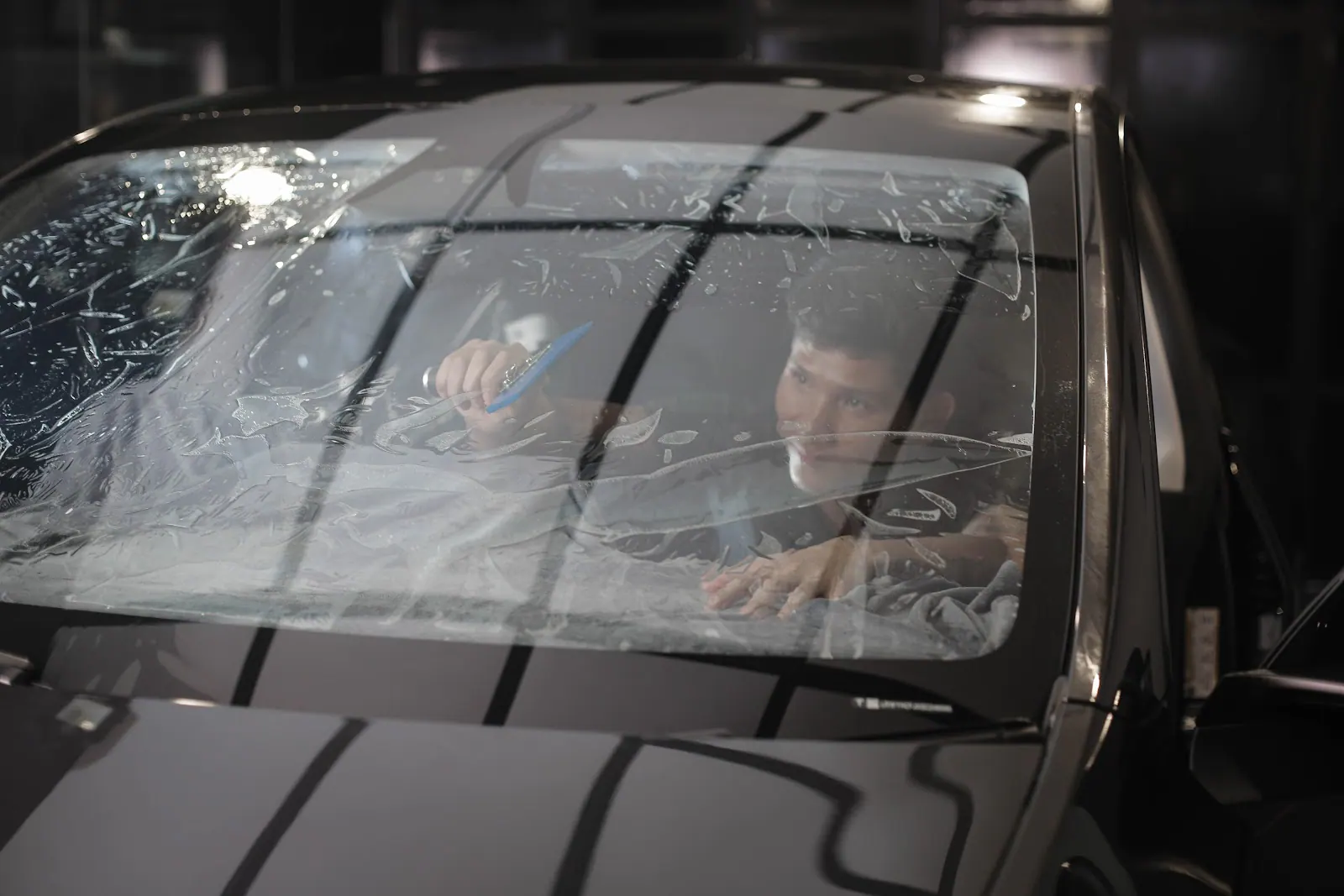
For a rear camera recording through the glass, this article's main concern is the light lost through the tint. Tinting can damage car electronics if fitting water reaches vulnerable components, which is a different problem. If the camera needs to be removed for access, you can agree who will refit it and check its view afterwards. Removal is not something to improvise on fresh film.
Glass needs protection during trimming too. Our installation-details reel shows precautions around cutting on glass, including protective pads. Before agreeing to rear tint work, you can discuss how the installer will protect the glass around the camera bracket and the heating lines. The method needs to suit the access available on your car.
Once the camera is back in place, a saved rear clip can confirm its direction and whether the bracket or cabin reflection has entered the view. A camera that powers up may still be pointing too high or too low. You can review that clip while safely parked, with any further mounting changes handled according to the camera and film fitting guidance.
Privacy does not require the darkest film
A medium rear shade can make the cabin harder to see into during the day while passing more light than a darker option. How much privacy you get also depends on the light inside and outside the car. If the cabin light is on at night, people outside may still see in.
A lighter shade does not automatically mean weaker heat rejection. VLT describes visible light, not the whole range of solar energy. IRR means infrared rejection. TSER means total solar energy rejection and covers the broader solar-energy result in a test. A high IRR number alone does not mean the film rejects that percentage of all heat entering your car.
Our METALUX film is positioned for night driving and glare reduction, with 97% IRR. MAGNETRON lists 99% IRR. Those infrared ratings are not rear-camera performance ratings, and neither makes a dark shade behave like clear glass. For example, the published METALUX table lists 30% VLT with 78% TSER and 70% VLT with 70% TSER. Shade and solar rejection are separate figures worth comparing under the same test conditions.
Your choice need not be the same for every rear window. A rear dashcam looking through the rear windscreen has a different job from a rear side window beside a passenger. You can discuss a lighter rear-windscreen option while considering privacy at the sides. Any proposal still needs to work for your own view out of the car and the camera's saved recordings, rather than matching every pane for appearance.
MATRIX is our entry-level nano ceramic option, with a listed infrared rejection of 99%. It offers different shades, so choosing the series does not settle how dark your rear window will be. The reel shows MATRIX fitted for privacy, not a test of rear-camera detail. Your own night clips are still needed to judge what the camera records.
Night clips show what your camera captures
Your own rear-camera recordings are the most useful way to judge a proposed tint change. A night clip through today's glass gives you a starting point. A recording after installation, on similar roads and in similar lighting, gives you something meaningful to compare. A different car's clip can only be a rough reference.
Before fitting, you can save a short rear clip from your usual drive, along with the current glass reading and camera settings. It helps to include the conditions that matter to you, such as a lit main road and the darker approach to home. There is no need to create a dangerous test or chase another vehicle to capture a plate.
A fitted example car may help you rule out a shade that looks clearly too dark, but a different camera or factory glass changes the result. A loose film sample against your window is less reliable still because it adds an air gap and reflections. It is a rough preview, not proof of how the installed film will perform.
Before agreeing on a shade, you can discuss which rear window the camera uses, whether it must be moved for fitting and how you will compare recordings afterwards. Your current clip gives the installer a clearer idea of the detail you want to keep than a request for ‘good night vision’ alone.

After installation and the curing period your installer advises, you can record similar conditions again. The sequence below keeps the comparison clear: a glass reading and saved clip before fitting, a rough shade preview if available, then a recording through the finished window. Meter readings and video answer different questions, so neither replaces the other.
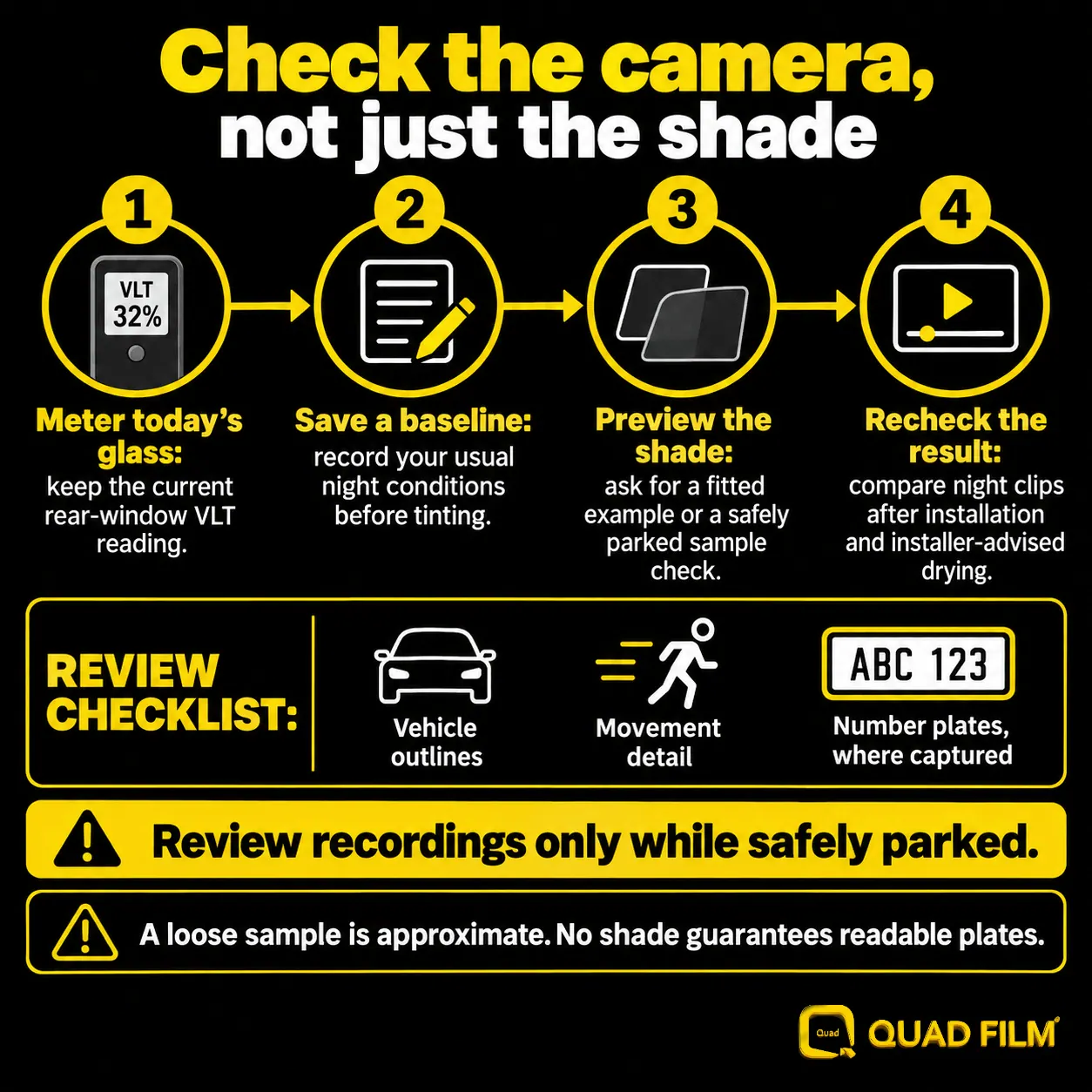
During review, vehicle outlines, direction of travel and movement detail matter alongside any number plates the camera captured. A parked car may show a clear plate that becomes unreadable once it moves. Rain and different headlight angles can also change the comparison, so one good frame is not enough to promise the same result every night.
All playback and setting changes belong while safely parked. If the finished recording loses detail you could previously see, you can compare the saved settings and ask the installer to check the camera's position and glass condition. If the remaining problem is simply too little light through the chosen shade, brighter settings may not solve it. A lighter film may be the more useful change.
Rear tint should suit your night recordings
A suitable rear tint preserves useful night recordings without making your own view too dark. The finished window needs checking with your camera, not just by looking through a sample. You are welcome to bring your car and current clips to our authorised installers to discuss shades, glass readings and checks after fitting.
Frequently Asked Questions
Does window tint affect a rear dashcam?
Yes. Tint reduces the light reaching the camera, which is usually more noticeable at night. Depending on the camera and conditions, recordings may become noisier, darker or more blurred. Daytime footage can still be clear when there is enough light.
What VLT should I choose for a rear dashcam?
No single visible light transmission (VLT) percentage guarantees useful recordings from every rear dashcam. Lighter glass and film together leave more light for the lens, but having your rear glass measured with a tint meter, comparing night footage and checking again after fitting will tell you more than any number. You may hear that a combined 20% is the safe line for a dashcam. It is not, because the camera and the road matter as much as the number.
Is dark rear tint legal in Malaysia?
Yes, for private-use cars with both exterior side mirrors fitted. JPJ sets no minimum visible light transmission (VLT) for rear side windows or the rear windscreen on those cars. The front windscreen still needs at least 70% VLT and the front side windows at least 50%, measured through glass and film together.
Can I fix dark dashcam footage by raising the brightness?
An exposure or brightness adjustment may make dark footage easier to see, but it can also increase grain or motion blur. It cannot recover detail the camera never recorded. If your rear camera has wide dynamic range (WDR), that setting may help balance bright and dark areas. Comparing saved night clips shows whether a change helps your camera.
Does factory privacy glass affect a rear dashcam too?
Yes. Factory privacy glass reduces the light reaching a rear dashcam before any extra film is fitted. Film then goes on top of a window that is already cutting light, so the camera ends up working with less than the film rating suggests. A meter reading shows the visible light passing through that glass, not how well the camera records it.
Will a dashcam CPL filter help or hurt at night?
A circular polarising filter (CPL) reduces reflections but also blocks some light, so night recordings may look darker or grainier. If your rear camera has a removable filter, its manual can explain how to handle it. Comparing saved night clips with and without the filter can show whether it helps on your usual roads. Any changes and playback belong while safely parked.

William Lee
Car Detailing Expert, Blog Editor
"He is a chemical engineer, automotive aesthetic practitioner, and founder in the car protection industry. Through his writing, he provides genuine, practical, and technically grounded information for car owners who want to better understand paint protection film, coatings, window tint, detailing, and long-term vehicle care. His content focuses on clarity, honesty, and real-world results — helping readers avoid misleading claims, poor workmanship, and shortcuts that often lead to premature damage or costly rework. By combining material science knowledge with industry experience, William helps car owners make informed decisions that protect their vehicles with confidence."
View All ArticlesProtect your Investment today
Don't wait for stone chips to ruin your paint. Speak to our experts about custom PPF and Tinting solutions.