

- Ask for the panel list in writing before you compare two quotes. Full front means different things at different shops.
- Ask how far back the bonnet piece goes. That one answer changes the size of the job more than anything else.
- Ask what the plan is for the boot lip and the rocker panels, which a full front never covers.
- Ask whether the film edge is wrapped or trimmed, and where the line lands on each panel.
- Ask about yellowing cover specifically. It is not covered the same way by every brand.
Proton X50 PPF is a coverage decision long before it is a film decision. The panels that get hit on a Malaysian road are not evenly spread across the car, and the standard packages are not shaped around where the damage actually lands.
The X50 is one of the most common cars in any Klang Valley carpark, which means it also spends more time in tight bays, trolley bays and the queue at a drive-through than most vehicles ever will. That is a different damage profile to a weekend car, and it points the coverage list somewhere slightly unexpected.
You are probably here holding two quotes that both say full front and both cost different amounts. The gap between them is almost never the film. It is the panels, and our guide to which car parts actually need film is the fastest way to see why.
Which Panels Take the Damage First
The bonnet leading edge and the front bumper face, in that order, and they are not close to anything else. Both are pointed directly into the airflow at highway speed, which means everything the vehicle in front throws up arrives at closing speed rather than at yours.
After those two, the ranking shifts depending on how you use the car. The front fenders behind the wheels take a constant fine spray of grit that sandblasts rather than chips. The headlights take stones plus years of ultraviolet, and unlike paint they cannot be resprayed back.
Then come the panels nobody quotes and everybody eventually regrets. The boot loading lip, which loses a little paint every time a bag of groceries drags over it. The rocker panels below the doors, which collect road spray on every wet drive. The rear bumper, which meets trolleys and other cars in bays rather than stones on roads.
That last group is where an X50 differs from a car that mostly lives on a highway. A family SUV doing school runs and mall carparks accumulates damage at the back and along the bottom faster than it accumulates chips at the front, and none of it is covered by a front-only package.
There is an easy way to work out which profile you are. Look at your own car under a strong light and count where the marks actually are. If most of them are on the bonnet and bumper, you are a highway car and the standard packages fit you. If most of them are around the boot opening and along the sills, you are a carpark car, and the standard packages are protecting the wrong end. Our piece on getting film after the first chips appear covers what to do once you have already found some.
Why Thicker Film Tears Further
Owners assume the thickest film in a range is the toughest one at every measure. On the Quad clear PPF range that turns out not to be true for one specific property, and it is the property that matters most once something has already gone wrong.
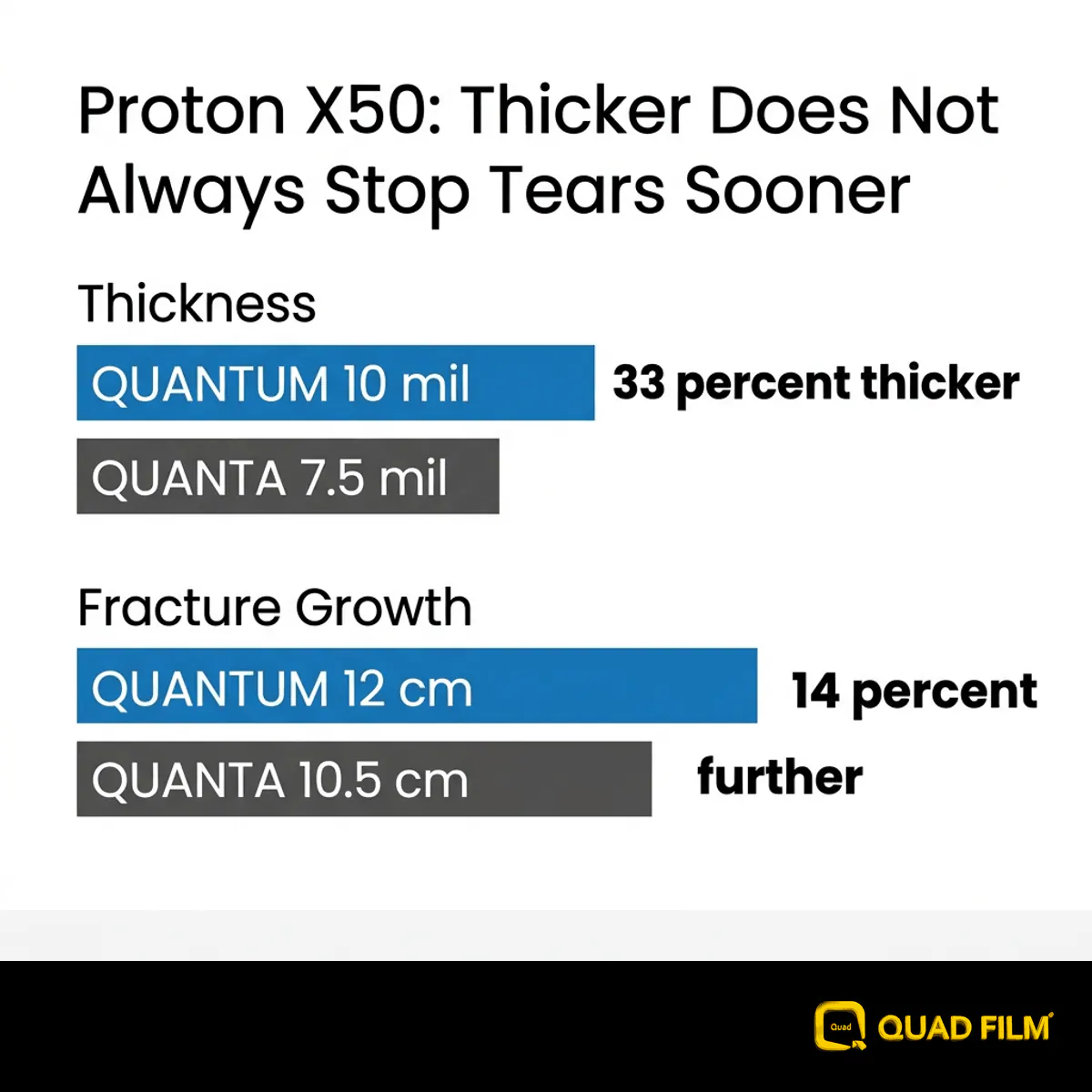
Fracture growth rate is a measure of how far a tear travels through the film once it starts. QUANTUM is the 10 mil film and it measures 12 cm. QUATTRO at 8.5 mil measures 11.5 cm. QUANTA, the thinnest clear film in the range at 7.5 mil, measures 10.5 cm.
Here is the comparison run properly. QUANTUM is 10 mil against QUANTA's 7.5 mil, which makes it 33 percent thicker. But its fracture growth is 12 cm against 10.5 cm, so from the same starting tear the thicker film runs 1.5 cm further, which is about 14 percent further, not shorter. Thickness buys impact absorption. It does not buy tear containment.
None of that makes the thick film a bad choice. It makes it a specific choice, for panels taking repeated direct hits where absorbing the energy is the whole job. On a panel where the risk is a snagged edge or a careless removal, the thinner film is genuinely better behaved.
Adhesion tells a similar story. All three clear films sit at 1,000 gf, which means the thing that changes between them is not how hard they grip your paint. It is how they behave once fitted and how they come away at the end. That is worth knowing because grip is the property owners worry about most and the one that does not actually vary across the clear range at all.
How to Rank Coverage on an X50
Five levels, and most owners stop somewhere between the second and third. Work down the list and stop where the value stops making sense for how you actually use the car, rather than where a package boundary happens to fall.
Level 1: Bonnet Edge and Bumper Face
The two panels taking direct impacts at speed. If nothing else gets film, these two should. Between them they account for most of the chips on a two-year-old car.
Level 2: Add Headlights and Fenders
Lenses haze under our sun and cannot be resprayed. Fenders behind the wheels take the fine grit that dulls paint rather than chipping it. Both are small areas of film for a large share of the visible ageing.
Level 3: Add Mirrors and Door Cups
Mirrors sit out in the airflow and catch what the body misses. Door cups take a fingernail from every person who has ever opened your door, which on a family car is a lot of fingernails.
Level 4: Add the Boot Lip and Rockers
This is the level most quotes skip and most owners want. Groceries, luggage and road spray, on the two surfaces a second-hand buyer looks at hardest.
Level 5: Full Body
Everything, including the roof, rear quarters and rear bumper. Worth it on a car you intend to keep for a decade, and worth thinking twice about on one you plan to change in three years.
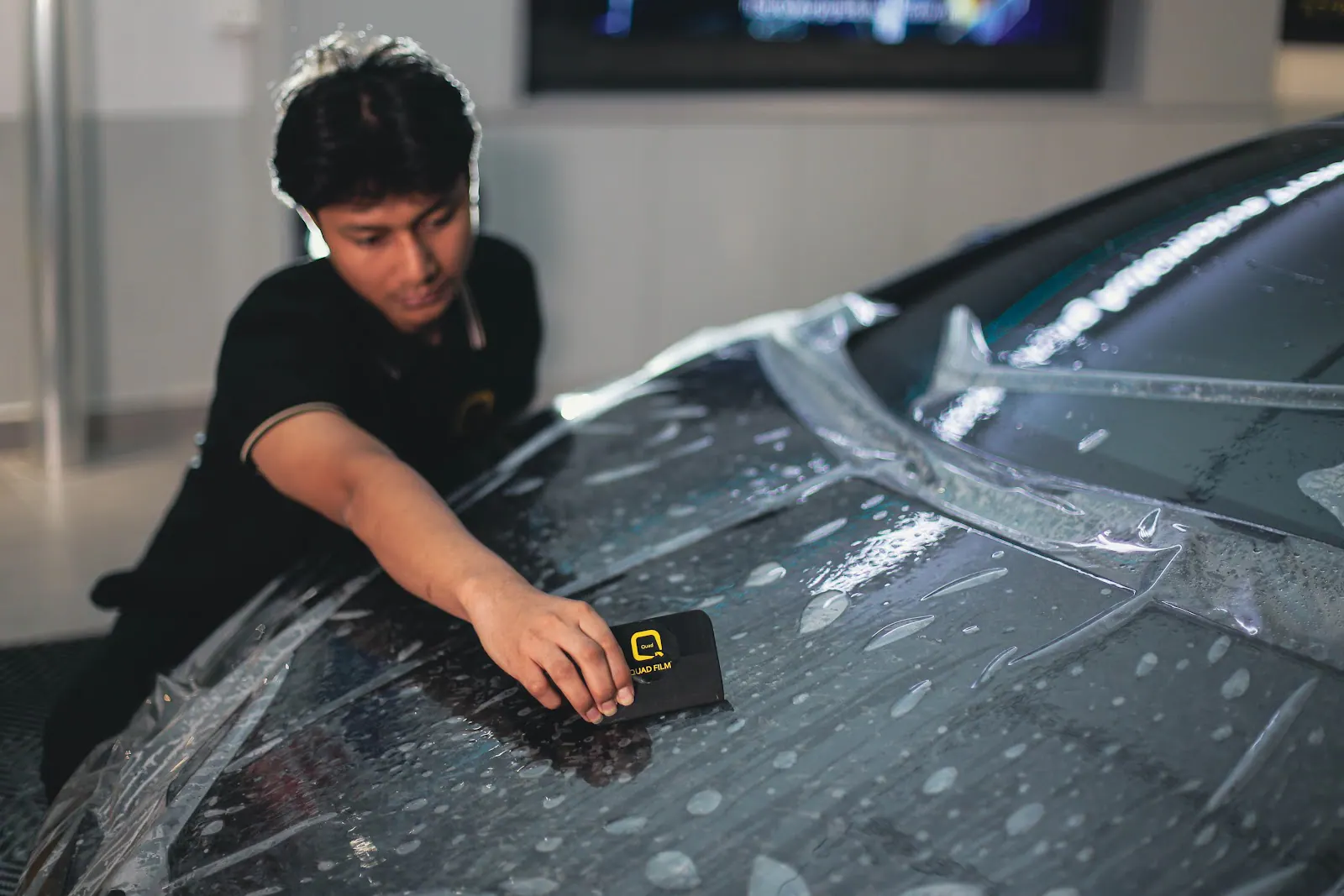
Watch the pressure and the angle in that shot. A bonnet piece laid without tension sits flat for years. One stretched into position wants to pull back to its original shape from the day it goes on, and the first place that shows is the edge nearest the windscreen.
What Full Front Never Touches
Everything from the front doors backwards. Rear doors, rear quarters, boot lid and its loading lip, roof, rocker panels and rear bumper. On an X50 used as a family car, three of those take more damage in a year than the fenders do.
The boot lip is the clearest example. It is a horizontal edge at exactly the height of a shopping bag and exactly the place a suitcase pivots when you swing it into the boot. It loses paint in small amounts, invisibly, over months, and then one day you notice a dull grey line along the whole edge.
The rocker panels are the second. Low, immediately behind the front wheels, and permanently in the path of whatever the tyres throw backwards. Wet season does most of the damage because water carries grit along the panel rather than bouncing it off.
The rear bumper is the third and it is the one people mentally file under bad luck rather than wear. Trolley corners, other people's doors, the bollard nobody saw. Film does not save a bumper from a real impact, but it takes almost all of the scuffs, and scuffs are what actually make a car look tired.
None of those three panels are hard to add. They are small pieces of film compared with a bonnet, they go on quickly, and they can be quoted individually rather than as part of a jump to full body. What stops them getting done is simply that nobody puts them on the list, and a list you did not write is a list somebody else wrote for you. If you are weighing film against a coating instead, our comparison of the two sets out what each one actually stops.
That clip is about why owners choose film in the first place, and the answers in it are mostly about keeping a car looking the way it did rather than about showing anything off.
4 Questions Before You Book Anything
The panel list, the bonnet depth, the edge treatment and the paint condition. Every complaint about a film job that went badly traces back to one of those four not being settled at the counter.
What Exactly Is on the Panel List
Get it written. Bonnet, bumper, fenders, headlights, mirrors, and then explicitly whether door cups, boot lip and rockers are in or out.
How Far Back Does the Bonnet Go
A quarter, a half or the full panel to the windscreen. This single answer changes the film area more than any other line on the quote.
Wrapped Edge or Trimmed Edge
A wrapped edge disappears around the panel. A trimmed edge sits on the paint and collects a dark line of dirt along its length within a year.
What Is Already on the Paint
Film is clear, so anything under it stays visible. Ask for the paint to be checked in strong light and agree what gets corrected before anything is cut.
Our complete guide to film in Malaysia covers the rest of the vocabulary you will hear at a counter, which makes those four questions much easier to ask with confidence.
QUATTRO, QUANTA or QUANTUM on an X50
QUATTRO is the best selling clear film and the sensible default on an X50. QUANTA is the lighter option for owners covering more panels. QUANTUM is the heavy duty choice for a car that lives on highways and takes repeated direct hits.
QUATTRO is 8.5 mil gloss double-layer TPU, with a self-healing rate of 98.5 percent, adhesion of 1,000 gf, fracture growth of 11.5 cm and a release force of 14 gf. Its positioning is increased glossiness, and it is the film most owners end up on because it sits between the two extremes without giving up much at either end.
QUANTA is 7.5 mil gloss, self-healing at 98 percent, adhesion 1,000 gf, fracture growth 10.5 cm and release force 12 gf. Positioned as the invisible daily guard, it has the lowest fracture growth in the clear range and the lowest release force, which makes it the easiest of the three to take off cleanly years later.
QUANTUM is the 10 mil heavy duty armour, self-healing at 99 percent, adhesion 1,000 gf, fracture growth 12 cm and release force 16 gf, with an elongation to break of 490 percent. It scores highest in the range on protection, thickness and gloss, and it is the film to specify when a panel is taking real impacts rather than incidental ones.
| Panel | What it meets | Coverage level | Suggested film | Why |
|---|---|---|---|---|
| Bonnet leading edge | Highway grit at closing speed | Level 1 | QUANTUM | Repeated direct impacts, absorption matters most |
| Front bumper face | Road grit, tar, kerbs | Level 1 | QUANTUM | Same exposure as the bonnet, plus kerb contact |
| Headlights | Stones and ultraviolet | Level 2 | QUATTRO | Clarity over the lens matters more than thickness |
| Front fenders | Fine grit thrown by the tyres | Level 2 | QUATTRO | Sandblasting rather than chipping |
| Side mirrors | Stones in the airflow | Level 3 | QUATTRO | Tight contours need a film that lays down easily |
| Door cups | Fingernails and keys | Level 3 | QUANTA | Small area, easiest film to replace later |
| Boot loading lip | Groceries and luggage | Level 4 | QUANTA | Drag wear rather than impact |
| Rocker panels | Road spray and grit | Level 4 | QUATTRO | Long panel, constant low level abrasion |
| Rear bumper | Trolleys, bays, bags | Level 5 | QUANTA | Scuffs rather than stones |
| Roof and rear quarters | Fallout and general wear | Level 5 | QUANTA | Large flat areas with low impact risk |
QUARMOR is available on request for owners who specifically want a hydrophobic finish. Note that the satin and matte films are separate products entirely. QUATRIX is satin with a soft low sheen and QUBOND is matte with no shine at all, and neither is a variation of the other.
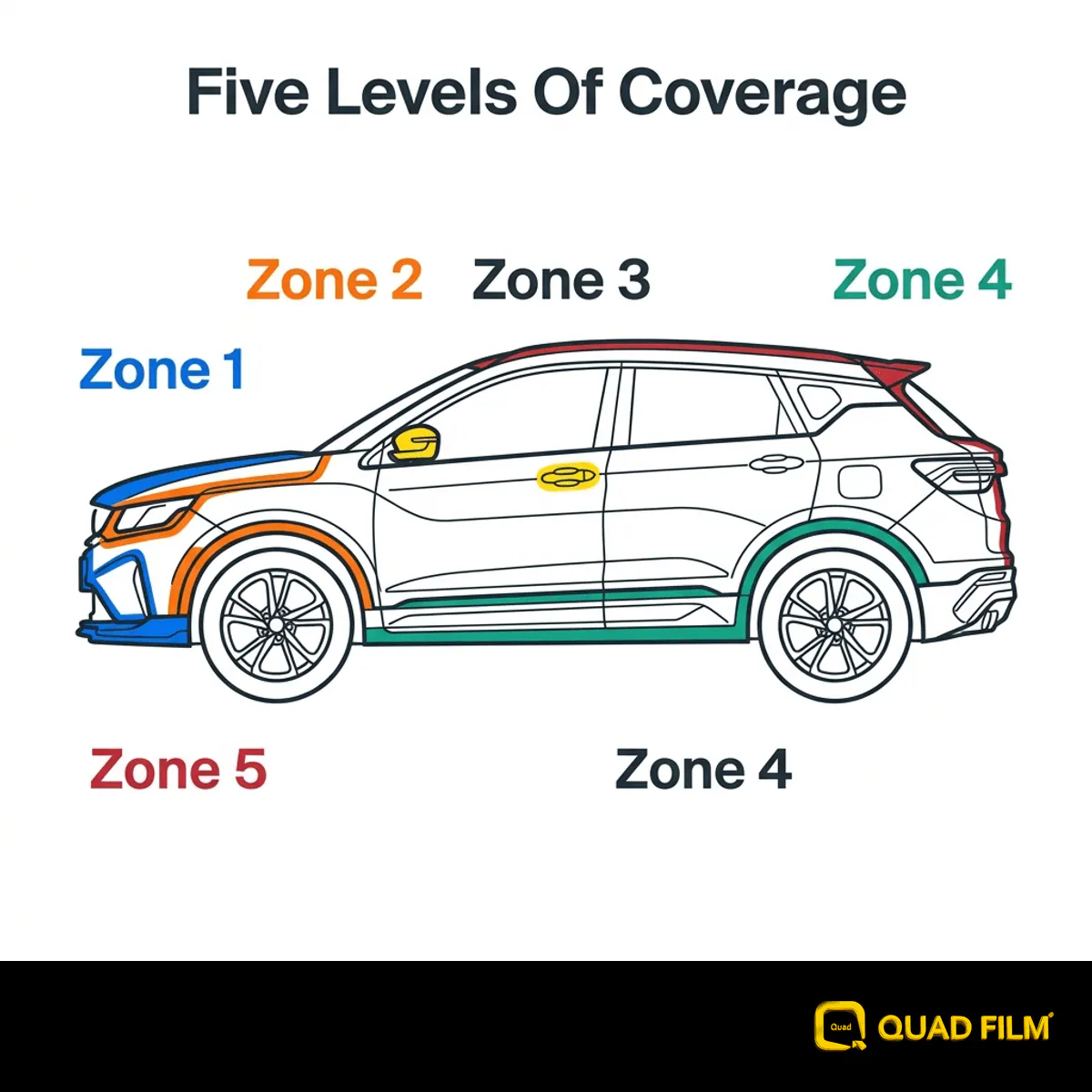
Mark the level you want on that diagram and take it with you. It converts an open ended conversation about packages into a closed one about panels, and it is the only version of the conversation you can check against a job sheet afterwards.
Self-healing is the property most people misunderstand from the outside. It closes light surface scratching in the film when the panel warms up, which in our climate happens on its own most afternoons. It does not undo a chip that went through to paint before the film was fitted.
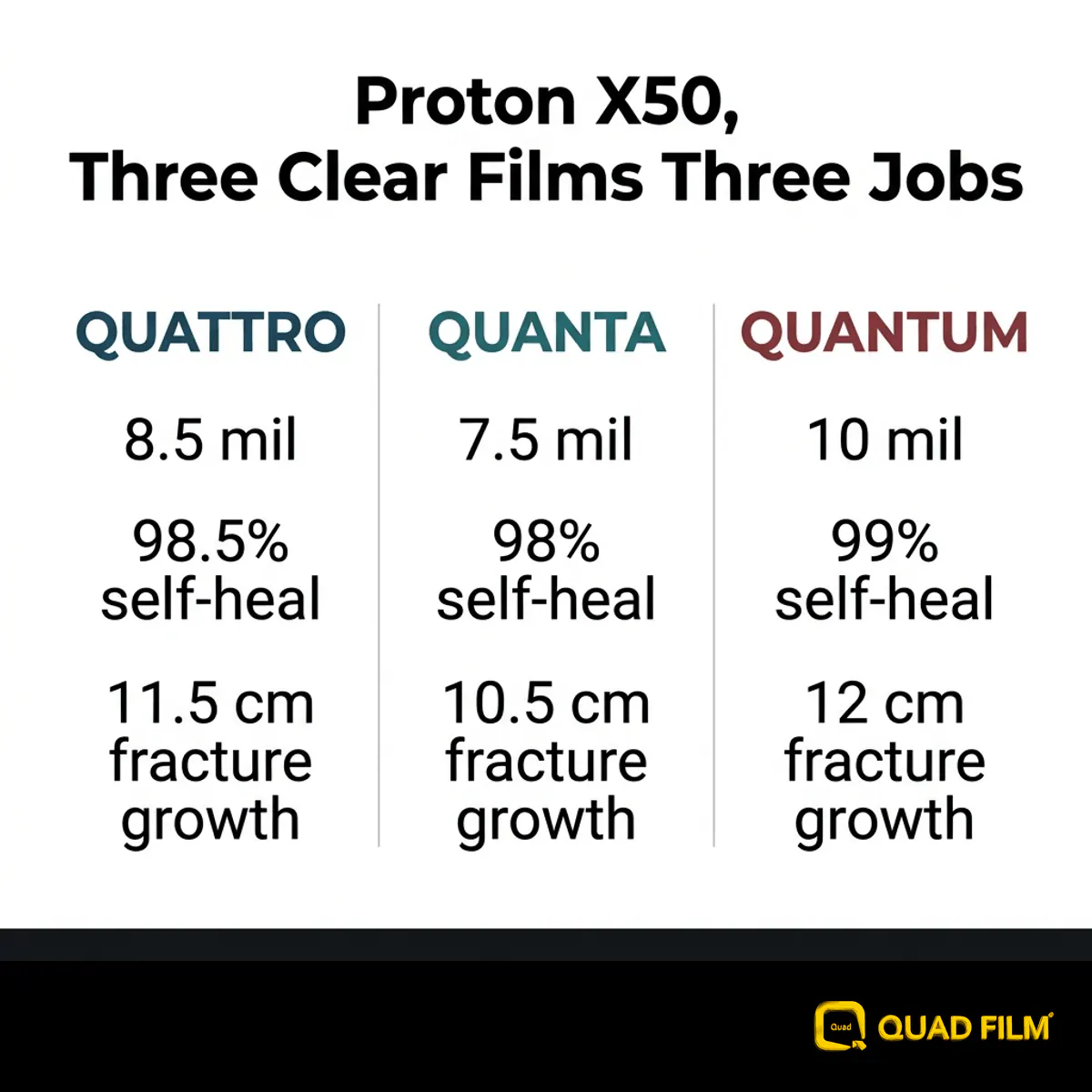
One property worth calling out on that list. Yellowing is covered under the Quad PPF warranty alongside the usual defects, which is not standard across the industry and is worth asking about specifically wherever you end up buying. Our article on what happens to cheap film in our humidity explains why that clause exists.
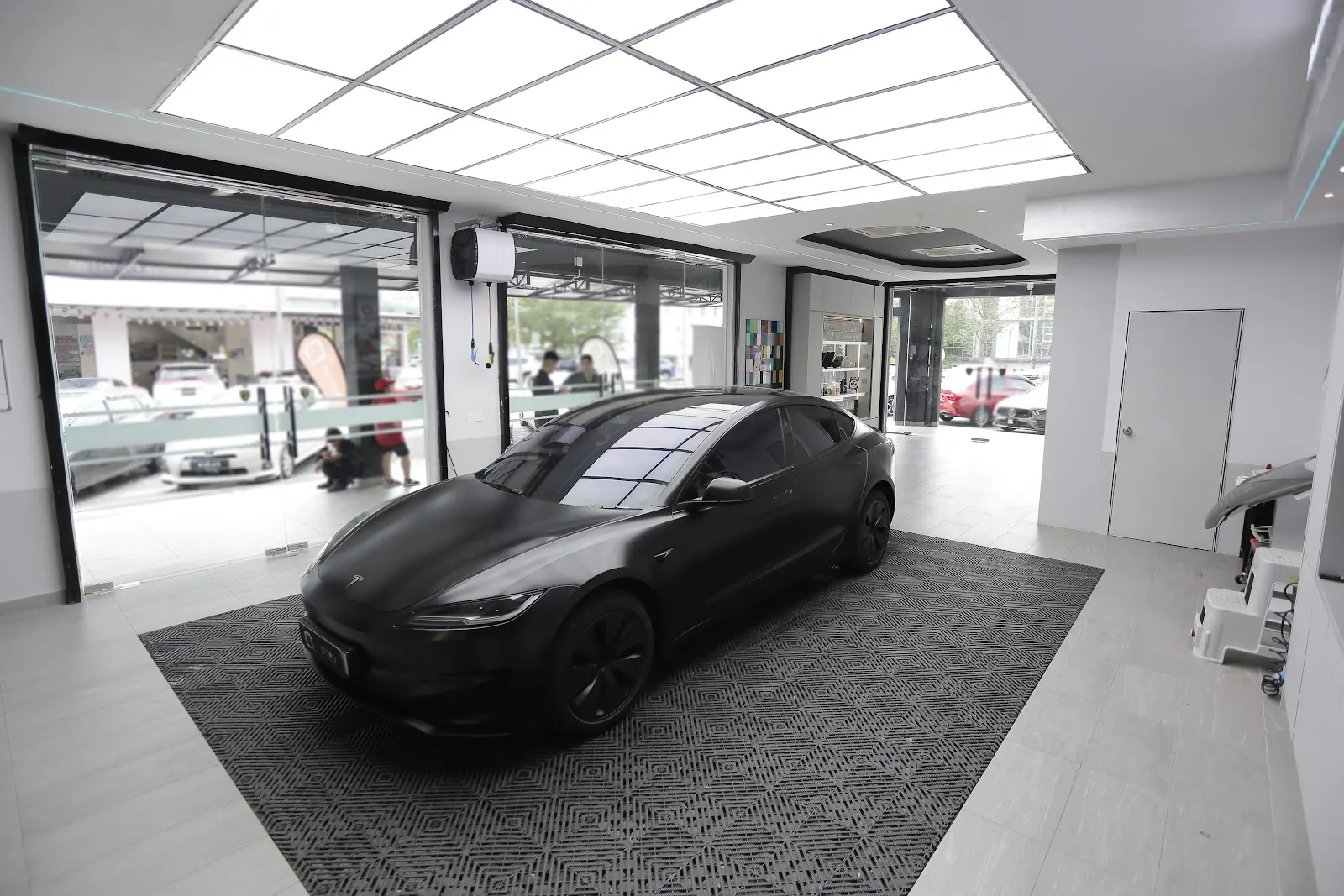
The conversation that happens in a room like that one determines almost everything about how the job turns out. By the time film is being cut, every meaningful decision has already been made.
Deciding Your X50 Coverage
Pick your level before you call anyone, then hold every shop to the same list. Level one if the car is new and the budget is tight. Level two or three for most owners. Level four if the car does school runs and mall carparks, which on an X50 it almost certainly does.
Then plan for removal from the start, because film comes off eventually. A film with low release force and low fracture growth is easier to take off cleanly, which matters on a car you might sell in five years, and our piece on what removal does to paint covers what to expect.
If you want the list quoted panel by panel rather than as a package, Quad Film works that way when you ask for it. Bring your marked-up level and the conversation takes about ten minutes.
Proton X50 PPF Questions Owners Ask
Is PPF worth it on a Proton X50 in Malaysia?
On the bonnet edge and front bumper, yes for almost any owner, because those two panels collect chips within the first year on any car doing highway kilometres. Beyond that it depends on whether the car does school runs and carparks, in which case the boot lip and rocker panels matter more than the fenders do.
Which panels should I do first on an X50?
Bonnet leading edge and front bumper face, in that order. They are the two surfaces pointed directly into the airflow at speed, which means debris reaches them at closing speed rather than at your speed.
Is thicker PPF always better on a Proton X50?
Not on every measure. QUANTUM at 10 mil is 33 percent thicker than QUANTA at 7.5 mil, but its fracture growth rate is 12 cm against 10.5 cm, so a tear travels about 14 percent further through the thicker film. Thickness buys impact absorption rather than tear containment.
What is fracture growth rate on PPF?
It is how far a tear propagates through the film once one has started. Lower is better for containment. Across the clear range, QUANTA measures 10.5 cm, QUATTRO 11.5 cm and QUANTUM 12 cm.
Does Quad PPF cover yellowing?
Yellowing is covered under the Quad PPF warranty alongside the other defects, which is a genuine point of difference in this market. It is worth asking about specifically at whichever shop you use, because the answer varies by brand.
Can PPF be removed from a Proton X50 without damaging paint?
Yes, when it is removed properly by someone who knows how it was fitted. Release force differs across the range, with QUANTA at 12 gf, QUATTRO at 14 gf and QUANTUM at 16 gf, and a lower figure means the film lifts away with less pull on the paint.
What does full front PPF include on a Proton X50?
Bonnet, front bumper, front fenders, headlights and side mirrors, with door cups sometimes included and sometimes not. The largest variable is how far back the bonnet piece goes, which is why two full front quotes can be for genuinely different jobs.
Is QUBOND matte the same as QUATRIX satin?
No. They are two separate products. Satin is QUATRIX, which has a soft low sheen. Matte is QUBOND and the dedicated Matte film, which have no shine at all. Neither is a version of the other and they do not look alike in person.
Protect your Investment today
Don't wait for stone chips to ruin your paint. Speak to our experts about custom PPF and Tinting solutions.