
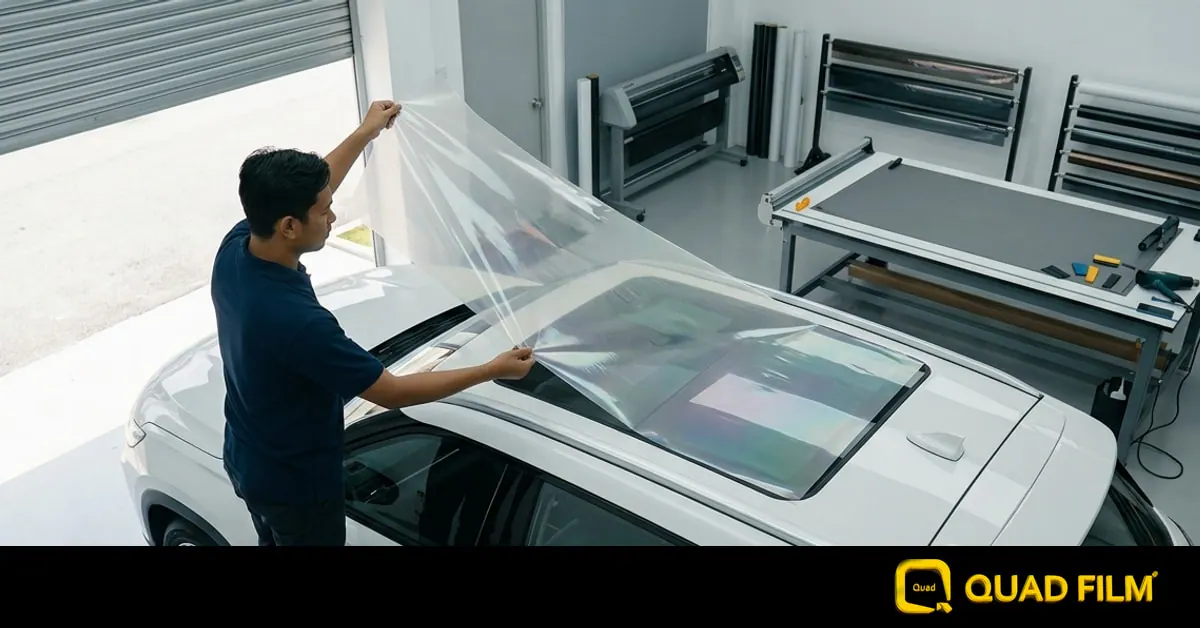
- Get the roof quoted as its own line before you discuss anything about the side glass.
- Ask for total solar energy rejection at the exact shade, pane by pane, not one figure for the car.
- Ask which two panes carry a legal minimum, and treat the rest as a comfort decision.
- Ask whether the film is metallic sputtered or ceramic, because it changes how it behaves on your car.
- Get the series name on the job sheet, not just a percentage.
Jaecoo J7 window tint in Malaysia gets sold on the side glass, and the side glass is not the pane causing the problem. The panoramic roof is the largest single sheet of glass on the car and the only one facing the sun almost square on through the middle of every afternoon.
PCauto runs a standing page whose entire subject is whether the J7 has a sunroof, which tells you how often people go looking. On Lowyat, the official owners' club thread is close to silent, with one member saying outright that not many J7 owners are on the forum. So the question keeps getting asked and rarely getting answered properly.
Your car has been on Malaysian roads since July 2024 or later, which means you have already sat through two full hot seasons in it. You know which seat gets uncomfortable first and roughly what time of day it happens, and our look at why every shop pushes ceramic film explains why the answer you get at a counter often misses that entirely.
What the Roof Costs You Every Drive
Jaecoo lists a large panoramic sunroof on the J7, and the AWD specification lists it alongside a panoramic glass shade. That pane is the only glass on the car receiving the sun from almost directly overhead when the sun is at its strongest, and it is the one nobody quotes properly.
Side windows get an easier ride than owners assume. The sun crosses them at a steep angle for most of the day, so a good share of the energy hitting them arrives off-axis and glances away. Between about eleven and three, the roof gets no such help.
The factory glass shade does not solve it either. A shade sits under the pane. It blocks light reaching your head, which makes the cabin darker and easier on the eyes, but the glass above it still absorbs energy and still radiates downward into the car. Darker is not cooler when the fabric is on the wrong side of the glass.
That is why the roof deserves its own line on the quote and its own product decision. Different area, different angle, different heat path. Our MG S5 EV tint article and the iCaur 03 piece both work through the same problem on cars with the same kind of roof.
That clip puts a dedicated sunroof film next to ordinary window tint on the same pane, which is the comparison the counter conversation almost never gets to.
Why 140 Kilometres Tells You Something
Quad ran a controlled comparison of its EV Sunroof PPF against another brand's film, and the result is the clearest number available on what roof glass actually costs a car. Same route, same settings, same starting charge, and a measurable gap at the end.
The conditions were an ambient temperature of 33 to 35 degrees, the air conditioning set to 20 degrees, fan at level 10, and both cars starting at 93 percent battery. After 140 kilometres the car with Quad EV Sunroof PPF finished at 63 percent. The comparison car finished at 53 percent.
Here is what that gap means in proportion. The Quad-filmed car consumed 30 percentage points of battery over the route. The other consumed 40. Divide 30 by 40 and the filmed car used 25 percent less energy across the same 140 kilometres, under identical conditions, with the only variable being what was on the roof.
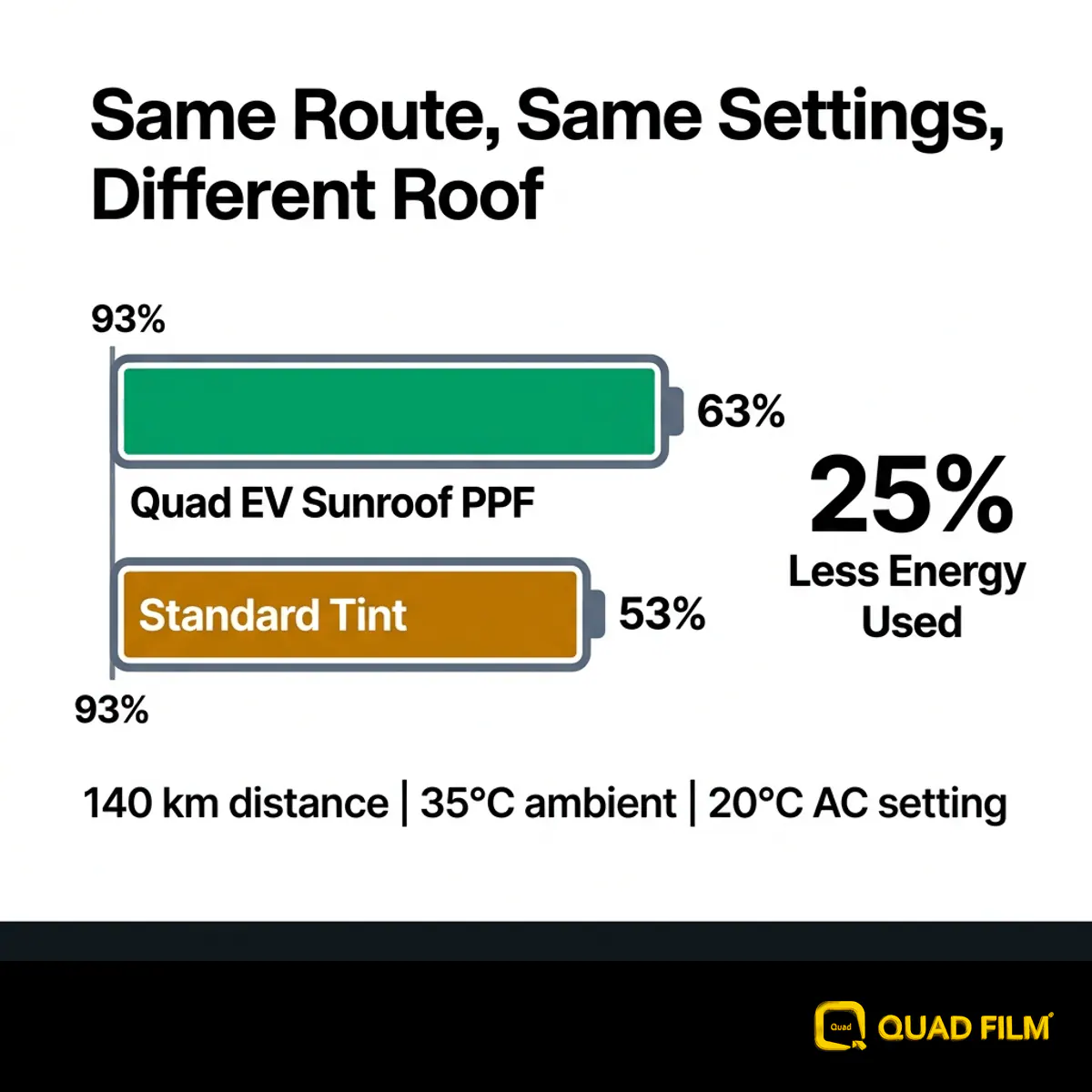
That test was run on an electric car, so read it for what it shows rather than as a claim about your specific variant. What it measures is the air conditioning load created by a hot roof panel. On a battery car that load appears as percentage points. On the petrol J7 it appears as engine load and fuel, and on the plug-in hybrid it appears as both.
The reason a roof panel creates that much load is worth understanding. Glass that has absorbed energy does not stop working when you get in and start the engine. It goes on radiating heat downward into the cabin for as long as it stays hot, which means the air conditioning is not just cooling air, it is fighting a warm surface directly above the passengers. Cut the energy reaching the pane in the first place and that fight gets shorter every time.
How to Spec Each J7 Pane
Five decisions, and the last one is not a shade choice at all. Work front to back so the legal panes are settled before you get to the ones where the choice is entirely yours.
Step 1: Windscreen at VLT 70
Seventy percent visible light transmission is the legal floor. MEGALUX at VLT 70 rejects 72 percent of total solar energy, which is the strongest figure available while staying inside the limit.
Step 2: Front Doors at VLT 50
Fifty percent is the floor here. MEGALUX at VLT 50 rejects 76 percent of total solar energy, METALUX rejects 74 percent, and MAGNETRON rejects 70 percent.
Step 3: Rear Doors at VLT 30
No minimum applies behind the B-pillar. VLT 30 gives rear passengers real privacy and adds heat rejection, without turning the rear cabin into a blind spot when you reverse at night.
Step 4: Rear Windscreen at VLT 30
The J7 is 4,500 mm long on a 2,672 mm wheelbase, so there is a lot of car behind your mirror. Thirty percent keeps that view genuinely usable in low light.
Step 5: Panoramic Roof on Its Own Line
Not a shade decision. A product decision about whether the roof stays see-through while getting cooler, which is exactly what the EV Sunroof PPF is built to do at VLT 72.
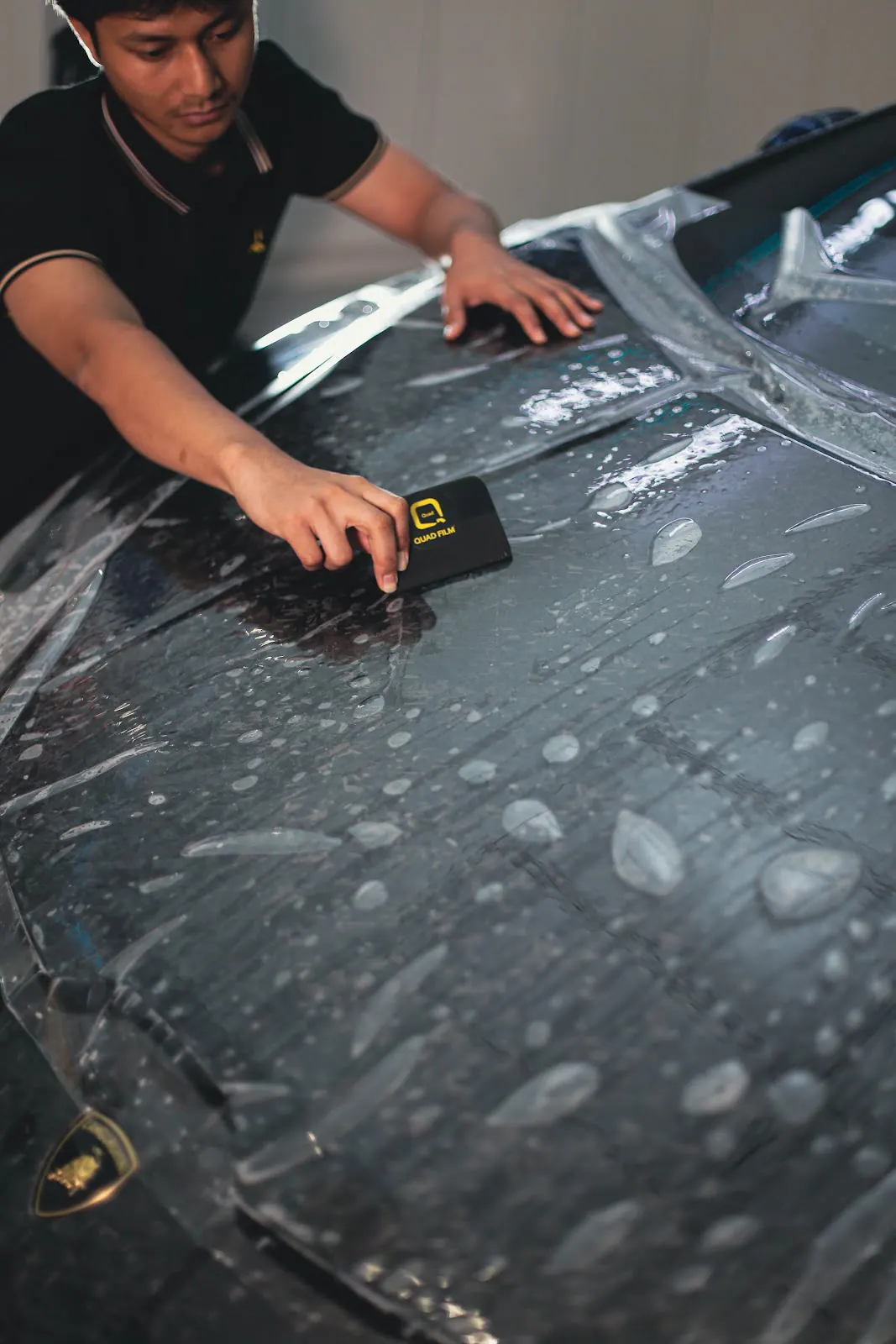
The wet stage is where a job is either clean or permanently not. Every speck that survives it is still going to be there in five years, and on a roof panel viewed from underneath against the sky, specks show up far more clearly than they ever do on a door.
What the Law Sets and What It Skips
Two panes carry a legal minimum. The front windscreen must transmit at least 70 percent of visible light and the front side windows at least 50 percent. The rear side windows and the rear windscreen have no minimum at all.
The purpose of the rule is that the driver can be seen from outside the vehicle. It applies to the glass in front of you and the two windows beside you, and it stops there. Everything behind the B-pillar falls outside it entirely.
There is a second omission, and on a J7 it is the significant one. Nothing in the regulation mentions the roof. The largest single pane on the car sits completely outside the legal conversation, which means the film going on it should be chosen on what it does rather than on what is permitted.
None of that is licence to fit the darkest thing available behind the B-pillar. Total solar energy rejection and visible light transmission move together only up to a point, and past that point you are buying privacy rather than comfort. Our tint buying checklist covers what to verify at the counter before any of this gets written down.
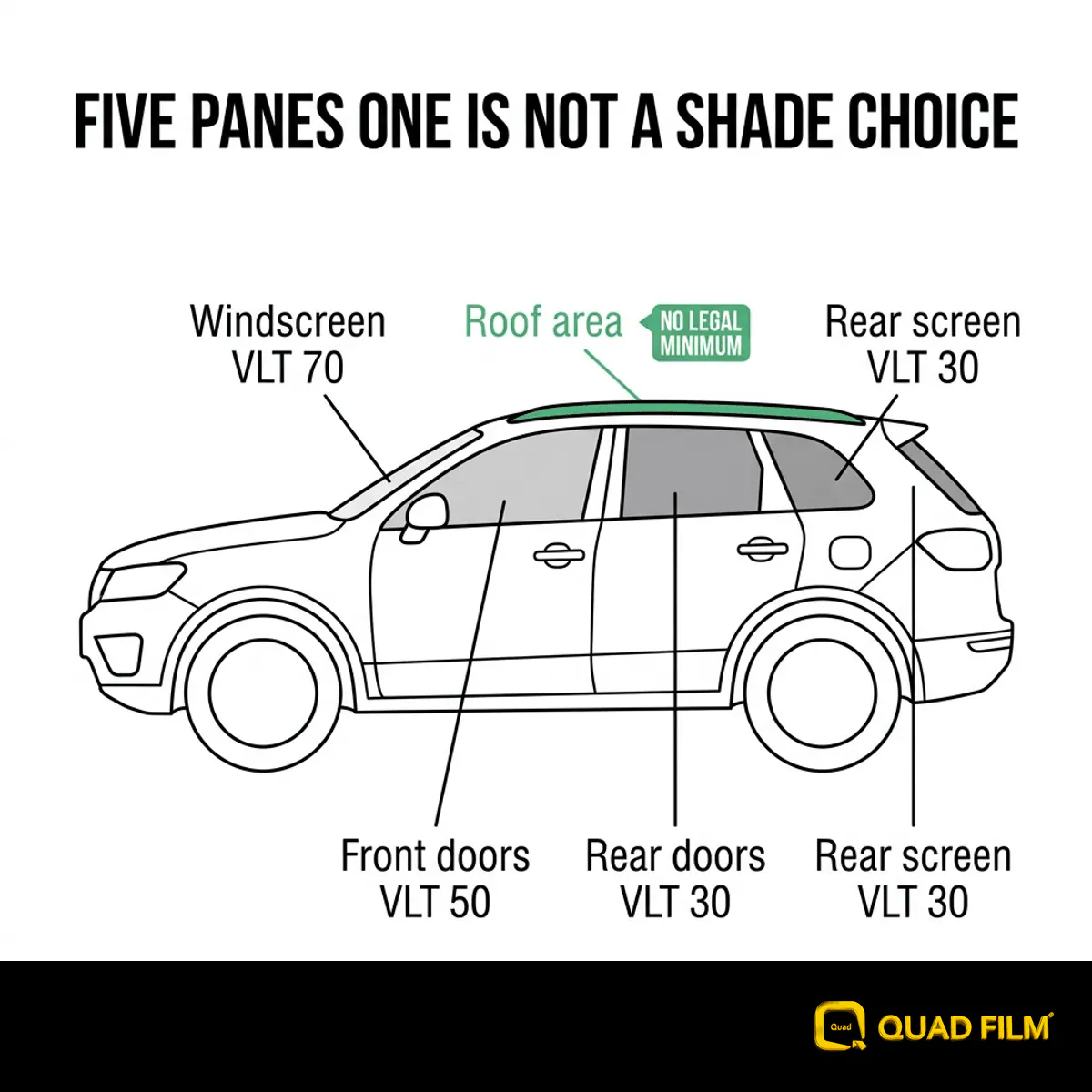
Take that in with you. Most of the argument that happens at a tint counter comes from somebody believing the rear glass is regulated when it is not, or that the roof is just another window when it is not.
One practical note on the rear screen. On a car this length the interior mirror is doing more work than it does on a sedan, because there is more vehicle between your eyes and the glass. Going darker than 30 percent back there costs you real visibility in a basement carpark at night, and it buys privacy you already have from the rear door glass. That is the trade to think about rather than the legal question, because there is no legal question on that pane at all.
3 Things J7 Owners Get Wrong
Quoting the car instead of the panes, treating infrared rejection as the deciding number, and leaving the roof to the end of the conversation. All three are decisions made before anyone touches the car, and all three are easy to reverse in advance.
Quoting the Whole Car as One Number
A single shade across five panes means at least one of them is wrong, and usually it is the two with a legal floor or the one overhead. Five lines on a job sheet costs nothing and fixes it.
Buying on Infrared Rejection
Infrared rejection is 99 percent on MEGALUX, MAGNETRON, MIRACLE and MATRIX, and 97 percent on METALUX. Those figures are too close together to separate anything. Total solar energy rejection is where the real difference lives.
Leaving the Roof Until Last
The roof gets discussed after the budget conversation has already happened, which is how the largest pane on the car ends up as the only untreated one. Put it first and the rest of the quote arranges itself around it.
The most useful habit is simply to write the five lines before making any calls, so every shop is quoting against the same document rather than against a conversation.
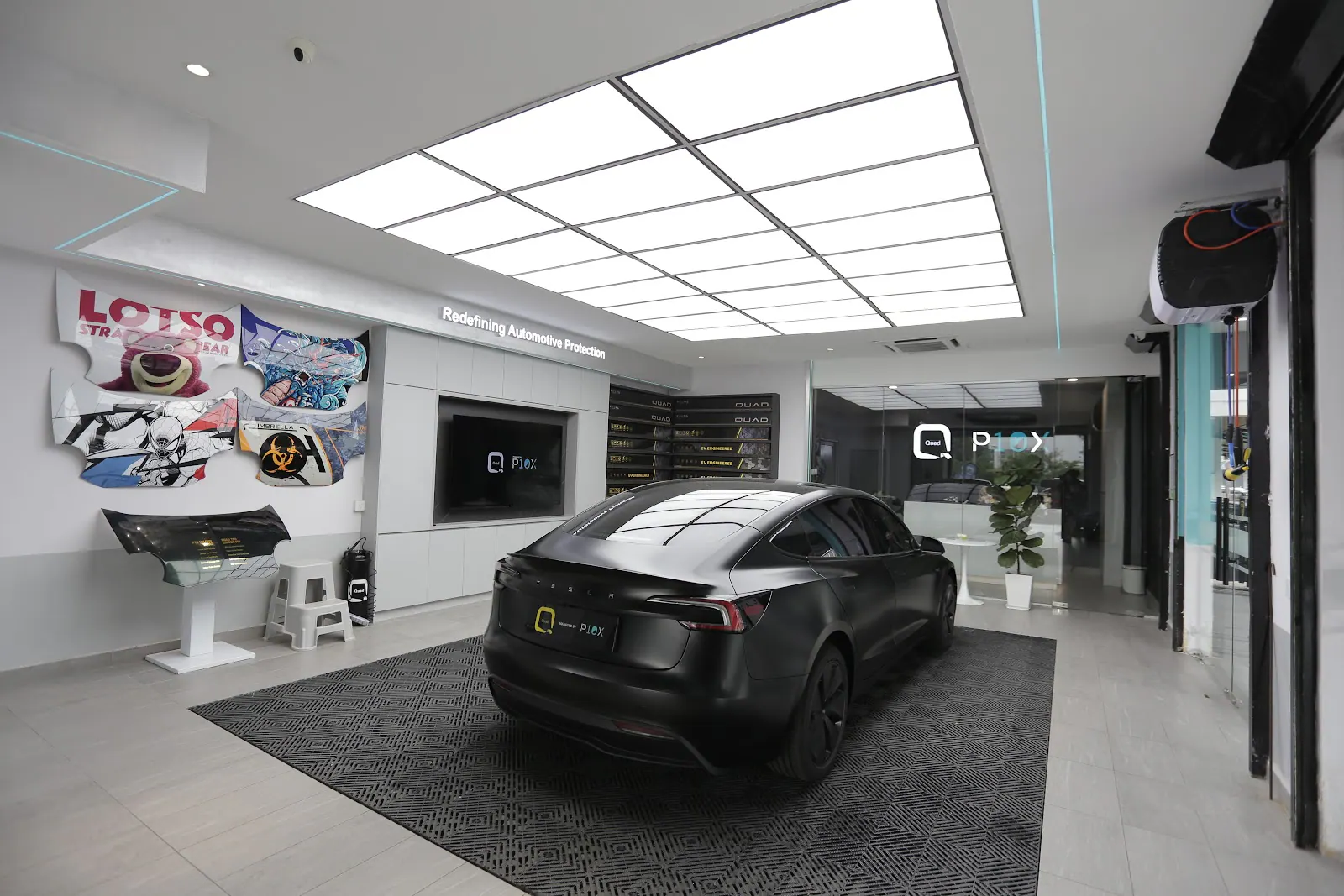
A room like that is where every one of the five decisions gets made. Once a sheet of film has been cut to a pane, changing your mind stops being a conversation and becomes a cost, so the useful work happens well before the car goes into a bay.
METALUX or MAGNETRON on a J7
Both are officially recommended and they solve different halves of the same complaint. METALUX is the clarity and night driving film. MAGNETRON is the hybrid built for stable heat rejection and colour that holds over years.
METALUX is a 24 layer multi-layer sputtered film using 36 rare earth metals through a German Leybold dual-vacuum chamber. Infrared rejection is 97 percent, ultraviolet rejection 99 percent, and total solar energy rejection runs from 70 percent at VLT 70 to 83 percent at VLT 5. It is optimised for optical clarity, which matters on the rear screen of a long car.
MAGNETRON combines 12 sputtered layers with nano-ceramic. Infrared rejection is 99 percent, ultraviolet 99 percent, and total solar energy rejection runs from 66 percent at VLT 70 to 79 percent at VLT 5. The hybrid construction targets colour stability and resistance to bubbling after long exposure.
MEGALUX sits above both with 48 sputtered layers across four cycles and the highest total solar energy rejection at every shade in the range. MIRACLE is the ultraviolet specialist at 100 percent ultraviolet rejection across every shade, which our article on tint and skin exposure goes into properly. MATRIX is the entry nano-ceramic film at 2 mil.
| Glass | Legal minimum VLT | Suggested spec | TSER | IRR | Why this pane |
|---|---|---|---|---|---|
| Front windscreen | 70 percent | MEGALUX VLT 70 | 72 percent | 99 percent | Strongest figure available inside the legal floor |
| Front side windows | 50 percent | MEGALUX VLT 50 | 76 percent | 99 percent | Legal floor with the highest heat rejection |
| Rear side windows | No minimum | MAGNETRON VLT 30 | 74 percent | 99 percent | Privacy for rear passengers with stable colour |
| Rear windscreen | No minimum | METALUX VLT 30 | 78 percent | 97 percent | Clarity through a long car at night |
| Panoramic roof | No minimum | EV Sunroof PPF, VLT 72 | Reflects over 95 percent of heat | Blocks over 99 percent UV | Stays see-through while dropping cabin temperature |
Every figure there is the published specification for that series at that exact shade. None of them are ranges, which is deliberate, because a spec written as a range is one nobody can be held to later.
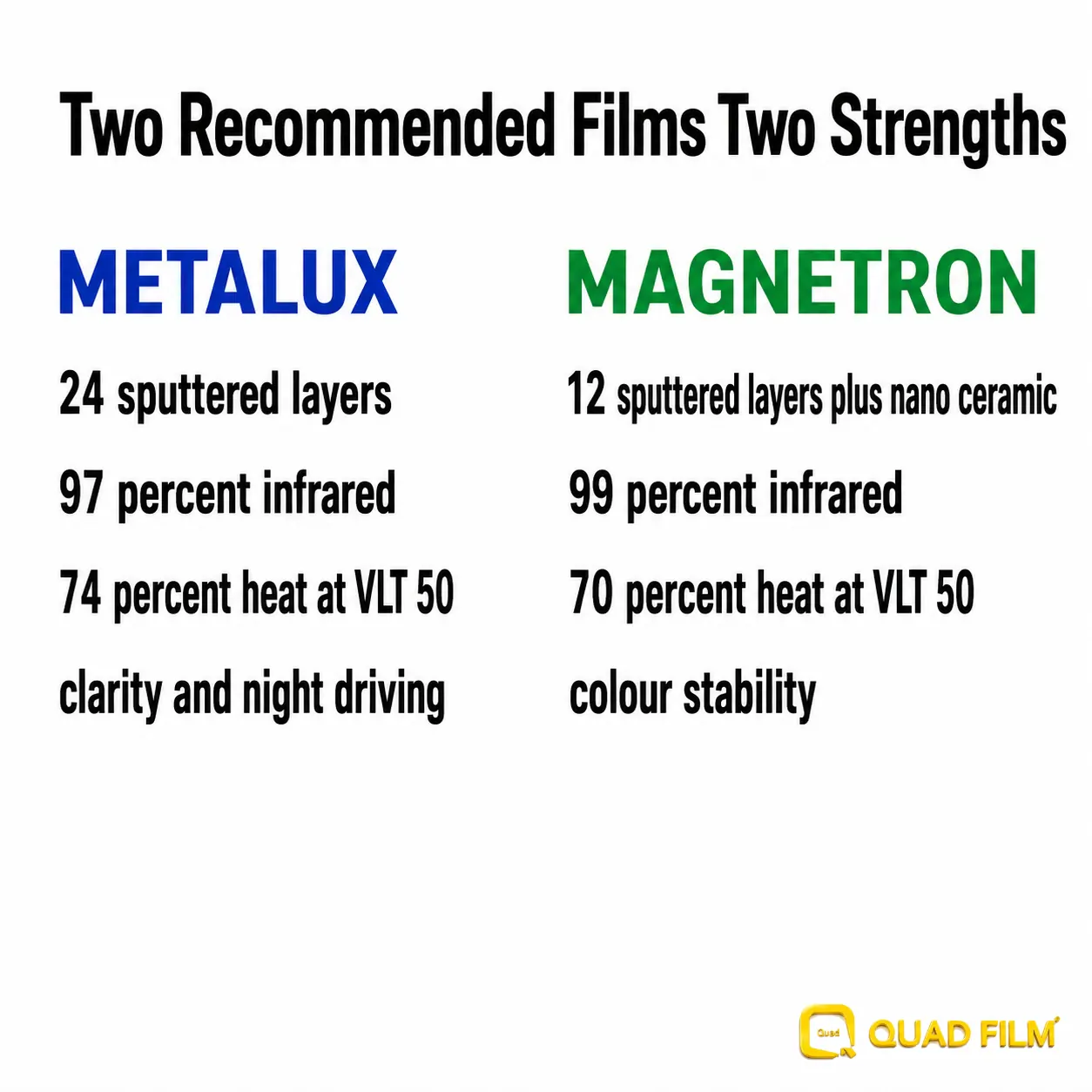
Neither column is the winner. If your complaint is night glare and the clarity of the rear view, the left one is your film. If your complaint is that the cabin never really cools and you want it to still behave the same in year six, the right one is.
Watching the sunroof product go on gives you a sense of the scale of the pane, which is hard to appreciate from inside the car. It is a large single piece of glass and it is worked in one go.
Booking the J7 Job Properly
Write the five lines first. Windscreen, front doors, rear doors, rear screen, roof. Put the series name and the shade against each, then put the total solar energy rejection figure beside that. Take it in and let every shop quote against the same document.
Then check the job sheet matches. A percentage on its own is not a specification, because VLT 30 in one series and VLT 30 in another are different films with different numbers behind them. Sputtered film also needs an installer who has done a lot of it, and our piece on why so few can fit it properly is worth reading before you choose on convenience.
Settle the roof before anything else. It is the pane that changes the shape of the whole quote, and it is far easier to plan around at the start than to add at the end. Quad Film will work through the panes one at a time if you ask for the quote that way.
Jaecoo J7 Window Tint Questions Owners Ask
What is the best window tint for a Jaecoo J7 in Malaysia?
MEGALUX at VLT 50 on the front doors, because it is legal and rejects 76 percent of total solar energy. VLT 70 on the windscreen, VLT 30 on the rear glass, and a separate specification for the panoramic roof rather than a leftover piece from the door job.
Does the Jaecoo J7 have a panoramic sunroof?
Jaecoo lists a large panoramic sunroof on the J7, and the AWD specification lists it alongside a panoramic glass shade. It is the biggest pane on the car, which is why it belongs on the quote as its own line.
What is the legal tint percentage for a Jaecoo J7?
The front windscreen must transmit at least 70 percent of visible light and the front side windows at least 50 percent. The rear side windows and the rear windscreen have no legal minimum, so the shade on those three panes is entirely your choice.
Does tinting the sunroof actually reduce heat?
In a controlled 140 kilometre comparison at 33 to 35 degrees ambient with the air conditioning set to 20 degrees, a car with Quad EV Sunroof PPF finished at 63 percent battery against 53 percent for the comparison film. That is 25 percent less energy consumed over the same route.
Is 99 percent infrared rejection worth paying for?
It is not the number to choose on, because it hardly varies. MEGALUX, MAGNETRON, MIRACLE and MATRIX are all at 99 percent and METALUX is at 97 percent. Total solar energy rejection is the figure that separates the series, and it spans 12 points at VLT 50.
Should I tint the panoramic roof or leave the factory shade?
The shade sits under the glass, so it stops light reaching you but does nothing about the pane above it heating and radiating downward. A dedicated sunroof film holds visible light transmission at 72 percent, so the roof stays see-through while getting measurably cooler.
What is the difference between METALUX and MAGNETRON?
METALUX is a 24 layer sputtered film optimised for optical clarity and night driving, at 97 percent infrared rejection. MAGNETRON is a hybrid of 12 sputtered layers and nano-ceramic at 99 percent infrared rejection, built around colour stability. Both are officially recommended.
How long does a full car tint take on a Jaecoo J7?
Most of a working day for five panes done properly, including shrinking the windscreen film to the curve, handling the large roof panel and letting everything settle before the windows are wound down. A quote of an hour and a half does not include those steps.
Protect your Investment today
Don't wait for stone chips to ruin your paint. Speak to our experts about custom PPF and Tinting solutions.